
Parked above the Timor Sea floor with 35,000 tons of steel on its back, a vessel the length of 3.5 football fields just loaded its first barrel of liquid gold, and the reason it was ever built comes down to a plant on shore that almost went dark forever
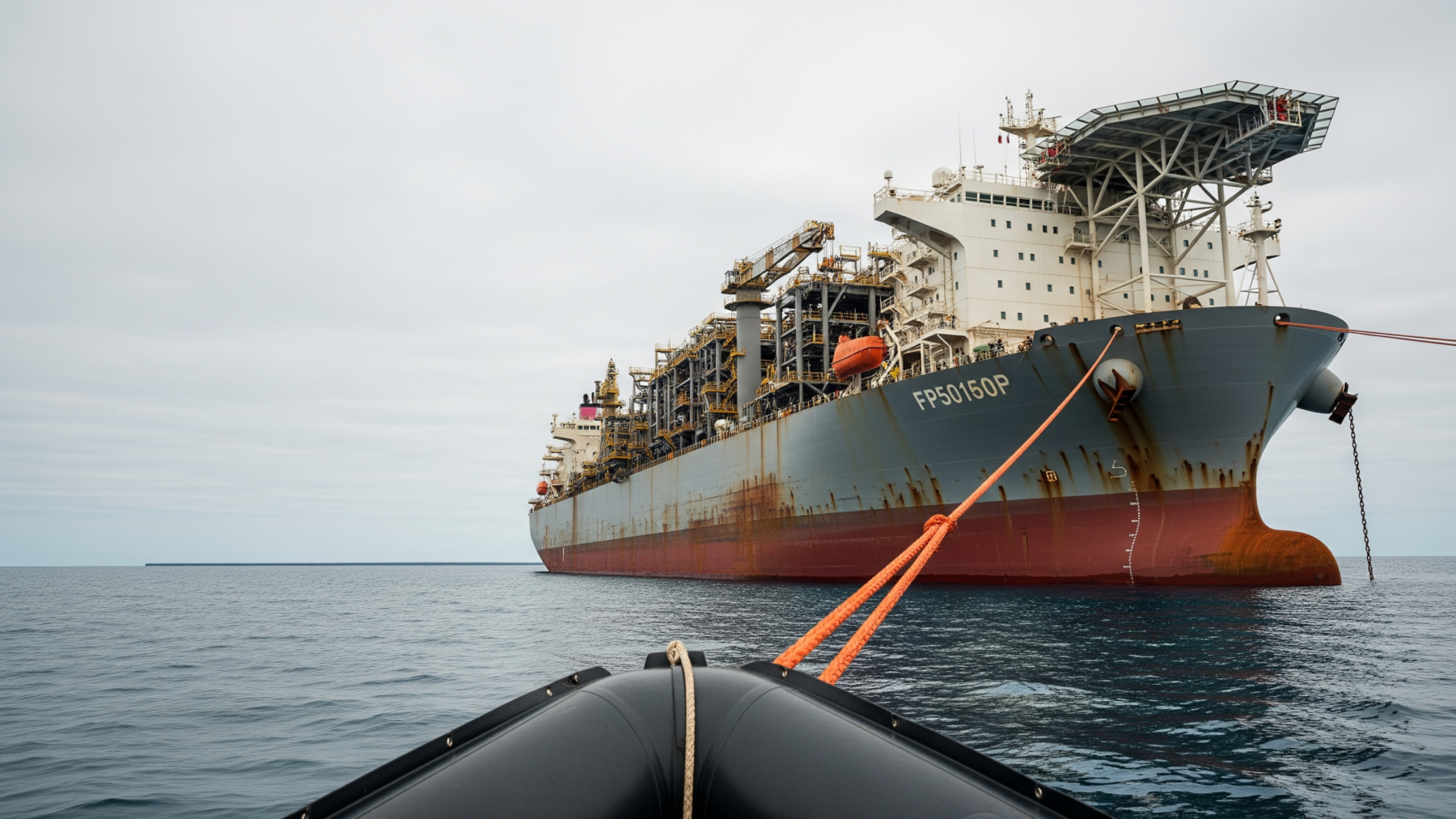
Something enormous is anchored in the Timor Sea, and most people on shore have no idea it is there.
It sits 285 kilometers north of Darwin, in water deep enough to swallow any building in Australia’s Northern Territory.
One hundred and forty people live and work on it, rotating in and out by helicopter, far beyond sight of any coast.
Santos has maintained that Barossa is essential to regional energy security and to keeping downstream industrial customers supplied across Asia for a generation.
This summer, it did something it had never done before: it filled a tanker with liquid gold and pointed that ship toward South Korea.
What that moment actually saved is a story that begins not at sea, but in a modest industrial park on the outskirts of Darwin itself.
A plant that was running out of time
Darwin LNG has been turning gas into cold liquid for export since 2006.
For nearly two decades it fed on a single offshore gas field called Bayu-Undan.
By the early 2020s, Bayu-Undan was spent.
Without a new source of gas, the entire plant faced permanent closure, along with the export contracts, the jobs, and the tax revenue that flowed from it.
Santos, the project’s operator, had a plan: drill a completely new field called Barossa, build a new offshore processing vessel from scratch, and pipe the gas south through a duplicated seabed line.
The plan was years in the making and would cost billions.
Everything depended on a single piece of hardware that did not yet exist.
Building a floating city in a Korean yard
The vessel was constructed in South Korea and then sailed to Singapore for its topsides fit out.
The hull stretches 358 meters in length and 64 meters across, making it one of the largest floating production, storage and offloading units ever assembled.
The topsides alone weigh 35,000 tons, roughly equal to the steel in three large aircraft carriers.
It carries a gas handling capacity of 850 million standard cubic feet per day and a condensate handling capacity of 11,000 barrels per day.
A turret mooring system anchors it to the seabed and lets the hull weathervane into waves and wind without snapping its umbilical lines.
The vessel arrived at the Barossa field and received its first gas in September 2025.
Then the real work began.
Compressor seals, heat exchangers and a long winter
Commissioning a machine this complex is never simple, and Barossa was no exception.
Dry gas seals on the FPSO’s compressors had to be replaced to allow production at full capacity.
Heat exchangers then needed flushing and cleaning to remove blockages before the restart.
The vessel went offline, was repaired, and came back.
Gas production resumed after operations restarted in early May 2026, with work coordinated closely between BW Offshore and Santos.
In June 2026, BW Offshore confirmed that the vessel had passed a key technical benchmark called the interim performance test.
Key production, processing and utility systems were confirmed to be operating in an integrated manner, capable of delivering stable performance under real production conditions.
The shore plant, already overhauled and chilled down, was waiting.
The first condensate cargo and what it unlocked
In late July 2026, the BW Opal crossed a threshold that no one involved will forget quickly.
Santos loaded the first condensate cargo from the Barossa gas project, a 300,000-barrel shipment placed onto the tanker Boccadesse on July 24, 2026, bound for SK Incheon Petrochem in South Korea.
The Darwin LNG plant is now operating at 97 percent of planned rates, with LNG cargoes loading approximately every eight days.
That rhythm, roughly one fully loaded LNG carrier departing Darwin each week, is the rhythm of a plant that was twelve months away from going dark.
The FPSO is projected to supply the Darwin LNG plant for the next two decades.
Investors tracking the upstream sector can read about Kosmos Energy and the Paratus drilling sale that freed up capital for exactly these kinds of long cycle projects.
Two decades of gas, and the caveat nobody skips
All six wells drilled in the Barossa gas field have intersected excellent reservoir quality.
Testing on five wells demonstrated outstanding flow capacity that exceeds pre drill estimates.
Each well can theoretically deliver around 300 million cubic feet of gas per day on its own.
The project is jointly owned by Santos with a 50 percent stake, PRISM Energy International Australia with 37.5 percent, and JERA Australia with the remaining 12.5 percent.
The project drew scrutiny from environmental groups concerned about emissions, and those debates continue in Australian courts and regulatory bodies.
Santos has maintained that Barossa is essential to regional energy security and to keeping downstream industrial customers supplied across Asia for a generation.
On a July morning in Darwin, a tanker slipped away from the jetty toward the Timor Sea, carrying 300,000 barrels of condensate northward to a refinery in Korea.
Somewhere out beyond the horizon, the floating city that filled it was already processing the next load.
Hugo is an engineer with strong technical expertise. Multilingual from an early age, his writing combines technical clarity with a strong interest in science and energy.
