
Pennsylvania’s warehouse rooftops have spent decades baking in the sun, and a new bill wants to turn them into power plants for the communities below
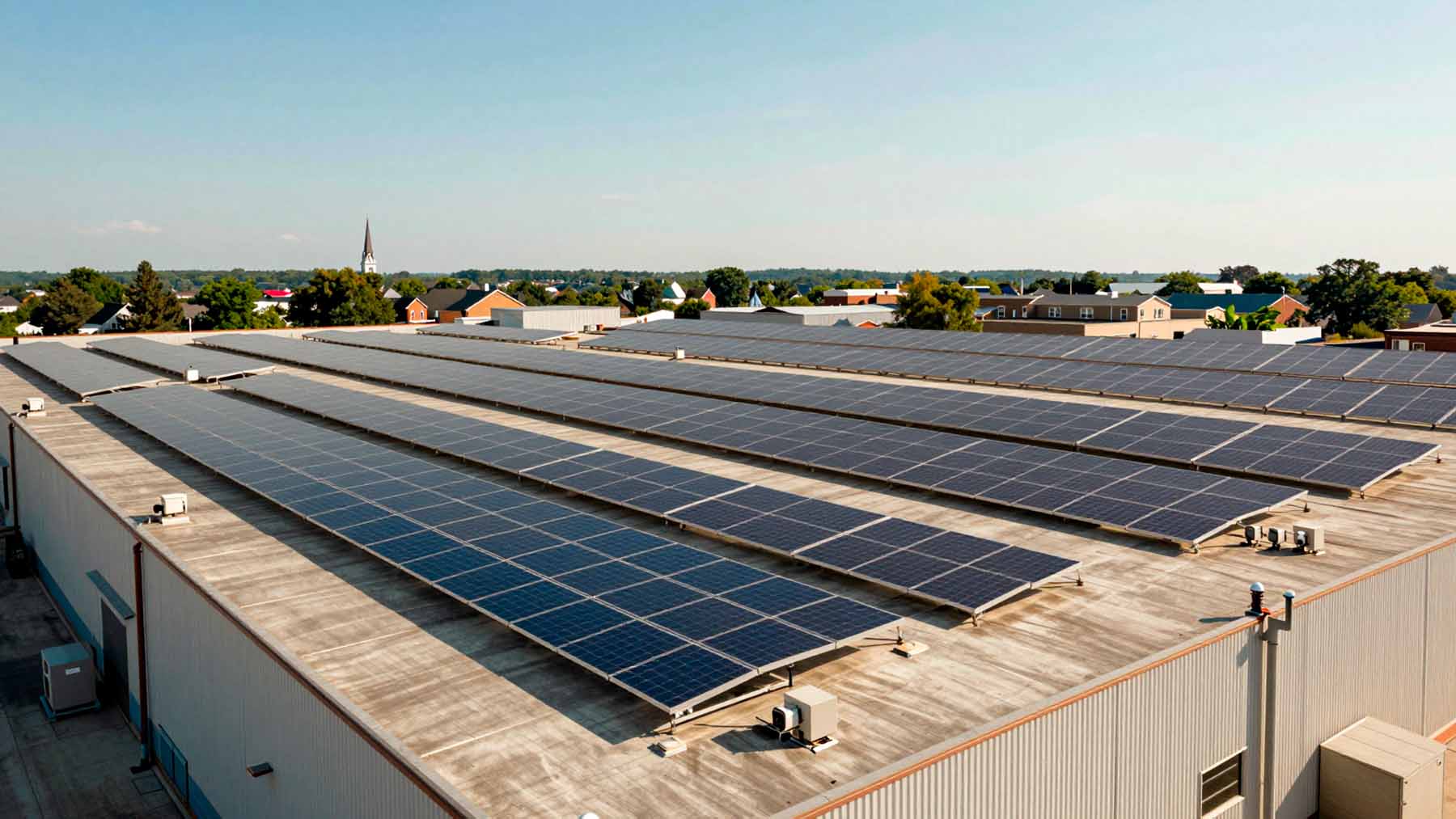
Across Pennsylvania, millions of square feet of flat warehouse rooftops sit largely unused, baking under the sun year after year. For decades, that space has been treated as little more than a surface to hold HVAC units and drainage pipes.
That may be starting to change. At a recent gathering in Exeter Township, state Rep. Jacklyn Rusnock stepped forward with a proposal to reframe those idle rooftops as energy infrastructure — a potential source of solar power that could feed the grid and help push down electricity costs for communities across the commonwealth.
Miles of rooftop, megawatts of potential
Warehouse rooftops share qualities that make them unusually attractive for solar development. They’re large, flat, and already built on land that’s been cleared for decades. Unlike utility-scale solar farms, which often require clearing fields or forests, these rooftops are ready-made platforms — no new land disturbance required.
They ripple outward — squeezing household budgets, eating into thin margins for small businesses, and competing directly with classroom funding for school districts.
Pennsylvania’s warehouse sector is substantial. The state’s logistics and distribution industry has expanded steadily, leaving behind an enormous footprint of low-rise industrial buildings with wide, sun-exposed rooftops sitting largely untapped.
The contrast is hard to ignore. These surfaces absorb sunlight every day without converting a single watt into usable electricity. Rusnock’s proposal reframes that idle space — not as wasted real estate, but as overlooked energy infrastructure. Something the state already has. Just hasn’t used yet.
What Rep. Rusnock’s bill actually proposes
The legislation is straightforward in concept. Solar panels would go on warehouse rooftops across Pennsylvania, and the electricity they generate would feed back into the local grid. The goal isn’t simply to lower energy costs for warehouse operators — it’s to benefit the surrounding communities connected to that same grid.
Rusnock made that distinction clear at the Exeter Township event, where she appeared alongside education and labor leaders. Their presence was intentional. The bill is framed not just as an energy measure but as an economic and community investment, with real implications for school budgets, local workers, and neighborhood businesses. By positioning the proposal at that intersection, Rusnock is making a case that reaches well beyond solar panels on rooftops.
Schools, families, and businesses in the crosshairs of rising energy costs
Electricity prices don’t stay contained to utility bills. They ripple outward — squeezing household budgets, eating into thin margins for small businesses, and competing directly with classroom funding for school districts.
Rusnock has specifically pointed to schools as potential beneficiaries. Her argument: if districts can lower what they spend on utilities, that money gets redirected toward teachers, supplies, and programs rather than simply disappearing into overhead. It’s a concrete claim, and it gives the proposal a human dimension that pure energy policy often lacks. Adding more locally generated solar power to the grid could also ease price pressure systemically — when generation is distributed across many sources, the grid becomes less vulnerable to spikes from any single point of failure.
This proposal isn’t aimed at helping one warehouse owner trim an electricity bill. It’s targeting the kind of structural cost relief that could be felt across entire communities.
Jobs, local economies, and the case for in-state energy
Rusnock has been explicit about the economic argument. Solar expansion at this scale would require installation, maintenance, and ongoing technical work — all of it tied to skilled trades jobs that can’t be outsourced.
There’s a less obvious benefit for local businesses, too. When electricity is produced closer to where it’s consumed, communities become less dependent on energy sourced from outside the region, making local economies more resilient to external disruptions.
Rusnock put it directly: “When we invest in solar energy, we are investing in ourselves. We’re investing in skilled workers who can earn a family-sustaining wage. We are investing in local businesses that fuel our economy. And we are investing in communities that deserve affordable and reliable energy.”
That framing — jobs, affordability, local investment — is built to attract a broad coalition. It speaks to labor interests, fiscal conservatives worried about school budgets, and business owners watching operating costs climb. That cross-cutting appeal may matter considerably as the bill moves through the legislature.
What comes next for the proposal
Right now, the bill is being actively promoted but hasn’t advanced through the legislative process. To become policy, it would need to move through committee, build broader support among lawmakers, and ultimately be signed into law — none of those steps guaranteed.
Still, the timing isn’t accidental. States across the country are increasingly looking at distributed solar as a way to relieve pressure on aging grid infrastructure without massive new construction. Pennsylvania’s warehouse density gives it a particular advantage in that space. If the bill gains traction, it could serve as a model for other states with large industrial rooftop footprints and communities struggling with energy costs — or it could become a test case, revealing where the political, regulatory, and logistical obstacles are hardest to clear.
Either way, the conversation Rusnock started in Exeter Township is unlikely to stay local for long. The rooftops are already there. The question now is whether Pennsylvania’s legislature is ready to put them to work.

Carlos is an engineer with strong expertise in technical and industrial topics. He previously worked at international companies such as Siemens and is multilingual.
