
Printed into 80% of every solar backsheet sold before 2023, a strand of chemistry no installer ever names survives rain, heat and hail for decades, and the creek beside the recycling yard is where it finally arrives
The pitch is almost irresistible: no emissions, no moving parts, no fuel bill.
A solar panel arrives on a truck, gets bolted to a rooftop or a field, and converts sunlight into electricity for 25 years without burning a single molecule of anything.
The chemistry woven into the underside of that panel rarely comes up in the sales conversation.
When a panel reaches an end of life facility, fluoropolymers liberated from a broken backsheet can move in leachate toward whatever drainage runs below the site.
For most of those 25 years, the omission barely seems to matter.
Then the panel leaves.
A coating engineered to outlast everything
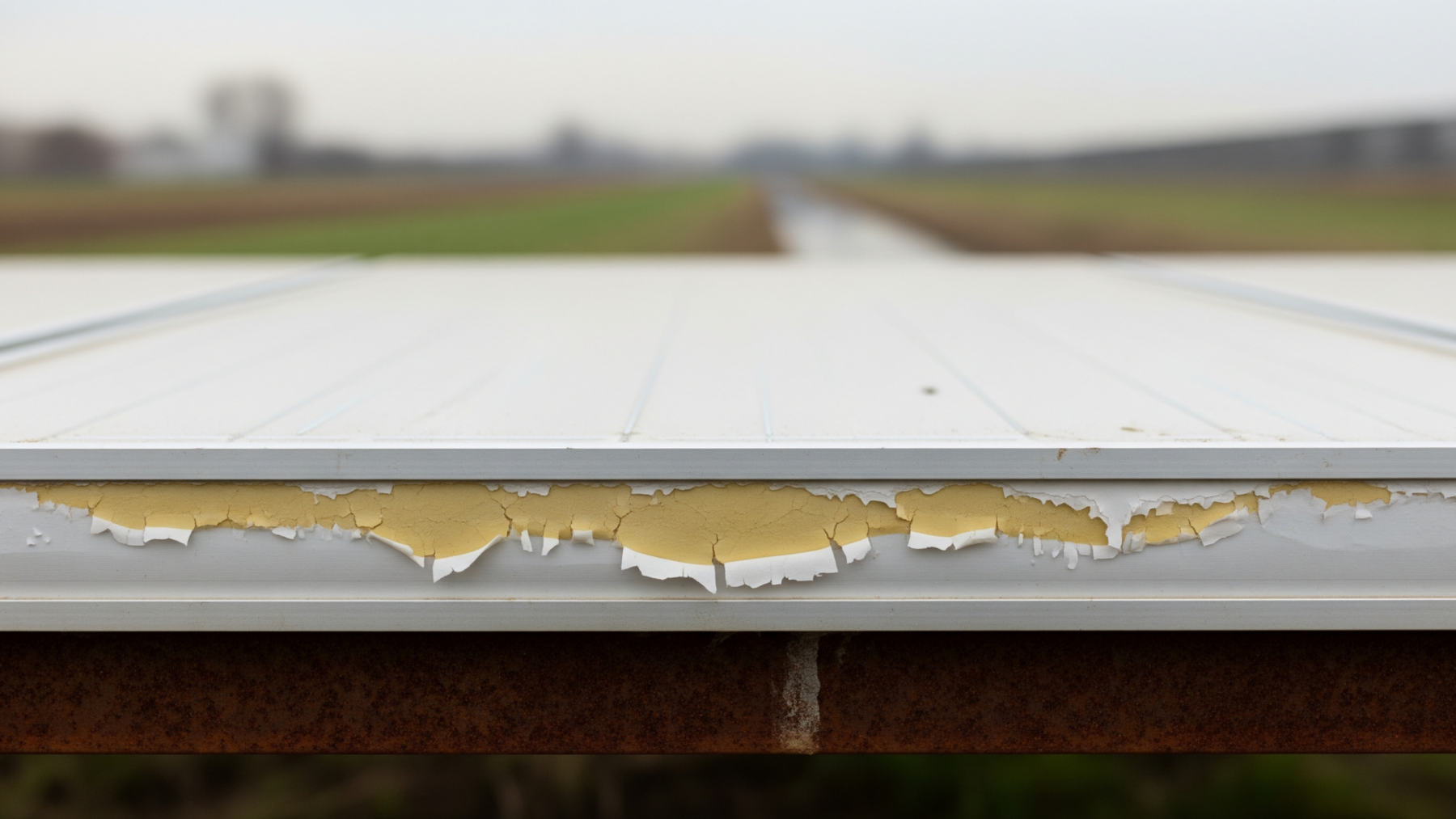
Solar panels are designed to be survivors. The glass front handles hail, the aluminum frame handles weight, and the layer on the back handles everything else: moisture creeping in from damp soil, UV light working through the edges, and temperature cycling from desert noon to desert midnight. That layer is called the backsheet, and the material most manufacturers reached for when utility scale solar boomed in the 2000s was a fluoropolymer, a synthetic coating with a carbon to fluorine bond so strong that almost nothing in nature can break it.
Fluoropolymers resist heat up to several hundred degrees, repel water, and shrug off acids that form when rain meets industrial air. For a panel expected to generate power reliably for a quarter century in an open field, they were a logical, battle tested choice. The industry adopted them widely, and for years the conversation stopped there.
The quiet ingredient in most panels shipped
A systematic review published in Renewable and Sustainable Energy Reviews, led by researchers Preeti Nain and Annick Anctil, mapped how extensively these compounds appear across a standard photovoltaic module. Fluoropolymers show up in backsheets, in the wiring insulation that carries current from cell to inverter, and sometimes in protective coatings over individual components. What that review makes plain is that these fluoropolymers belong to the broader chemical family known as PFAS, per- and polyfluoroalkyl substances, a group of thousands of synthetic compounds united by that same nearly unbreakable bond.
PFAS-free backsheet alternatives existed even then. The same review found they held roughly 20 percent of the market as of 2022, while the other 80 percent relied on fluoropolymers because they worked and because no regulation required anyone to look more closely at what happened next.
The question nobody asked at installation
The fluoropolymers used in solar backsheets are large, stable molecules, not the highly mobile PFAS compounds like PFOA or PFOS that contaminated drinking water supplies near military bases and industrial plants. During a panel’s working life, the risk of leaching is considered low, and the Massachusetts Department of Energy Resources concluded that solar panels “pose little, if any, risk” of chemical releases to the environment during normal use.
A companion study simulating what happens to modules under landfill conditions found that over 30 days, acidic chemistry and physical breakup can release a significant share of bound compounds into synthetic leachate. The backsheet faces that same question once a panel is shredded or crushed, and that is the gap between the promise on the spec sheet and the reality beside the drainage ditch.
Where a familiar chemistry and a solar field finally meet
Here is the part the industry has not yet reckoned with publicly. The compounds printed into those backsheets are PFAS, and PFAS do not degrade on any human timescale. A 2026 review drawing on work from Michigan State University and Oak Ridge National Laboratory named the problem plainly: industry transparency about which fluoropolymers appear in which components and in what quantities is essentially absent.
Nain and Anctil described it as “widespread confusion between different PFAS types” that leaves regulators, recyclers, and downstream waterway managers unable to plan effectively. When a panel reaches an end of life facility, fluoropolymers liberated from a broken backsheet can move in leachate toward whatever drainage runs below the site. Millions of panels from the first great buildout will reach that moment in the 2030s.
A cleaner sheet is already waiting
The encouraging truth is that replacement materials already exist and are already shipping. Backsheets built from polyamide or polyethylene terephthalate carry no fluoropolymer content, and several major manufacturers have shifted toward them in newer product lines. Independent testing shows they match the moisture and UV resistance that made fluoropolymers attractive, so the industry is not being asked to accept a performance tradeoff.
What the research community is now pushing for is mandatory disclosure: a requirement that module datasheets name every polymer in every layer, so recyclers know what they are handling before the shredder starts. That single change would let end of life facilities route fluoropolymer panels to processors equipped to contain leachate rather than to open yards beside unprotected streams. Solar’s record on emissions and land use is genuinely strong, and the backsheet story does not erase it. It is a specific, solvable problem that a maturing industry is supposed to find and fix before the downstream creek does it for them.

Hugo is an engineer with strong technical expertise. Multilingual from an early age, his writing combines technical clarity with a strong interest in science and energy.
