
In Puerto Rico, a storm-battered island of 8,000 is about to run on hydrogen when the sun goes dark
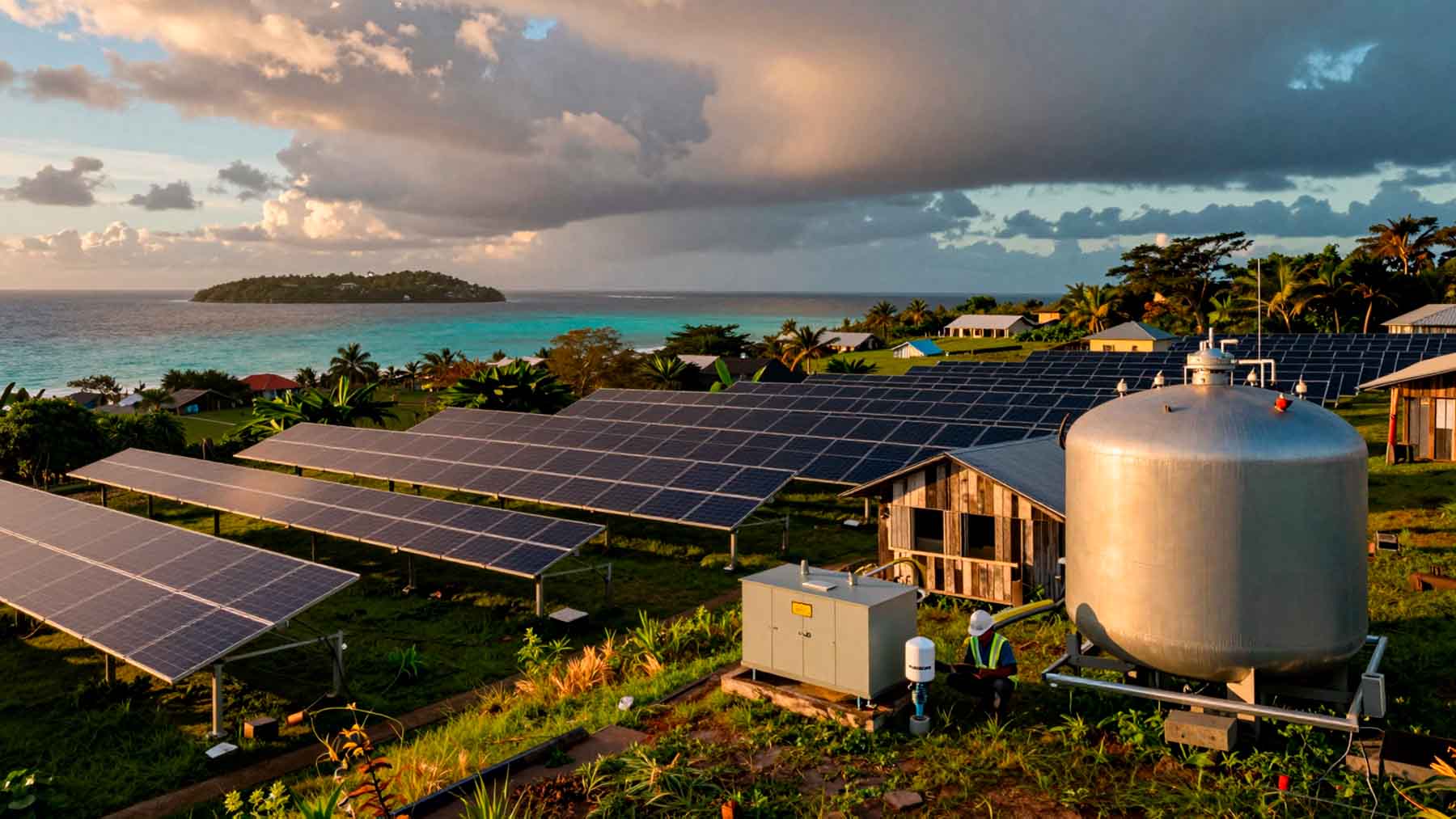 Image generated with artificial intelligence
After Hurricane Maria tore through Puerto Rico in 2017, energy regulator Javier Rúa-Jovet watched the night sky glow along the horizon — thousands of diesel generators running at once, the whole island burning fossil fuels just to survive.
Vieques, a small island of about 8,000 people ten miles off Puerto Rico’s eastern coast, knows that vulnerability better than most. It receives power through a single undersea cable, and when storms hit, it has nowhere else to turn. Now, on a local farm there, a team of Cornell University researchers is deploying something the island has never seen before.
An island wired for failure
Vieques doesn’t have a backup plan. The island’s sole power source is an undersea cable connecting it to mainland Puerto Rico — and when that cable goes down, the community has no local baseload generation to fall back on. Storms are the obvious threat, but they bring a second problem: days of heavy cloud cover that drain the output of existing solar-battery microgrids. When the sun disappears and the cable fails, residents reach for diesel generators to keep water pumps running, food refrigerated, and the health clinic open.
Abruña’s stated goal is to cut electricity prices on Vieques from roughly 28 cents per kilowatt-hour down to 15 to 16 cents — a reduction of nearly 50 percent.
That dependence carries a steep price. Puerto Rico already has some of the highest electricity rates in the United States — residents pay 28 to 29 cents per kilowatt-hour, according to Javier Rúa-Jovet, now chief policy officer at the Solar and Energy Storage Association of Puerto Rico. Rates are climbing further. As of July 2026, monthly fixed charges for residential customers doubled, and they’re set to double again next year under a recent Puerto Rico Energy Bureau ruling. On Vieques specifically, the per-kilowatt-hour price runs even higher than the mainland average, because every watt of power travels through that single undersea cable.
A farm becomes a hydrogen laboratory
The Cornell team chose an unlikely setting for their experiment: La Finca de Hamberto, a working farm on Vieques. Leading the project is Héctor Abruña, a Puerto Rican researcher at Cornell University who sees the island as both a test case and a proof of concept for isolated communities worldwide.
The plan unfolds in stages. First, Abruña’s team is doubling the farm’s installed solar capacity from 50 to 100 kilowatts and expanding its battery storage. Then, in early 2027, a Nel Hydrogen electrolyzer is slated for deployment. When the sun is shining, solar-plus-storage will power the electrolyzer to produce clean hydrogen, which gets compressed and stored in on-site gas cylinders — a reservoir built up deliberately ahead of hurricane season.
During outages, that stored hydrogen becomes mobile. The farm’s owners can move portable fuel cells around the island to wherever they’re needed most, delivering up to 2.5 megawatt-hours of additional power to critical services. The system is designed to serve the health clinic, refrigeration for food and medicine, and drinking water pumps — the same essentials that diesel generators currently keep alive.
Why hydrogen beats more batteries here
The most direct alternative would be adding more batteries to the existing microgrid. Batteries work well — up to a point. The current setup can keep essential services running for a few days without sunshine. Hydrogen fuel cells push that resilience window to 10 days, Abruña says.
Physical economics also favor hydrogen at this scale. Batteries scale in fixed increments, which limits flexibility. Hydrogen storage works differently: you don’t need to upgrade the fuel cell itself to get more energy — you simply add tank volume. “All you do is scale up the tanks and add more tank volume,” says Paul Mutolo, a strategic advisor to the project. That makes hydrogen increasingly cost-competitive with batteries as outages stretch beyond a few hours.
There’s a local factor too. The Jones Act — a 1920 law requiring goods shipped between U.S. ports to travel on American-built, American-crewed vessels — inflates diesel costs on Vieques significantly. Producing hydrogen on-site eliminates those transport expenses entirely, an economic advantage that wouldn’t apply everywhere.
The economics: a 20-year bet
The project’s financial case rests on a long time horizon. Over a 20-year lifespan, Mutolo estimates that hydrogen installation and maintenance costs will come in below the equivalent cost of running diesel generators for the same period. That’s a meaningful projection, even if it demands patience from funders and community stakeholders.
Abruña’s stated goal is to cut electricity prices on Vieques from roughly 28 cents per kilowatt-hour down to 15 to 16 cents — a reduction of nearly 50 percent. The project is partly funded by settlement money from Volkswagen’s 2019 emissions-lawsuit class action. The Cornell team is still seeking additional funding to procure the hydrogen production, storage, and fuel cell components. High upfront costs remain the clearest obstacle to replicating the model elsewhere, even when the long-term math works out.
Vieques joins a cautious national experiment
Vieques won’t be operating in complete isolation. PG&E installed a 293 MWh hydrogen-enabled microgrid in Calistoga, California — a town of about 5,200 people — in August 2025. The closest U.S. parallel to Vieques, it pairs battery storage with hydrogen fuel cells to protect a wildfire-vulnerable community from preemptive power shutoffs. One key difference: Calistoga trucks in its hydrogen rather than producing it on-site. As of April 2026, the system had completed performance testing but hadn’t yet been activated for a real emergency.
Separate demonstration projects have run at the National Laboratory of the Rockies in Colorado and at White Sands Missile Range in New Mexico, where the U.S. Army installed a hydrogen nanogrid in March 2026. These efforts signal growing institutional interest, though no utility has yet moved beyond a single installation.
Industry voices are cautiously optimistic. “Today, the cost of hydrogen is expensive, but you know that cost is coming down, as is the cost of fuel cells,” says Craig Horne, CTO of Energy Vault, which partnered on the Calistoga project. What happens in Vieques — a community producing its own clean hydrogen, on a working farm, ahead of hurricane season — could help answer whether that optimism translates into something replicable. If the electrolyzer goes online in early 2027 and holds through its first storm season, other forgotten islands may finally have a model worth following.

Carlos is an engineer with strong expertise in technical and industrial topics. He previously worked at international companies such as Siemens and is multilingual.
