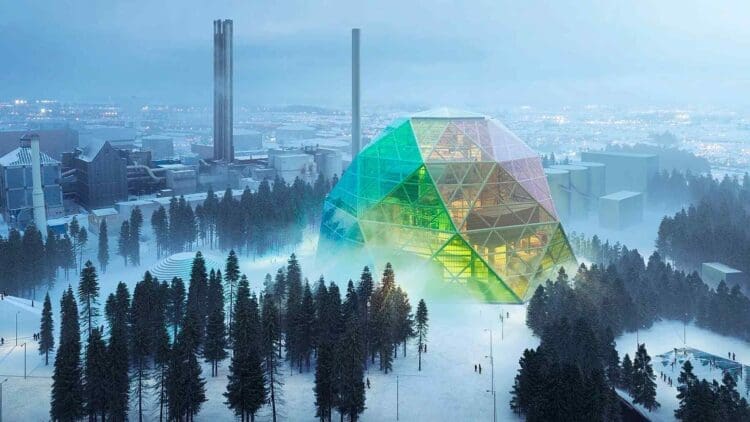

A unique architectural innovation to encapsulate education and sustainability within a giant rainbow dome.
This architecture brings eco-friendliness to life in the most vibrant and imaginative way possible, but it also addresses the greater urban needs.
The shimmering dome resulted from experimentation, and the “happy accident” could now swallow an invisible crisis.



As this sophisticated internal ecosystem silently breathes out clean air, could it represent what the future of green solutions looks like?
How urban needs call for unique climate solutions
City centers are now the fundamental “battleground” for climate change.
Urban regions are one of the biggest contributors to the invisible crisis, but they are also the most vulnerable.
The majority of carbon dioxide emissions are attributed to urban activities, especially considering energy demands, transportation, and industry.
The problem is, “remote” green solutions cannot be used as primary weapons in this battle.
Unique architecture is needed to serve as “safehouses” to deliver energy where it is demanded.
New climate change battle plans should include transforming “dead” industrial zones into vibrant, living, sustainable zones.
Multifunctional infrastructure could help to shape this plan, and perhaps even give cities a winning chance in the battle.
Radiant safehouses will provide the tactical edge to transform invisible climate vulnerabilities into visible victories.
Unique, multifunctional infrastructure to win the climate battle
Urban needs are greater than ever before.
Cities consume nearly 75% of global primary energy and emit approximately 70% of global greenhouse gas emissions. Tech industries and data centers are responsible for driving up energy consumption.
Experts believe that increasing renewable energy usage by 1% would decrease carbon emissions by 1.2%. To achieve this, many cities have been exploring unique approaches to integrate renewables.
Seattle has become a major technology hub and is home to innovations such as Amazon and Microsoft. High energy demands are thus inevitable.
As the saying goes, “modern problems require modern solutions.” Seattle’s modern solution is installing 1.1 kW solar flowers that bloom and pulse with sound.
However, the Bjarke Ingels Group (BIG) decided to use a more colorful approach in the Swedish city of Uppsala.
A vibrant, rainbow dome has been constructed, and it is captivating in more ways than one.
The BIG rainbow dome to help Sweden win the war
BIG’s colorful architectural design was nicknamed the “Diamond Dome” and is actually the Uppsala Power Plant.
The Diamond Dome operates seasonally and serves the city during the cold winter months. During the off-season, it opens to the public for an entirely different reason.
Seasonal waste conversion into clean power
Winter operations entail burning organic waste, such as wood chips, to generate heat and electricity. This helps to provide heat for the city’s homes.
The rainbow dome itself is a lattice of glass and color-tinted solar panels. The building thus powers itself through solar energy while biomass burns on the inside.
In the summer, the Uppsala Power Plant stops operations. It then serves as a public greenhouse to help educate locals and tourists about the plant and sustainability.
BIG’s design proves that wrapping stadiums with building-integrated photovoltaics is not the only way to win the climate battle.
Changing power plants into multifunctional, eco-friendly architecture could inevitably help win the battle and the war.
Hopefully, BIG’s concept for Vattenfall will move from proposal to prototype, as it certainly addresses the needs of urban regions.
As we slowly but surely near the 2030 climate milestones, leaving urban infrastructure as is no longer makes sense.
The invisible crisis of carbon and waste can be met with highly creative, and functional solutions. Going green is no longer limited to basic technology, as a world filled with colorful innovations is finally taking shape.
Disclaimer: Our coverage of events affecting companies is purely informative and descriptive. Under no circumstances does it seek to promote an opinion or create a trend, nor can it be taken as investment advice or a recommendation of any kind.