
A single electric wire runs the whole 897 miles from a Ugandan lake to the Indian Ocean, wrapped around the steel to stop the oil pipeline’s waxy crude from setting hard
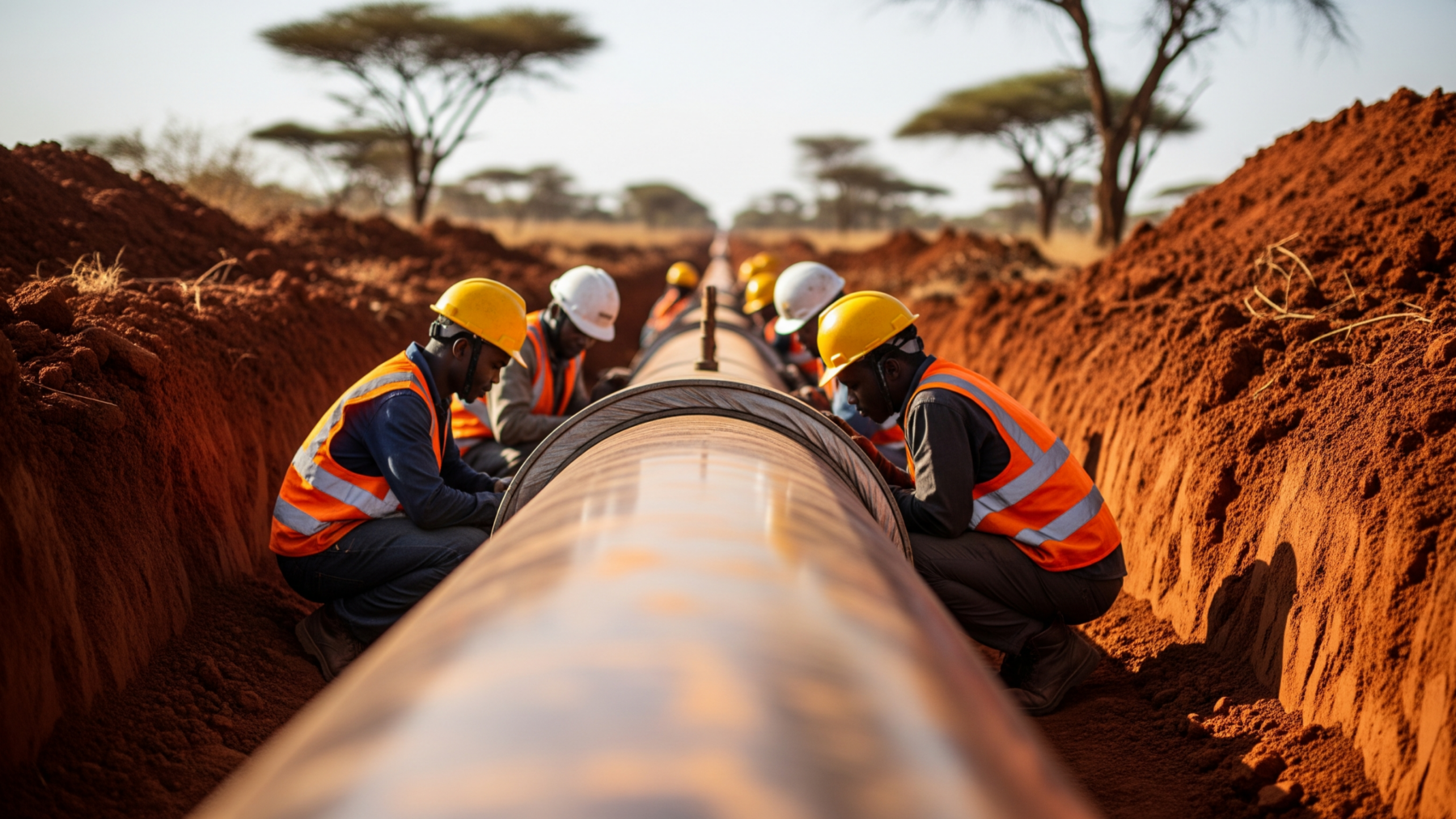 Image generated with artificial intelligence
Outside Hoima in western Uganda, a length of steel pipe reaches the trench wrapped in something most pipelines never carry.
Coiled along its full length is a continuous electric wire.
It is not there to find leaks or carry data.
At peak it is designed to move up to 246,000 barrels a day, drawn from an Albertine Graben that holds an estimated 6.5 billion barrels in the ground.
It is there to stop the oil inside from turning solid before it reaches the sea.
That single wire runs the entire way to the Tanzanian coast, mile after mile of warmed steel.
Why would crude oil turn solid in a tropical pipe, and how does a wire keep it moving?
Why the crude will not flow without heat
The oil under Uganda’s Lake Albert is nothing like the light crude that runs freely at room temperature from the North Sea or the Permian. It is waxy and thick, with a high pour point, the temperature below which it stiffens and locks up like cold butter inside a pipe.
Insulation alone cannot hold it.
Conventional lines handle a cold stretch with a jacket of insulation or a short burst of steam, but neither works across nearly nine hundred miles of tropical soil, highland forest and river crossings.
So the designers ran an electric heating cable along the entire pipe.
The cable does one job without pause. It holds the crude at about 122 degrees Fahrenheit, roughly 50 Celsius, every mile and every hour the line runs, turning the whole corridor into one length of warmed steel, not a pipe with a few heated spots.
What 897 miles of heated pipe looks like
On the ground the scale turns physical. A 24 inch buried line runs from the Hoima fields down to the Tanzanian coast, crossing red equatorial soil that shifts from swampy lake edges to highland forest, every length wrapped to hold its heat before it goes in the ground.
The crude does not move on its own.
A chain of six pump stations across the two countries pushes it along, station to station, toward the sea. At the far end, a marine terminal at Chongoleani was built out into the Indian Ocean near Tanga so tankers can load straight from the pipe.
Much of it was built locally. Ugandan engineers and technicians laid long stretches of a project no one in the region had attempted before.
The record, the money and who owns it
The line has a name and a price. It is the East African Crude Oil Pipeline, a project valued at around five billion dollars, led by TotalEnergies with a 62 percent stake alongside Uganda’s national oil company, Tanzania’s petroleum corporation and China’s CNOOC.
The record is narrow but real.
No other crude line of anything like this length runs on continuous electric heating, which is what earns it the title of the world’s longest heated oil pipeline. At peak it is designed to move up to 246,000 barrels a day, drawn from an Albertine Graben that holds an estimated 6.5 billion barrels in the ground.
The build is nearly done. An April 2026 update placed overall progress around 82 percent with all the line pipe delivered and the coastal jetty near 88 percent finished, and hydrotesting is set to begin in the second half of the year, the last major step before first oil.
The complications the scale cannot hide
The heat that makes the line work is also its weak point. Warming 897 miles of steel without pause draws heavy grid power, and Tanzania has to finish transmission lines to the pump stations before the pipe can reach its operating temperature end to end.
A gap in that power is the nightmare.
Lose the heat anywhere along the route and the crude can begin to set, a solidification event that could take weeks to clear, a risk that shadows other heated corridors like the Rovuma LNG build in Mozambique.
The engineering margin here is thinner than the pipe’s length suggests.
The ground it crosses is contested too.
Hundreds of miles of the route sit in the Lake Victoria basin that supports some 40 million people, close to 100,000 have been affected by land loss with compensation that advocates say fell short, and the line skirts sensitive protected areas, points the latest construction update does not dwell on.
What is at stake when the oil finally moves
For Uganda the payoff is historic. Once the line is tested and running, the country becomes an oil exporting nation for the first time, changing its revenue and its place in global crude markets almost overnight.
The market is the other unknown.
A project carrying billions in costs lives or dies on the gap between first oil and a real export rate, and the same price swings that have slowed megaprojects elsewhere will test this one, as global supply keeps reshaping the value of every barrel that reaches the coast.
So two kinds of heat are in play. The cable keeps Uganda’s crude liquid across two countries and nine hundred miles, but whether demand at the far end of the line stays warm enough to repay it is a different problem entirely.
Hugo is an engineer with strong technical expertise. Multilingual from an early age, his writing combines technical clarity with a strong interest in science and energy.
