
RWE reports 40% jump in first-half 2026 adjusted EBITDA to $3.4 billion, raises full-year investment plan
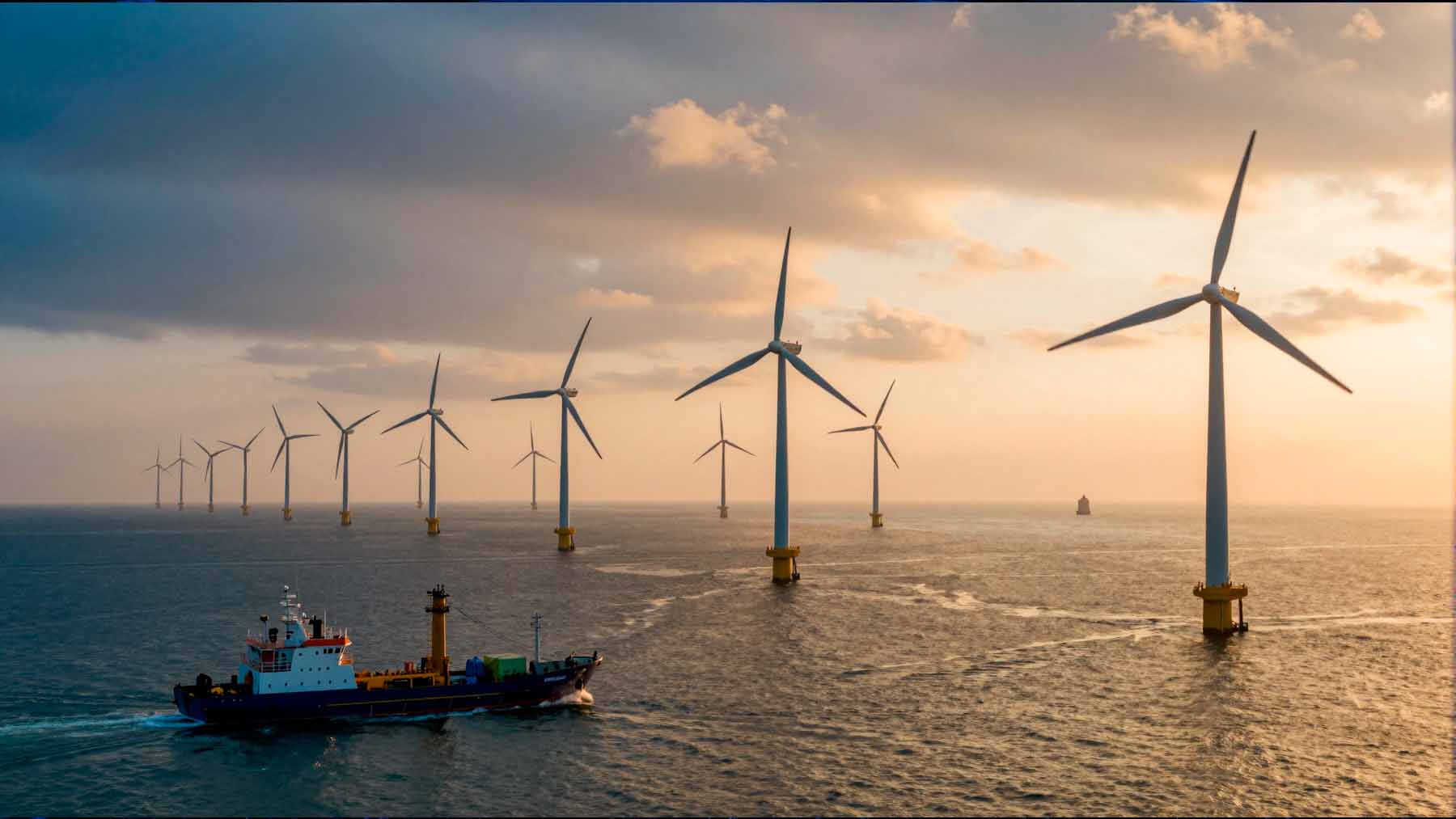 Image generated with artificial intelligence
RWE posted adjusted EBITDA of $3.27 billion (€3.0 billion) in the first half of 2026, up more than 40% from $2.29 billion (€2.1 billion) in the same period a year earlier. Adjusted earnings per share climbed more than 60% to $1.93 (€1.77), from $1.18 (€1.08). The German energy company published the results on August 13, 2026.
First-half 2026 financial results at a glance
The headline numbers tell a pretty clear story. Adjusted EBITDA jumped to $3.27 billion (€3.0 billion) from $2.29 billion (€2.1 billion) in H1 2025—a rise of more than 40%. Adjusted net income followed the same direction, climbing to $1.42 billion (€1.3 billion) from $0.87 billion (€0.8 billion) in the prior-year period.
Earnings per share moved even more sharply. Adjusted EPS reached $1.93 (€1.77), up from $1.18 (€1.08) a year earlier—a gain of more than 60%, outpacing EBITDA growth and reflecting stronger bottom-line leverage across RWE’s portfolio.
Flexible Generation posted the sharpest year-on-year swing—adjusted EBITDA reached $1.12 billion (€1,025 million) versus $661 million (€606 million) in H1 2025.
On dividends, RWE held its ground. The company confirmed its 2026 dividend target of $1.44 (€1.32) per share and reiterated a 10% annual dividend growth path running through 2031—a commitment that gives investors a longer-term income signal alongside the near-term earnings beat.
Key drivers behind the earnings increase
Wind was the single biggest operational tailwind. Europe saw normalized and above-average wind conditions in H1 2026, after notably weak winds in the same period of 2025. That swing lifted generation volumes across both offshore and onshore wind segments by a meaningful margin.
New capacity additions compounded the effect. RWE commissioned 752 MW of wind, solar, and battery storage since January 2026, and zooming out further, the company has added 2.6 GW since the end of June 2025—a real expansion of its earnings base.
One item stands apart as a clear one-off. The Dutch state paid RWE $362 million (€332 million) in compensation for statutory restrictions placed on coal-fired generation at its Eemshaven plant during H1 2022. That payment landed in the Flexible Generation segment and gave a significant non-recurring boost to the overall result.
Two smaller contributors also helped: UK capacity market revenues added to Flexible Generation earnings, while proprietary trading at RWE Supply & Trading recovered in Q2 after a weak start to the year.
Segment-by-segment performance
Offshore Wind earned $883 million (€810 million) in adjusted EBITDA, up from $701 million (€643 million) in H1 2025. The improvement came mainly from higher generation volumes as wind conditions returned to normal after last year’s soft performance.
Onshore Wind/Solar was the largest single segment contributor at $1.11 billion (€1,016 million), compared with $905 million (€830 million) a year earlier. Capacity additions and better wind drove the gain, though adverse USD/EUR exchange effects reduced the euro value of US dollar-denominated revenues and partially offset the improvement.
Flexible Generation posted the sharpest year-on-year swing—adjusted EBITDA reached $1.12 billion (€1,025 million) versus $661 million (€606 million) in H1 2025. The Dutch compensation payment accounts for most of that gap, with UK capacity market revenues providing additional support.
Supply & Trading rebounded from a rough start. After a weak Q1, proprietary trading strengthened in Q2, lifting the segment’s H1 adjusted EBITDA to $146 million (€134 million)—well above the $17.4 million (€16 million) recorded in the same period last year, which was itself a low point.
Revised investment plan and pipeline
RWE raised its full-year 2026 net investment guidance to $9.8–$12.0 billion (€9–11 billion), up from the previous $6.5–$8.7 billion (€6–8 billion) range. The revision reflects the acquisition of a majority stake in Amprion, the German transmission grid operator. In the first six months alone, RWE invested $6.87 billion (€6.3 billion) net.
The construction pipeline stays substantial. A further 10.3 GW of capacity is currently under construction, and the total generation portfolio now stands at nearly 41 GW across renewables, flexible generation, battery storage, and related assets.
The broader capital plan stays intact—RWE’s total planned net investments of $45.8 billion (€42 billion) through 2031 remain on track, with the Amprion deal folded into that figure rather than added on top.
Net debt stood at $16.35 billion (€15.0 billion) as of June 30, 2026. RWE attributed the increase from year-end 2025 mainly to high investment spending and seasonal cash flow patterns. Despite the rising debt level, the company expects its leverage ratio—net debt to adjusted EBITDA—to stay below the lower end of its 3.0x–3.5x target corridor.
Long-term earnings outlook through 2031
RWE’s long-term targets stayed unchanged even as near-term guidance moved higher. The company is aiming for average adjusted EPS growth of 10% annually, reaching $4.96 (€4.55) per share by 2031—a target reaffirmed following the guidance upgrade for 2026 and 2027 announced in a press release on July 28, 2026.
CEO Markus Krebber pointed to structural demand growth as the foundation for that confidence. His statement accompanying the results cited growing global electricity demand and the required expansion of grid infrastructure as tailwinds over the medium and long term.
The Amprion majority stake fits that narrative directly. It extends RWE’s footprint beyond generation and trading into transmission infrastructure, a segment that benefits from regulated revenues and long-term grid investment programs across Europe.
RWE’s H1 2026 results combined a genuine operational improvement—better wind, more capacity—with a material one-off payment from the Dutch state. Adjusted EBITDA hit $3.27 billion (€3.0 billion), adjusted EPS rose more than 60%, and the company raised its full-year investment plan to account for the Amprion deal. Dividend commitments and the 2031 EPS target of $4.96 (€4.55) per share remain in place, underpinned by a nearly 41 GW portfolio and 10.3 GW still under construction.
Kelly is an experienced writer with 15 years of experience exploring the big stories that shape our world, from tech breakthroughs and space exploration to climate, energy, and the fascinating quirks of science. She has a talent for turning complex ideas into sharp, memorable insights that stay with readers long after they’ve finished reading.
