
Sherwin-Williams launches Heat-Flex AEB, a spray-applied coating that replaces mineral insulation and eliminates corrosion risk on industrial assets
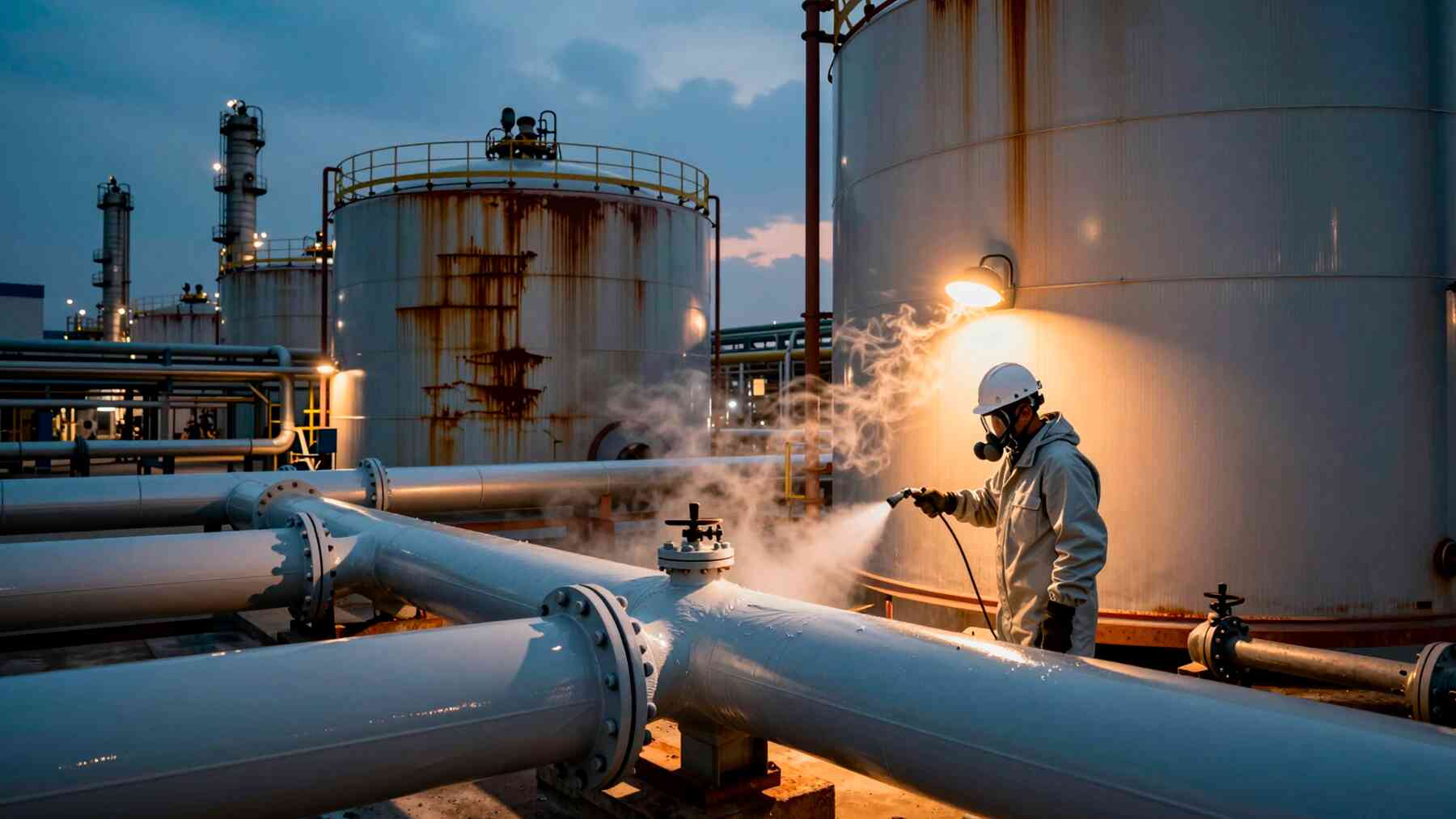 AI-made
Sherwin-Williams just launched Heat-Flex AEB — a spray-applied thermal insulative coating built to replace conventional mineral-based insulation on storage tanks, process vessels, and piping at industrial facilities. The premise is pretty direct: corrosion under insulation needs insulation to exist. Take away the insulation layer, and you take away the failure mode.
The single-component coating holds operating temperatures up to 350°F (177°C), with short-term capability reaching 400°F (204°C). That puts it in real substitution territory for the mineral wool, metal cladding, and hardware that make up traditional insulation assemblies.
Sherwin-Williams introduces heat-flex AEB to the industrial market
Heat-Flex AEB targets the asset types where corrosion under insulation has historically done the most damage: storage tanks, process vessels, and piping. These are also the assets where CUI-related maintenance costs tend to run steepest, which makes them the logical starting point for a product designed to eliminate the problem at a structural level.
That simplicity cuts the margin for application error and speeds up installation considerably compared to assembling a conventional insulation system piece by piece.
No mixing before application — the coating is single-component. Workers spray it directly onto prepared steel over a corrosion-protective primer; Sherwin-Williams recommends Heat-Flex 750 or Heat-Flex ACE as compatible options. That simplicity cuts the margin for application error and speeds up installation considerably compared to assembling a conventional insulation system piece by piece.
Why corrosion under insulation is a persistent industrial problem
CUI is simple enough in theory. Just stubborn in practice. Water works its way into conventional insulation assemblies—mineral wool, metal cladding, and all the hardware holding it together—and gets trapped against the steel underneath, where a corrosive environment builds slowly and out of sight.
By the time anyone detects the damage, it’s usually significant. Inspection means partial or full cladding removal, which is expensive and operationally disruptive. There’s no easy way to check what’s happening underneath without tearing the whole system apart.
The problem compounds in a second direction too. Moisture buildup inside traditional insulation degrades thermal efficiency over time, so facilities respond by running more process heat, which drives energy consumption up. The insulation that was supposed to reduce energy costs ends up raising them — a slow, self-reinforcing cycle that’s hard to break without replacing everything.
How the coating eliminates CUI by removing the insulation layer
The logic is clean. CUI requires a physical insulation layer to develop. Replace that layer with a thick-film coating, and there’s no longer any space where water can pool and corrode steel from below.
Neil Wilds, Global Product Director for CUI at Sherwin-Williams Protective & Marine, put it plainly: “By removing this from an asset and applying the thermal insulative coating in its place, there is no longer any physical system under which corrosion under insulation could occur. Therefore, the corrosion under insulation is eliminated by default.”
Getting the coating to actually perform like insulation took real engineering work. Wilds noted that the development team had to manipulate the coating’s molecular structure and formulation so it could retain process heat at temperatures high enough to genuinely substitute for traditional insulation—without affecting material flow inside the assets. Mineral wool loses efficiency as moisture accumulates; Heat-Flex AEB maintains stable thermal performance regardless of environmental moisture exposure, and that stability holds across the asset’s full operating life, not just at installation.
The application process offers operational and safety advantages
Traditional insulation installation puts workers in close physical contact with hot equipment—wrapping, banding, and cladding in tight or elevated spaces, often on assets that are still running. Heat-Flex AEB changes that dynamic. Spray application keeps personnel at a safer distance from hot surfaces, and assets can stay operational at temperatures up to 300°F (148°C) while the coating goes on, removing the need to shut down equipment for insulation work.
A single coat reduces surface temperature right away, eliminating burn risk for anyone who needs to approach the asset afterward. That’s an immediate safety benefit from the first pass.
New assets get a more efficient workflow as well. Rather than wrapping and cladding equipment on-site in constrained spaces, they can be coated in pre-assembly yards before installation. On large-scale industrial projects, that kind of flexibility adds up fast.
Sustainability and cost context for the product launch
The sustainability case for Heat-Flex AEB works on several levels. The most direct is asset longevity—eliminating CUI extends the service life of steel infrastructure, cutting both the financial and environmental costs of unplanned maintenance and early replacement.
The product also removes an entire material assembly from the picture. Manufacturing, shipping, and storing mineral wool, metal cladding, wiring, pins, and banding hardware all carry environmental costs. Heat-Flex AEB replaces that whole system with a single product, trimming associated manufacturing and logistics impacts in the process.
Consistent thermal efficiency over the asset’s life means facilities don’t need to compensate for insulation degradation by running more process heat. That directly lowers energy consumption — and Sherwin-Williams positions the combined effect of longer asset life, reduced material production, and stable energy use as contributing to lower carbon footprints across industrial operations.
Several significant benefits for asset maintenance
Heat-Flex AEB is a spray-applied, single-component thermal insulative coating designed to replace mineral-based insulation on industrial steel assets. It holds operating temperatures up to 350°F (177°C), handles short-term excursions to 400°F (204°C), and gets applied over a corrosion-protective primer directly to prepared steel — no mixing required.
Its core proposition is structural: removing the insulation layer eliminates the physical conditions that allow CUI to develop. Thermal performance stays consistent regardless of moisture exposure. Assets can stay online during coating, new assets can be coated off-site before installation, and application is safer than conventional insulation work. On the sustainability side, the product reduces material waste, extends asset life, and supports stable energy consumption across facility operations.
Kelly is an experienced writer with 15 years of experience exploring the big stories that shape our world, from tech breakthroughs and space exploration to climate, energy, and the fascinating quirks of science. She has a talent for turning complex ideas into sharp, memorable insights that stay with readers long after they’ve finished reading.
