
Shipped from Bilbao on a heavy lift vessel, 197 steel cylinders each weighing 1,670 metric tons are now being driven one by one into a stretch of seabed that happens to be one of the North Sea’s busiest whale migration lanes
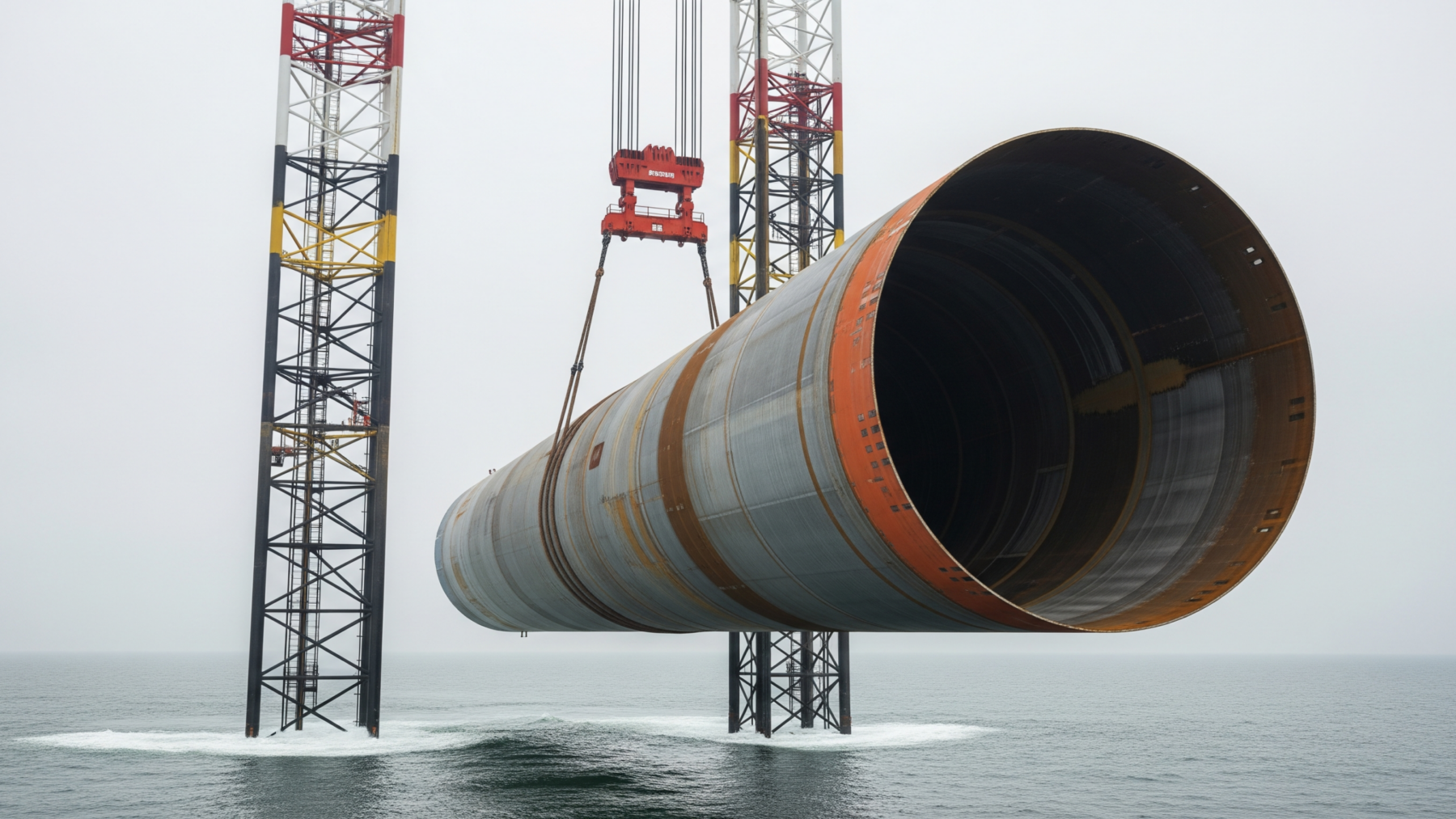
Something has been happening 120 miles off the coast of Norfolk since May 2026, and most people on shore have no idea it is there. A vessel the size of a small office block has been lowering steel cylinders into the sea, one by one, each weighing as much as nine of the heaviest blue whales ever recorded. The cylinders disappear into 100 feet of grey water and keep going until they find the sand. When the last one is in place, the stretch of empty North Sea above them will be the most powerful wind farm on earth.
A factory floor in Bilbao, a quayside in Teesside, and an ocean in between
Every foundation begins as a flat sheet of steel in the Basque Country of northern Spain, where Haizea Wind Group rolls, welds and assembles each cylinder inside a factory large enough to swallow a city block. The 197 monopiles each weigh an average of 1,670 tons and measure 295 feet in length, roughly the height of a 25-story building laid on its side. The diameter at the bottom can reach 36 feet, wide enough to park two transit buses side by side inside the open end.
Six of the massive structures traveled to the UK on a heavy lift vessel, covering 960 nautical miles from Bilbao to Teesside, where they were stored at Steel River Quay on the Teesworks site before being loaded onto installation vessels one campaign at a time. The logistics chain alone, factory, ship, quay, installation jack-up, crosses three countries and four specialist companies before a single cylinder touches the seabed.
The company paused the planned development of Hornsea 4 in May 2025 and announced plans to cut its global workforce by roughly 2,000 jobs by the end of 2027.
The vessel that had to be invented for a job this size
Ørsted is working with installation company Cadeler and its vessel Wind Ally, which was specifically designed to carry the largest monopiles ever made for a commercial wind farm. Once it reaches the installation site, Wind Ally plants four enormous steel legs onto the seabed, lifts its hull clear of the waves and becomes a perfectly stable platform from which to lower 1,670 tons of steel with precise control.
A team of more than 200 experts from Ørsted, Cadeler and Menck are working together across the Hornsea zone. Menck supplies the hydraulic hammer that pounds each cylinder into the seabed, sending pulse after pulse through the water column before the steel locks into the sand below. That noise travels a long way through cold seawater, which is why the marine mammal question matters as much as any engineering specification.
What travels these waters, and what a hammer sounds like from below
The stretch of the southern North Sea where Hornsea 3 sits is not empty. Harbor porpoises move through it all year, and minke whales pass seasonally along the same corridor the monopile campaign is now crossing. Every major offshore construction project in UK waters operates under a marine mammal mitigation protocol, meaning trained observers scan the surface before and during pile driving, with soft start procedures that ramp the hammer up gradually so any animal within range can move away.
The blue whale comparison Ørsted used when the first monopiles arrived in Teesside was not accidental marketing. Nine blue whales, stacked on a single foundation, then driven into the sea floor. That is one cylinder. There are 197 of them.
Hornsea 3, and the number that resets every record
The first of 197 XXL monopiles was installed on Ørsted’s Hornsea 3 Offshore Wind Farm in May 2026. With an installed capacity of 2.9 GW, Hornsea 3 is the largest single offshore wind farm in the world, owned by Ørsted and Apollo-managed funds, and expected to be operational in 2027. When complete, it will generate enough clean energy to power more than 3.3 million UK homes.
Luke Bridgman, Managing Director of Hornsea 3 at Ørsted, put it plainly after the first foundation went in: “Each monopile is the culmination of incredible feats of engineering, skill and experience,” he said, adding that Hornsea 3 “will be the world’s single largest offshore wind farm and shows how Ørsted and the UK continue to be leaders in the offshore wind industry.” For those tracking the broader approval push across northern Europe, Hornsea 3’s construction pace is the clearest proof yet that the engineering is no longer the bottleneck. Teesside’s role in this story is not incidental, with Steel River Quay now the main British staging post for foundations arriving from Spain, anchoring supply chain jobs to a part of England that once built steel for a different industry entirely.
What comes next, and the honest caveat that goes with a number this large
The 197th monopile is not yet in the ground, and Ørsted has been candid about the pressures surrounding a project of this scale. The company paused the planned development of Hornsea 4 in May 2025 and announced plans to cut its global workforce by roughly 2,000 jobs by the end of 2027. Hornsea 3 survived those cuts and remains the centerpiece of Ørsted’s European rebuild.
The marine picture will be watched closely as the pile driving campaign runs into 2027. Regulators require ongoing acoustic monitoring, and the data collected during installation feeds directly into models used for future consenting decisions. Developers hoping to follow Hornsea 3 into UK waters will inherit the evidence base this campaign is building, giving those planning applications still working through the system a much clearer framework to operate within.
What is already certain is the image from the North Sea in May 2026: a crane arm swinging 295 feet of Spanish steel into position above the water, and the sound of a hydraulic hammer beginning its slow, deliberate count toward a foundation that will still be standing when the next generation of engineers arrives to replace the blades above it.

Hugo is an engineer with strong technical expertise. Multilingual from an early age, his writing combines technical clarity with a strong interest in science and energy.
