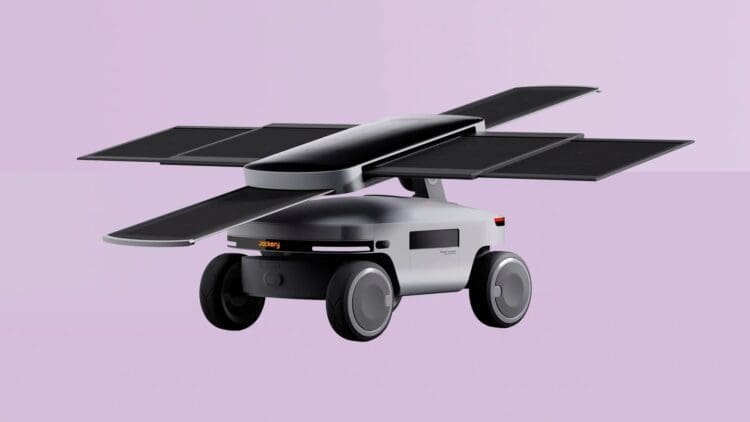
We are fortunate enough to live in a time that some have referred to as the “Intelligent Age,” highlighted by the fastest technological advancement ever. Several industries have undergone revolutionary changes as a result of this new era, including the energy industry. Conventional designs, such as solar panels, are over, as a groundbreaking high-tech solar “Martian” robot pushes us into the future. It automatically folds its cells, uses AI to chase sunlight, and so much more. The future is now!
Solar panels are over: It’s a completely new era
In this day and age, it’s not easy to keep up with the latest technological breakthroughs, as technological advancements are made at an exponential pace. While some may find it challenging to adapt, these advancements are nonetheless very welcome, especially in the energy industry. In the prior era, conventional designs delivered tremendous results, but as technology advances, so must we.
Conventional designs, such as solar panels, could soon be outdated. A pioneering U.S. company has engineered an intelligent solar “Martian” robot that outperforms most conventional solar technologies and addresses the following disadvantages faced by these designs, especially in home applications:


- Low efficiency, especially in terms of shading conditions or dirt accumulation
- Monitoring limitation, which results in time-consuming and difficult troubleshooting
- Sub-par energy management and difficult integration with some home systems
- Limited scalability due to limited space for some applications
“Martian” robot folds its cells and uses AI
The minds behind this ingenious design are none other than the portable power solution company called Jackery. The company’s pioneering technologies are driven by a vision to make green energy more accessible for everyone. Their latest technology, officially known as the Solar Mars Bot, will certainly achieve this vision with the help of intelligent features such as AI.
The Solar Mars Bot’s functioning is basically based on the concept of heliotropism, as this robot uses AI to seek out maximum sunlight exposure throughout the day. Heliotropism is a common muse in the solar world, as Seattle’s solar flowers that pulse with sound were inspired by the “Humming Heliotrope.” However, this intelligent robot does so much more than chase the sun.
Chasing sunlight and so much more
According to Jackery’s website, the Solar Mars Bot tracks angles (up to 60 degrees) with maximum solar irradiation with a powerful and accurate light-tracking sensor. Once the best angle has been established, the robot’s six solar panels and wheels move towards the sun. The panels can produce up to 600 W of electricity. It can also automatically fold its solar panels, making the design more compact when needed.
Furthermore, it is versatile in applications, as it has a series of output ports that can power several electrical devices up to 3,000 W, and a battery that stores 5,000 Wh. This makes this robot highly suitable for off-grid living, rescue operations, and outdoor events. Jackery’s website indicates that one charge is enough to power a small cabin for up to three days.
Other features:
- Highly durable
- Weather and corrosion resistant
- Can adapt to rugged terrains
- Aesthetic design
- Mobile App for remote monitoring
- Independent cruising capability and automatic route planning
- 5G signal module
- Autonomous battery level checking and charging
Thanks to the Intelligent Era, robots are becoming common in daily life, and the Solar Mars Bot, which reminds us of the Mars Rover, even though it will only roam on Earth, is sole proof. Jackery has not confirmed an official release date or price for the U.S., but some expect it to launch later this year. AI is becoming more integrated with daily life, which is evident in China’s next-gen challenge of achieving an intelligent society by 2035, which can be feasible thanks to its solar capacity.