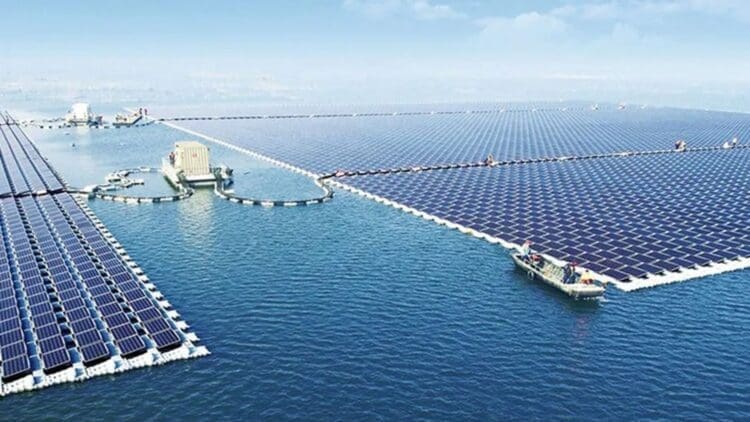
China is renowned as a leader in renewable technology manufacturing and renewable power production, especially solar. However, once upon a time, the country faced significant pollution challenges, and some may argue that it still does. Then it ran out of land for solar panels, leading to massive artificial lakes being built. The country’s perception of the solar power industry has been reshaped entirely after something unexpected was uncovered.
Thinking outside the smog box: Solar panel solutions beyond land
China has the highest installed renewable capacity worldwide, and its growth is expected to continue as the country aims to lower its reliance on fossil fuels for power production, especially coal. However, despite this decreased reliance, the country is still significantly struggling with pollution, more specifically, air pollution.
Reports from ScienceDirect.com and IQ Air indicate that several major cities across China still face Air Quality Index (AQI) levels over 200, which is deemed as “very unhealthy.” This has been a long-lasting problem, as China has struggled with air pollution for over a decade, with smog and particulate matter still affecting millions of people. Approximately two million deaths annually are associated with air pollution in the country.
This is why the Chinese government implemented stricter regulations in 2014 and declared a “war on pollution.” The strategy was simple: Decrease coal consumption and increase renewable energy. However, as valuable land becomes scarce, it becomes more difficult to increase renewable capacity, especially in urban areas. It was time to think outside the smog box, leading to an innovative solar solution beyond land.
The power of repurposing: China’s massive artificial solar lakes
China’s Huainan City became the perfect example of what can be achieved when one actively repurposes outdated land, or in this case, water. The major Chinese company, Sungrow Power Supply, was behind a pioneering project that repurposed land in Huainan that was used for coal mining. The land was abandoned due to frequent flooding after significant rain.
The water itself was deemed unsafe for use, as minerals leeched into the water. That is why repurposing the land for a massive floating solar power plant seemed like the ideal solution. A local government official in favor of the project stated the following:
“The plant not only makes full use of this area, reducing the demand for land, but also improves generation due to the cooling effects of the surface.”
While floating power plants are not uncommon now, seeing as America now boasts an artificial, floating photovoltaic island, this plant was commissioned in May 2017, making its results highly unexpected at the time.
Unexpected results, but there are still challenges
The mega-project features 160,000 solar panels floating on 800,000 square meters. According to Sungrow’s website, the 150 MW project can produce 220 GWh of clean solar power annually. This is enough electricity to power 15,000 homes. Furthermore, the floating panels reportedly improve water quality by blocking sunlight and thus inhibiting algae overgrowth.
Other benefits of floating solar plants
- Can be installed in proximity to urban areas
- Less power is lost during transmission
- Increased scalability
- Plants are movable in cases of emergency
- Increased access to clean power in coastal regions
Unfortunately, the maintenance of floating solar plants is a significant challenge, especially when it comes to making them resistant to rust and corrosion.
Another thing to consider, according to Interesting Engineering, is that careful planning and design must go into these plants’ infrastructure, especially their cables and electrical components. Should these components not be properly waterproof, shortages could be significantly fatal to all surrounding life on and in the water. These significant enhancements can be costly. However, despite these challenges, more countries are adopting floating solar power, including Indonesia, which commenced its 92 MW floating solar project.