
In a tiny Swiss village, every time a train rolls past, solar panels hidden beneath it generate clean electricity for nearby homes in a system the world has never seen before and one that has engineers asking the same question
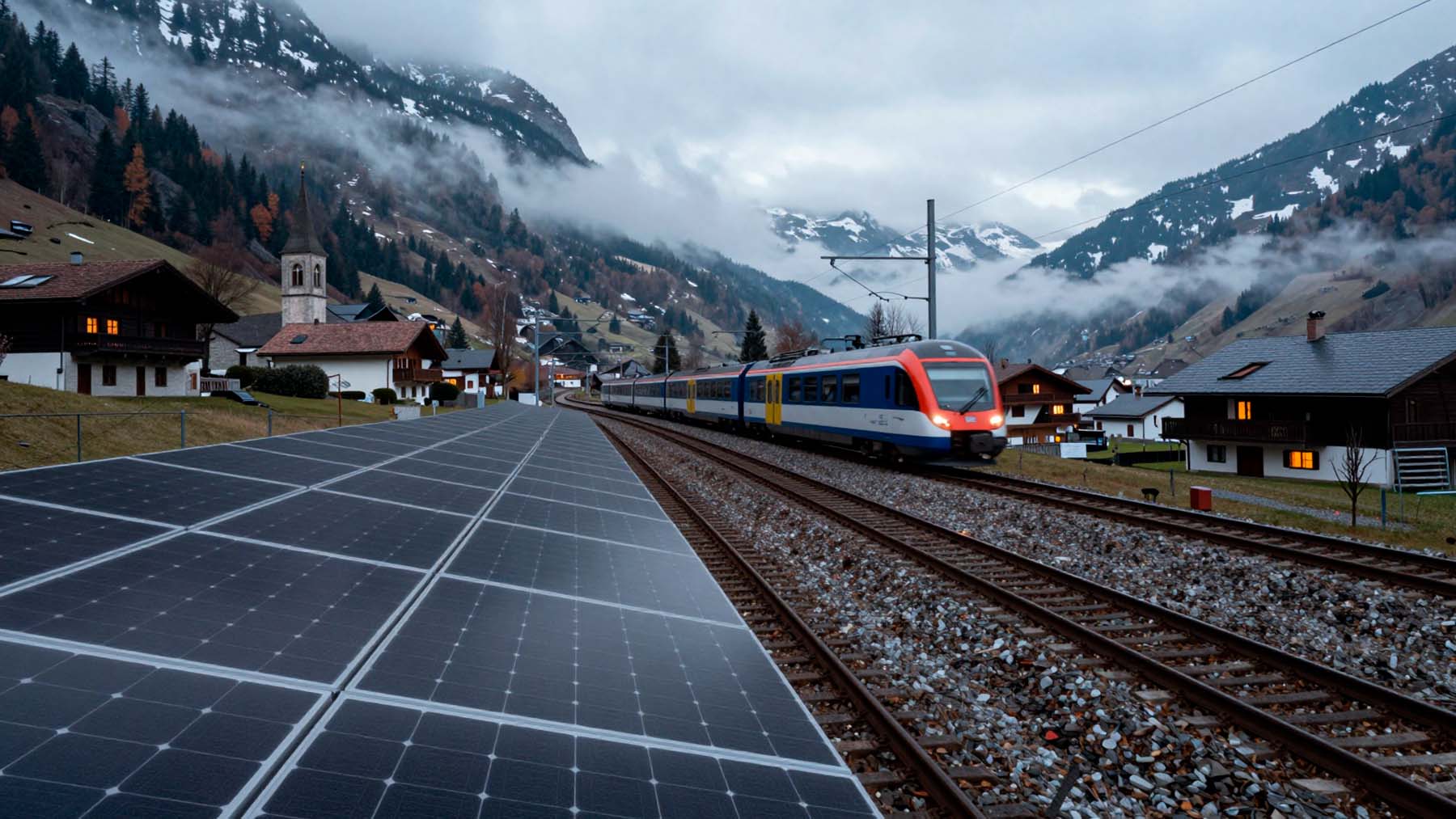
In a Swiss village, solar panels beneath active train tracks generate clean electricity for nearby homes — a world first
The strip of ground between two railway tracks has never had a job. It just sits there, gravel and ties, while trains pass overhead. In Buttes, a small village in the Swiss Alps, that’s been quietly changing for more than a year.
Since early 2024, solar panels installed beneath active rail lines have been generating real, measurable electricity — surviving more than 11,000 train crossings at speeds up to 55 mph without a single reported incident.
Hundreds of thousands of miles of track worldwide could become distributed clean energy infrastructure, feeding electricity directly to nearby homes and communities.
A first-of-its-kind installation in a tiny Swiss village
In April 2025, Sun-Ways — a Swiss startup — installed 48 solar panels along a 330-foot stretch of active railway in Buttes, Switzerland. It’s the first removable solar power plant ever placed on a working rail line anywhere in the world. That distinction matters: this isn’t a prototype in a lab or a simulation on a test track. It’s a live system, under real trains, in a real village.
The panels are patented and engineered to sit between the rails. When maintenance crews need track access, they come out. When the work is done, back they go. That design solves what would otherwise be an obvious dealbreaker for any railway operator — you can’t block track maintenance for the sake of solar output.
The pilot is officially scheduled to run through 2028.
One year in: what the data actually shows
The numbers from the first year are straightforward. More than 11,000 trains have rolled directly over the panels at speeds up to 55 mph, with no reported safety incidents. The installation has remained stable throughout — even after a month-long pause caused by snow and planned technical work.
Since May 2025, the system has produced over 16,000 kilowatt-hours of electricity, enough to cover the annual consumption of three to four Swiss households.
Sun-Ways founder Joseph Scuderi was direct about what the results mean. “We have achieved our objectives, both in terms of railway safety and electricity production,” he told Swissinfo. Clearing both benchmarks at once, on a first-of-its-kind pilot, is a meaningful result — not a guarantee of scale, but a credible proof of concept.
Why unused rail space matters for renewable energy
One of the persistent obstacles to expanding solar power is land. Utility-scale installations need large, flat, often rural plots — which means land purchases, displacement of existing uses, and sometimes deforestation. Rail corridors sidestep all of that. The space between the tracks was already there, already cleared, already doing nothing.
Switzerland’s roughly 3,300-mile rail network — excluding tunnels and poorly lit stretches — could theoretically generate up to 2% of the country’s electricity, according to Sun-Ways. That’s enough to power around 300,000 households from infrastructure that already exists.
The broader implication is hard to ignore. Railway corridors run through cities, suburbs, and countryside across dozens of nations. If the concept holds up at scale, the available surface area for distributed solar generation expands dramatically — without a single new land transaction required anywhere.
Global interest is already forming
Word has traveled faster than the Swiss regulatory process. In February 2025, France’s national railway company SNCF signed a deal with Sun-Ways — a meaningful early partner, given that France operates one of Europe’s most extensive rail networks.
The interest reaches well beyond Europe. In July 2025, Scuderi told PV Magazine that a delegation from Indonesia’s railway sector visited the Buttes site in person. “They came to convince themselves it was real and not a fake video,” he said. Indonesia’s rail network spans thousands of miles across a densely populated archipelago where energy access remains uneven.
Japan and South Korea have also expressed interest, despite their trains regularly traveling at more than 186 mph — well beyond the 55 mph threshold tested in Buttes. A pilot project in Italy may be organized before the end of 2025, according to Scuderi, who said he’s currently in contact with an Italian railway infrastructure company.
What needs to happen before this scales
The most immediate bottleneck is regulatory. Final approval in Switzerland is still pending, and Scuderi has been explicit about why that matters beyond Swiss borders. “The sooner we obtain final approval, the sooner our partners abroad will also be able to move forwards,” he said. International partners are watching the Swiss process closely before committing to their own installations.
Technical milestones will also define whether this technology can travel. Testing at higher speeds — particularly in countries where high-speed rail is the norm — will be critical, and longer pilot stretches are needed to understand performance across varied terrain, weather, and traffic volumes.
If those tests succeed, the scale of what becomes possible is significant. Hundreds of thousands of miles of track worldwide could become distributed clean energy infrastructure, feeding electricity directly to nearby homes and communities. The strip of ground between two rails has never had a job. In Buttes, it’s been working for over a year. The question now is how far that job can travel.


Carlos is an engineer with strong expertise in technical and industrial topics. He previously worked at international companies such as Siemens and is multilingual.
