
China has always been a pioneer when it comes to renewable technologies, from efficiency to scale, and from design to performance. The country even tried to shock the world with its “storm catcher” design, unaware that Germany had also quietly switched on a true “storm eater.” When it comes to riding out the storm, both these nations’ technologies will power through, but it seems as if Germany’s design holds benefits that transcend power production.
Riding out the storm: China versus Germany in the renewable energy race
In a time of crisis, most people believe it is best to weather the hard times. However, without the proper operations, this route can become significantly costly. This is quite true for regions often plagued by literal storms, which is why researchers have been working long and hard to create technology that will keep the lights on in times of crisis.
Two nations that have been working hard to expand their renewable capacities are China and Germany. Both nations face challenges with regard to extreme and stormy weather conditions, albeit very different stormy weather conditions. The coastal regions of China are frequently plagued by typhoons, which is why offshore renewable technologies are being advanced to withstand these conditions.
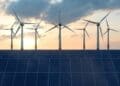
China’s Mingyang Smart Energy has been working on a 50 MW twin-head V-shaped floating turbine, with mass production planned for this year. Not only will it meet rising global energy demands, but its design will also allow it to function in severe, stormy weather. Germany, on the other hand, has quietly created a true “storm eater,” and it holds tremendous potential for the world.
Germany quietly introduced its true “storm eater”
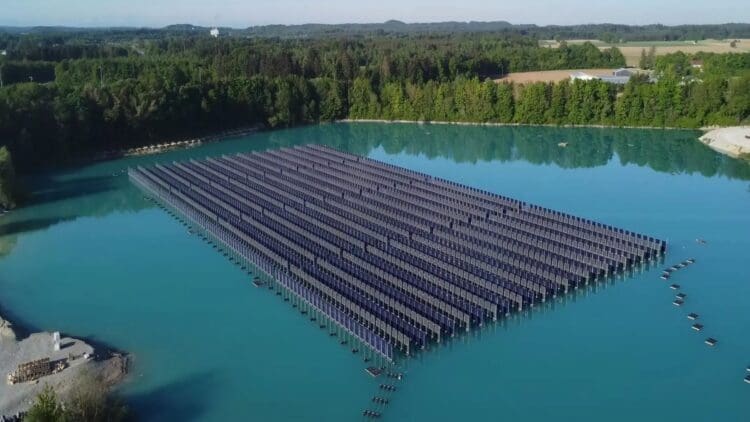
According to Interesting Engineering, Mingyang Smart Energy’s 50 MW offshore turbine can operate in Category 5 hurricane conditions, even when wind speeds hit 161 mph. This will be lifesaving in times of emergency, but Germany-based SINN Power’s design is just as impressive, if not more so. SINN Power has created the 1.84 MW SKipp-Float system, which is a pioneering floating solar plant.
The Starnerg District is about to benefit from a boost in renewable power
The SKipp-Float system was installed in Bavaria’s artificial lake at the Jais gravel pit in the Starnberg District. Floating solar power is rapidly becoming more popular; for example, a U.S. island added 164,000 solar panels to produce record energy. However, this German design is the first to feature vertically installed solar panels, and the company stated that its design allows stable daily power production with increased morning and evening outputs.
Beyond these benefits, the SKipp-Float system has other benefits beyond power production, such as “storm eating” potential, among others.
SINN Power says the benefits will transcend power production
The solar panels are fixed on a substructure that enables controlled movement during varying water levels and wind loads. Furthermore, only 4.65% of the lake’s surface is covered by the plant, ensuring minimal disruption. Initial operations resulted in an almost 60% reduction in the grid’s power usage, and SINN Power believes this reduction will rise to 70% once production has stabilized.
The company added that the floating solar plant had zero negative impact on the environment. In fact, early data showed that the lake’s water quality improved thanks to enhanced oxygen exchange. It also resulted in new habitats for waterfowl and fish. SINN Power wants to develop its technology for ocean applications, hoping to improve clean power generation at sea.
In conclusion, in the world of renewable technologies, there are several ways to ride out the storm, and depending on individual needs, designs such as China’s “storm catcher” and Germany’s “storm eater” can prove to be very useful. However, careful environmental impact research before installation is crucial, especially for offshore technologies. Offshore wind turbines resulted in a “bizarre mass movement” in whales, so who is to say that offshore solar plants won’t have an impact?
Disclaimer: Our coverage of events affecting companies is purely informative and descriptive. Under no circumstances does it seek to promote an opinion or create a trend, nor can it be taken as investment advice or a recommendation of any kind.