
One of the few places in the world known to offer warmth and relaxation in the middle of the snow is Sweden. However, not only does Sweden’s Solar Egg help one relax and rejuvenate, but it also evokes conversation about breaking environmental barriers while proving that flat cells are nonsense, as its 70 gold panels produce energy in the snow. Find out why this unique, artistic design is of utmost importance in a certain Swiss mining city, especially as it embraces transition.
Sweden’s Solar Egg: Breaking environmental barriers
In Swedish Lapland, one can find the northernmost city of Sweden, called Kiruna. This city’s existence is attributed to iron ore mining, dating back to 1890, when the LKAB mining company was established. Kiruna was established a decade later, connected to the world by the Ore Line railway, and played a significant role throughout history, especially during WWII as an iron supplier.
The town rapidly expanded, obtaining city status in 1948. Now, the city is forced to embrace transition, as the city center is being relocated, ironically, due to the iron ore mining. This decision was already made in 2004, as ground shifts increasingly became a problem. The Great Relocation is what inspired Sweden’s Solar Egg, which serves a dual purpose for the city’s residents.


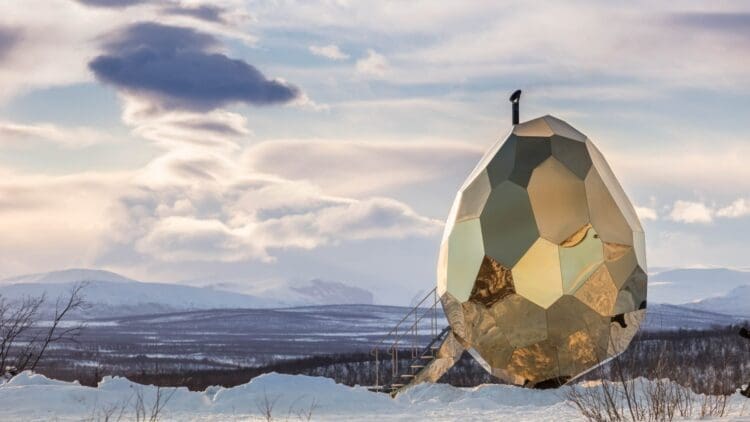
70 gold panels producing energy in the snow
The Swiss are known for their renewable energy installations, especially the Swiss solar designs that make you forget about silicon and perovskite cells. However, Mats Bigert and Lars Bergström, world-renowned artists, have created Sweden’s Solar Egg, a unique functional piece of art that consists of nearly 70 gold-plated panels and produces energy in the snow.
The Solar Egg is more than a mere artistic design, as it is a mobile sauna used by Kiruna residents as the Great Relocations proceed. Bigert and Bergström completed the golden egg-shaped sauna in 2017, and it has been central to important discussions concerning the iron ore mine’s impact on the environment, the changing landscape, and the city’s relocation.
Now, this mobile sauna is about more than producing hot power, as its shimmering aesthetics play a vital role in the city’s social gatherings and community debates.
From hot power to shimmering aesthetics
The sauna is purposely egg-shaped to symbolise the city’s ‘rebirth and new opportunities’ as the Great Relocation moves forward with the urban transformation. Furthermore, the reflective panels highlight the symbolism of the sauna as a meeting place for up to eight people to reflect on all the changes and challenges Kiruna and its residents are facing.
In the interior’s center is a heart-shaped stone and an iron wood stove, and the interior temperature can reach a maximum of 185 degrees Fahrenheit. The entire design was inspired by the city’s Arctic Climate, paying homage to the seasonal changes in light conditions. Interestingly, the mobile sauna traveled to other destinations before it permanently returned to its homeground in Kiruna, including:
- Minneapolis
- Paris
- Copenhagen
Fortunately, disassembling the sauna is not as challenging as one may think, as it can easily be broken down into 69 separate pieces, excluding the 1,512 screws, of course, and then reassembled where needed.
Bigert and Bergström’s egg-shaped sauna is one of several functional pieces of public art. These types of designs combine science, art, and sustainability into one key element, which play a vital role in society. Not only do they introduce aesthetics into public spaces, but they also deliver key messages to the public and spread awareness of the importance of renewable energies in the future of our planet’s sustainability. Another example of such a public display includes Seattle’s solar flowers, which bloom with energy and pulse with sound.
Disclaimer: Our coverage of events affecting companies is purely informative and descriptive. Under no circumstances does it seek to promote an opinion or create a trend, nor can it be taken as investment advice or a recommendation of any kind.