Choosing a software partner for an energy-focused project can feel like navigating a maze. In this article, we answer six practical questions so you can move forward with confidence:
- Which market forces make software indispensable to modern utilities and renewable operators?
- How did we shortlist the ten vendors worth your time?
- Who are the top energy software development companies to watch in 2026, and what do they actually do?
- How do their core services compare across data, cloud, IoT, AI, and compliance?
- What new tech trends will shape budgets this year?
- Finally, how do you select the right partner and avoid costly false starts?
Introduction
If you lead digital transformation in the energy sector, 2026 already feels different. Grid modernization dollars are flowing, AI regulation is tightening, and your board wants measurable carbon-reduction results tomorrow, not next decade. That urgency puts software engineering talent front and center. Yet the landscape of the best energy software development companies is crowded and noisy. We spoke with CTOs, scanned hundreds of deployments, and distilled the list to ten firms that consistently ship production-grade systems across renewables, utilities, and oil & gas.
Key Industry Challenges Accelerating Digital Solutions in Energy
Most executives we interviewed agree on three pain points: data chaos, compliance drag, and asset downtime. Sensors vomit gigabytes, but too often those numbers sit in siloed historians that nobody can query in real time. A single-stranded inverter can erase thin solar profit margins, while missed reporting deadlines trigger regulatory penalties.



Before diving into any code, it is useful to get the bigger picture of pressures pushing leaders at the top energy software development companies:
- Aging Infrastructure. The average substation in North America is 40 years old, and retrofit projects reveal brittle protocols that are resistant to modern APIs.
- Intermittent Supply. Renewables now make up 38% of new capacity additions worldwide; their variability demands automated balancing, not manual spreadsheets.
- Regulatory Complexity. A few dozen jurisdictions introduced new ESG disclosure rules between 2023 and 2025, raising the audit bar for data quality.
- Talent Shortages. Field crews retire faster than replacements arrive, so predictive maintenance isn’t a luxury; it’s survival.
- Capital Pressure. Rising interest rates squeeze project IRR, forcing sharper scrutiny of every software line item.
The list may feel daunting, but it’s precisely why the best energy software development providers design platforms that tame complexity rather than add another dashboard to the clutter. After implementation, leaders we surveyed report three recurring wins: 12-15% generation-output gains, quarter-million-dollar annual compliance savings, and morale boosts as engineers swap overtime firefighting for analytics-driven planning.
Market Forces Redefining the Modern Energy Sector
Beyond internal headaches, macro trends rewrite the playbook. Decarbonization pledges cover roughly 90% of global GDP, turning carbon intensity into a de facto currency. At the same time, distributed energy resources (DERs) like rooftop PV and behind-the-meter batteries are multiplying. Each DER is effectively a mini-power plant demanding coordination.
Let’s break down four market forces nudging companies toward top energy software development leaders:
Policy Tailwinds
- The U.S. Inflation Reduction Act extended investment-tax credit certainty through 2032, unlocking project pipelines.
- Europe’s REPowerEU raised its 2030 renewables target to 45%, igniting interconnection rushes.
Data Democratization
- API-accessible smart meters now reach 1.8 billion endpoints globally, supplying terabytes for AI model training.
- Growing open data sets, such as European network codes, allow start-ups to compete with incumbents.
Electrification of Everything
- EVs crossed 17% of new car sales worldwide in 2025, stressing transformers and prompting utilities to pilot time-of-use tariffs.
- Heat-pump adoption doubled in two years, further shifting load curves.
Investor Scrutiny
- An MSCI study from 2025 found that companies that show credible decarbonization paths and good climate disclosure tend to see their bond spreads tighten a lot more than companies that are not on track and have high emissions. This suggests that markets reward credible climate action and openness rather than just ambition.
Put simply, the modern energy business is less about kilowatt-hours sold and more about data-driven orchestration across assets, markets, and regulations. The firms on our list specialize in converting that orchestration into operational ROI.
How We Assessed Leading Energy Software Providers
Our vetting spanned four months. We waded through sales decks, but we spent more time on client references, live demos, and architecture deep dives. Five filters shaped the final ranking:
Proven Complexity. Each vendor has at least one production system handling grid-scale, multi-vendor data feeds or thousands of IoT nodes.
Outcome Evidence. We needed customers to confirm that the results were measurable, such as cost savings, more uptime, or compliance wins.
Cross-disciplinary Skills. Cloud, AI, cybersecurity, and domain governance expertise had to coexist under one roof.
Partnership Culture. Interviewed clients described them as collaborators, not code-for-hire.
Scalability Track Record. Rapidly increasing data volumes or user bases must not have forced expensive rewrites.
Only ten companies cleared every hurdle, ensuring this article highlights the top energy software development firms you can trust for multi-year programs.
List of the Top 10 Energy Software Development Companies for 2026
Selecting just ten vendors out of a global field of hundreds was tougher than it looks. We were not chasing marketing hype or one-off pilots. Instead, our analysts looked for sustained delivery on production systems, clear evidence of ROI, and a culture that treats partnership as more than a tagline. The companies below have survived stress tests ranging from real-time grid dispatch to nationwide facility rollouts. Each one addresses the energy sector’s most stubborn pain points: data fragmentation, regulatory headaches, and the need to monetize flexible assets. As you read the individual profiles, picture where their strengths overlay your own roadmap; the real magic happens when capabilities and business priorities intersect.
Techstack

Source: Techstack
Techstack sits at the intersection of renewable operations, grid integration, and AI-driven analytics. Headquartered in Ukraine, Poland, Estonia, and the US, the company pairs eleven years of sector focus with a rare 5.0 Clutch score. Our balancing platform for Finland’s Fingrid shows we can weave new code into national infrastructure without a hiccup. Techstack teams favor AWS-native stacks, microservices, and immutable deployment pipelines that survive utility change-control review.
Beyond the grid-balancing flagship, Techstack has made solar energy data portals that bring together production data from different vendors into a single platform. This makes it easier to monitor and analyze data across assets by standardizing it. These solutions combine different inverter APIs and data streams into pipelines that work in real time and in the past. Machine-learning models then predicted panel soiling, letting site managers time cleanings to maximize ROI. When a wind-portfolio customer needed to automate Nord Pool day-ahead bids, the same engineers augmented their EMS with price-elastic algorithms.
Techstack built a Solar Energy Data Portal for a U.S. provider that includes strong ingestion pipelines that turn telemetry from different vendors into both real-time updates and historical datasets. This solves the ongoing problem of different inverter protocols and guarantees high-integrity analytics at hourly, weekly, and yearly resolutions. This is the basis for tracking ROI, finding anomalies, and planning interventions.
Executives cite three reasons they renew retainers: transparent sprint reporting, architecture documents clear enough for third-party audits, and our habit of pre-building test harnesses that run inside CI/CD, cutting regression cycles from hours to minutes. For CTOs judged on uptime, that rigor matters.
Brightly Software
Source: Brightly Software
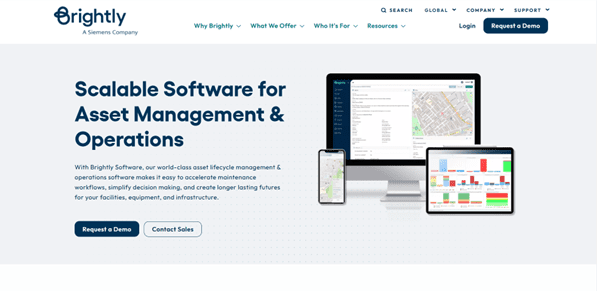
Now part of Siemens, Brightly owns the facilities side of the energy equation. Its SaaS suite spans Energy Manager and Stream, giving property and energy managers a single pane of glass. The kicker is out-of-the-box ESG frameworks that map utilities data to LEED, ENERGY STAR, and GRESB in clicks, not months.
Take Davis School District. Facilities ballooned 40% in floor area, yet Brightly’s anomaly-detection workflows shaved 17% off energy use. The platform also auto-audits bills. Duplicate line items, wrong tariff codes, and incorrect meter multipliers surface before finance signs payment, a feature customers say pays for licenses many times over.
Under the hood, Brightly uses event-driven architectures on Azure, leveraging Stream Analytics and Cosmos DB for near-real-time reporting. A RESTful API layer means enterprises can push data into Tableau or custom Net-Zero dashboards. Siemens consultants complement the tech by guiding building-retrofit planning – a blend few purely digital shops can match.
XB Software
Source: XB Software
XB Software shines when deadlines loom. Their proprietary Webix and DHTMLX libraries shorten UI builds, but the magic is under the hood: Node.js microservices orchestrated with Kubernetes and pipeline templates that generate Terraform maps on day one. That repeatability slashes project bootstrapping to days.
A North American utility hired XB to merge a homegrown OMS with a vendor SCADA. The catch: regulatory filings are due in three months. XB’s senior architects divided requirements into “compliance-critical” and “nice-to-have,” letting crews parallelize. They delivered phase 1 in ten weeks, earning praise from auditors who flagged zero cybersecurity gaps.
The company’s culture stems from its COO, a PhD who teaches project-management seminars. Status meetings are time-boxed, post-mortems are blameless, and every sprint ends with a recorded demo. Clients appreciate the discipline, especially at scale.
SysGears

Source: SysGears
SysGears started in fintech but pivoted hard into energy once it saw parallels between high-volume trading data and grid telemetry. Today, 60% of revenue comes from utilities. Their Scala expertise feeds data lakes big enough to store ten-year SCADA archives while delivering 200-millisecond query speeds.
One oil & gas customer used SysGears to build an asset-tracking portal. Each drilling rig streams up to 4,000 tags a second. SysGears batched events via Akka Streams and wrote predictive failure models in Spark MLlib. In the first six months, early-fault detection prevented five blowouts, saving roughly $4 million in unplanned downtime.
Their procurement platform automates RFP generation and supplier scoring, overlaying wholesale-price indexes to surface optimal buy windows. A municipal utility using the tool reduced average cost per megawatt-hour by 7% in its first procurement cycle.
Exoft

Source: Exoft
Exoft’s Ukrainian engineers excel at turning chaotic manual processes into clean web dashboards. ELEKS and the Nomura Research Institute (NRI) worked together on a project to research and plan energy efficiency in smart cities. They looked into how to use CityGML, a geospatial data standard for cities, to model sustainable urban areas and ran detailed urban energy simulations to find places where photovoltaic optimization and microgrid installations could be made.
In EV charging, Exoft built a white-label app stack – React Native mobile app, Laravel backend, and Stripe payments – deployable in six weeks. Utilities appreciate the bundle because they can swap logos without breaking code. Clients stick around for continuous updates: Plug-and-charge support, ISO 15118 PKI integration, and dynamic price surcharges during peaks.
Albiorix

Source: Albiorix
Albiorix melds strong UI chops with data-science rigor. Their machine-learning team built a model predicting meter tampering by analyzing high-frequency consumption and geospatial anomalies. It was piloted by a South Asian distribution company, which was able to reduce non-technical losses by 14%.
Albiorix’s carbon management platform uses Scope 1, 2, and 3 data, and then it suggests abatement actions based on the input. The tool calculates marginal abatement cost curves, which link interventions with ROI, which is every CFO’s favorite thing. Architectural patterns are based on serverless AWS Lambda functions, thereby reducing idle costs – that value proposition is put forward by smaller co-ops for when budgets are tight.
ELEKS

Source: ELEKS
With 2,100+ staff, ELEKS is shadowed by heavyweights, but it retains an R&D culture. Their DAKAR power-flow solver, currently in its fifth generation, is capable of handling 500 000 bus models over several interconnected countries. Grid operators such as Ukrenergo rely on DAKAR simulation for pre-planned outage windows for N-1 security under increasing renewable penetration.
Apart from the legacy strength, ELEKS is testing the ground with drone-based line inspections. Cracked insulator cracks are tagged using high-resolution imagery flowing through a computer-vision pipeline. Early trials reduced the number of cycles in inspection from 60 days down to 12 and increased the rate of detection. ELEKS pairs data with SAP integration, which automatically generates the work order detection rates. ELEKS pairs that data with SAP integration, automatically generating work orders.
Innowise Group

Source: Innowise
Innowise leans into city-wide digitalization. Its wind-farm tool has led to improvements like higher energy production (up to 6%) and lower maintenance costs (18%). ML models predict blade-icing risk four hours out, letting crews apply de-icing fluid proactively. Customer downtime dropped 8%.
Blockchain pilots demonstrate asset origin tracking. Innowise built a Hyperledger-based registry for a geothermal consortium. Investors view tokenized performance data, locking in trust. The group also delivers smart streetlight systems: LoRaWAN mesh networks feed dashboards that highlight lamp failures and track ROI on LED retrofits.
Enverus

Source: Everus
Think of Enverus as the Bloomberg Terminal for energy. Its PRISM platform ingests land deeds, production data, and weather, then layers AI to surface insights in plain language. When ERCOT faced capacity crunches, major generators consulted PRISM’s sub-hourly forecasts to adjust maintenance schedules, averting price spikes.
Enverus AI, launched in December 2025, offers chat-style querying. A power trader might ask, “Which PJM zones showed the steepest load drop during yesterday’s storm?” The engine parses the request, hits structured data, and replies with charts plus contextual commentary. Behind the scenes, RAG (retrieval-augmented generation) keeps hallucinations at bay.
EPAM Systems

Source: EPAM
EPAM’s 62,000+ workforce means scale. Their energy vertical combines design studios with DevOps centers, offering a soup-to-nuts transformation. EPAM helped a European refiner deploy digital twins for distillation columns. By using AWS to mimic thermodynamic states, the refinery changed the mix of feedstocks and raised the yield by 3%, which is worth tens of millions of dollars.
Together, EPAM and Baker Hughes made an AI pipeline that brings together data from sensors deep down. Field engineers now get alerts about problems 40 minutes before they get too bad, which saves time that isn’t useful. In the meantime, EPAM’s InfoNgen text-analytics platform collects regulatory filings and marks rule changes so that compliance teams can stay ahead of the game.
Comparing Energy Software Development Capabilities
When energy executives shop, they don’t just look at price; they also think about domain knowledge, security maturity, time-to-value, and future-proof architecture. After dozens of stakeholder interviews, four comparison themes emerged.
- Data Engineering Depth. Enverus dominates raw data ingestion at the petabyte scale, while SysGears turns big-data theory into sub-second query speeds. Techstack’s AWS-native pipelines shine for renewable portfolios that change every quarter.
- Industry Focus. Brightly concentrates on built-environment efficiency; Exoft thrives on smart-city deployments; and EPAM and ELEKS bring the heft required for multi-country utilities. That specialization matters when edge cases become daily realities.
- AI Readiness. Enverus AI is already in commercial use, but Techstack and Albiorix field smaller, highly tuned models that live on inverters or meters. The choice is less about buzzwords and more about where intelligence must sit – cloud or edge.
- Compliance & Trust. ELEKS and EPAM carry the broadest set of certifications, yet SysGears and XB Software balance the scales with meticulous documentation that auditors praise.
A utility modernizing SCADA might value cyber-resilience first, while a solar developer racing interconnection deadlines may lean toward vendors who prototype in weeks. Context, not absolutes, decides the winner among the top energy software development companies.
Here is a quick comparative view executives often request:
Techstack – Custom EMS, grid bid automation, ML-first culture.
Brightly – Facilities focus, ESG frameworks, Siemens backing.
XB Software – Rapid UI, strong project-management discipline.
SysGears – Big-data pipelines, predictive maintenance.
Exoft – IoT integrations, fast MVPs, smart-city niche.
Albiorix – Carbon analytics, user-centric design.
ELEKS – SCADA and power-flow R&D, drone analytics.
Innowise – Blockchain traceability, smart-lighting IoT.
Enverus – Data behemoth, generative AI insights.
EPAM – Global scale, digital twins, end-to-end consulting.
Key Energy Tech Trends Defining 2026
Several emergent technologies now appear on nearly every RFP. Understanding them helps you vet claims made by the best energy software development providers.
Trend 1: Generative AI for Domain Experts
Unlike generic chatbots, vertical models take in equipment manuals, outage logs, and regulatory codes. The result of this is that they return precise answers linked to source – another game changer for control-room operators.
Trend 2: Edge-Native Analytics
Latency matters. By shipping ML models to inverters or RTUs instead, companies have fewer round-trips to their cloud. Firmware now supports Python or WSA snippets, allowing outlier detections to be done on the device.
Trend 3: Granular Hourly Certificates
EnergyTag’s standard for hourly renewable credits moves into mainstream procurement, letting buyers prove 24/7 clean power claims. Software must therefore time-stamp generation with accuracy down to 15-minute intervals or less.
Trend 4: Open Demand Response
Interoperability across thermostats, EVs, and industrial loads is created using protocols such as OpenADR 3.0. Vendors putting these hooks in the door allow new revenue streams for asset owners.
Trend 5: Cyber-Resilient Architectures
The NREL flags cyber events targeting DER controllers as a top risk. Micro-segmented networks, tracking of the SBOM, and runtime behavior analytics are procurement ticking boxes.
How to Select the Right Software Partner for Energy Solutions
Step one: articulate business goals in dollar, uptime, or carbon terms.
Step two: translate goals into capabilities – artificial intelligence-based forecasting, integration of grid codes, or digital twin simulation.
Step three: interrogate each bidder’s reference architecture. Ask who handles IAM, what IaC they use, and how they log PLC commands for audit.
Here is a practical checklist executives shared with us:
- Demo Depth. Request a live walkthrough of a similar solution, not a sanitized slide deck.
- Team Continuity. Name your core engineers and guarantee availability.
- Compliance Mapping. Provide a matrix of regulatory obligations and how the software enforces each.
- Integration Roadmap. Detail how legacy SCADA, SAP, and GIS will talk to the new stack.
- Ownership Model. Clarify IP rights and source-code escrow to avoid vendor lock-in.
Don’t just check things off the list; use it as a conversation starter. Energy systems last longer than changes in the market and corporate reorganizations. When risks come up, take extra time to think about how well you fit in with the culture, how often you communicate, how willing you are to question assumptions, and how open you are. The top energy software development leaders on our shortlist earned their reputations by telling clients what they need to hear, not what they hope to hear. That honesty, more than any feature set, is what keeps projects on budget and assets online.
Why Techstack Fits Complex Energy Software Projects
Our discipline often de-risks high-stakes rollouts. During a Nordic balancing project, Techstack created a digital twin of market rules inside a test harness. Every time Fingrid updated API specs, the harness reran all bid-formation scenarios, catching mismatches before production. That proactive stance avoided imbalance penalties that can run €50,000 per incident.
Our firm straddles custom flexibility and enterprise governance, making it one of the best energy software development companies for CTOs afraid of scope creep. Techstack’s architects prewrite backlog epics linked to business KPIs, aligning sprint burndown with CFO scorecards. Many vendors promise “partnership”; Techstack operationalizes it.
Digital Solutions Powering Energy Management Systems
Modern EMS platforms share four pillars: unified data ingestion, AI-driven forecasting, automated market interaction, and cyber-resilient deployment. Let’s see how these components manifest.
First, data ingestion. Connectors get telemetry from OPC UA servers, RESTful APIs, and CSV buckets. Tags are turned into a standard schema by middleware.
Second, analytics engines. Forecast modules combine LSTM neural nets with rules-based overrides, producing short-term load projections.
Third, market gateways. REST adapters push bids to ISO portals – PJM, CAISO, Nord Pool – then ingest clearing prices for revenue reconciliation.
Fourth, security. Zero-trust design, tokenized APIs, and real-time anomaly scoring shut down lateral movement.
Firms such as Techstack, SysGears, and XB Software are now packaging reference architectures, so the utilities can spin up EMS cores in weeks as opposed to quarters. The amount of flexibility allowed to turn modules, such as maintenance, trading, or carbon reporting, on and off keeps roadmaps future-proof.
Where Energy Digitalization Is Heading Next
Looking beyond 2026, we foresee the convergence of energy data with finance and mobility. Picture this: an EV plugged into a garage bidirectionally supplies the grid at 6 p.m. but earns fractional tokens representing carbon-free megawatt-hours. Those tokens settle on public ledgers for transparent ESG scorekeeping. Vendors such as ELEKS and Innowise already prototyped the tech.
Meanwhile, hydrogen projects crave blended digital twins integrating electrolyzer stacks, renewable supply curves, and pipeline logistics. EPAM’s process engineers-turned-coders spearhead such twins. Enverus’s data lake could overlay land rights and taxation, letting developers pick optimal sites.
Expect regulators to demand provenance of every kilowatt-hour, pushing top energy software development firms to bake cryptographic attestations into MES and EMS layers. The arms race will reward companies mastering both code and policy nuance.
Conclusion
2026 will reward executives who pick partners that not only code quickly but also understand market dynamics, compliance, and asset lifecycles. The ten vendors above represent the best energy software development providers proven to deliver measurable impact. Use the assessment framework, map it to your goals, and remember: the right partnership compounds value long after the first release ships.
FAQ
What does an energy software development company do?
It designs, builds, and maintains digital systems such as EMS, SCADA extensions, analytics dashboards, or trading platforms that help utilities and renewable operators run assets safely, efficiently, and in compliance with regulations.
What types of energy software solutions are most common?
Energy management systems, predictive maintenance tools, utility billing platforms, grid analytics, EV charging apps, carbon-tracking dashboards, and digital twins rank high on 2026 roadmaps.
How much does energy software development cost?
Budgets vary from $150,000 for a focused pilot to multi-million-dollar, multi-year programs. Variables include system complexity, integration depth, security requirements, and whether you choose niche specialists or large top energy software development firms.
Which industries use energy software development services?
Power generation, transmission, and distribution utilities; renewable IPPs; oil & gas majors; commercial real estate; smart-city authorities; and emerging hydrogen and storage operators all rely on top energy software development leaders to modernize operations.