
UK business group warns against blocking North Sea fields as government weighs multi-billion-pound LNG import expansion
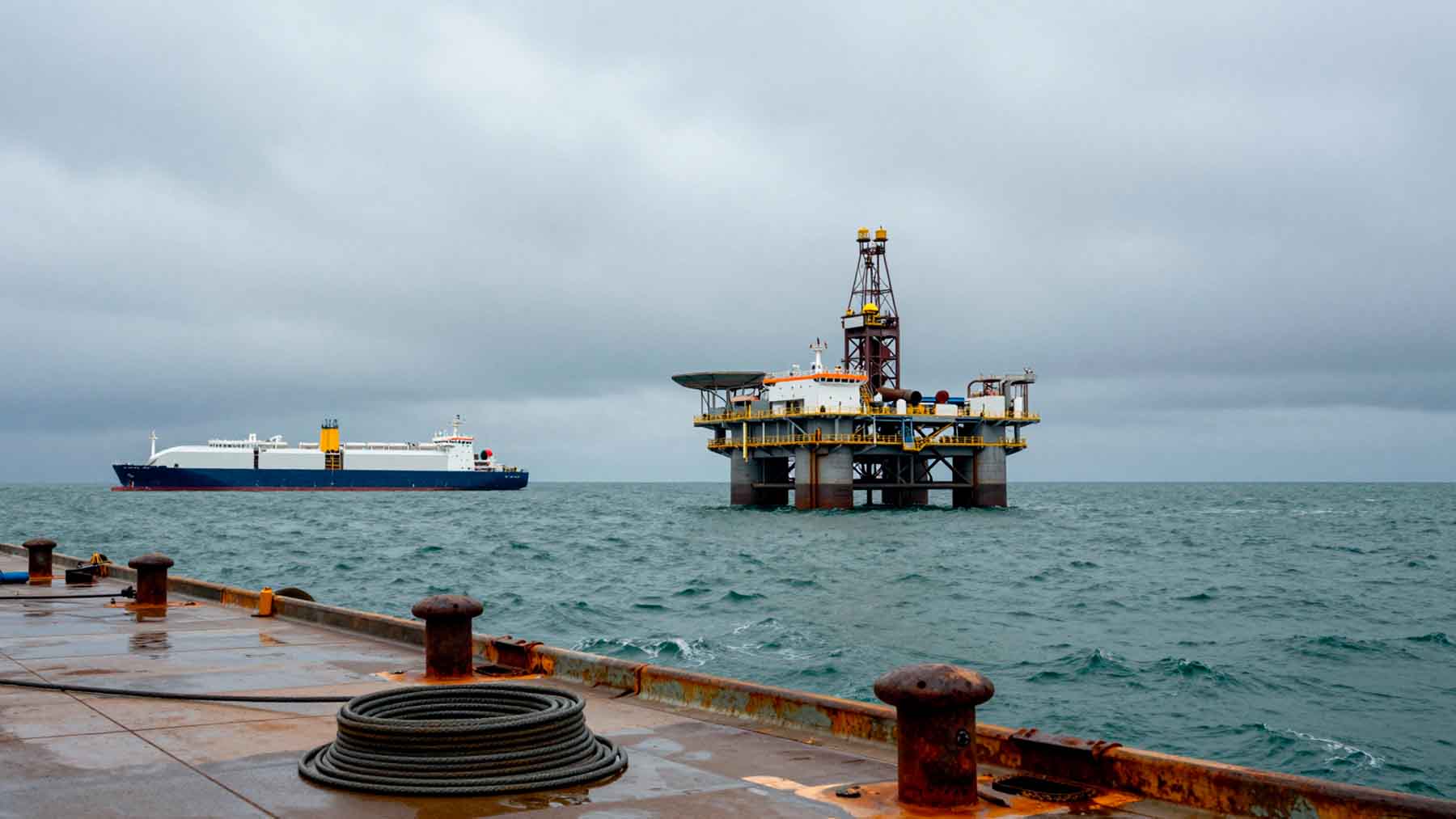 Image generated with artificial intelligence
A leading Scottish business group warned this week that it would “defy belief” for the UK government to block new North Sea gas fields while simultaneously preparing to spend billions expanding Britain’s capacity to import liquefied natural gas from overseas. The warning came from Aberdeen & Grampian Chamber of Commerce, whose Chief Executive Russell Borthwick said a government paper on LNG import infrastructure had exposed the “hypocrisy” of current North Sea policy—targeting fields like Jackdaw and Rosebank while planning to wave in higher-carbon tankers to fill the gap.
AGCC issues warning over North Sea policy and LNG import plans
Aberdeen & Grampian Chamber of Commerce went public with its criticism after The Sunday Times reported that ministers are actively considering stepping in to support new LNG import infrastructure. The trigger was a Department for Energy Security and Net Zero (DESNZ) paper that, according to AGCC, basically admits the government’s own policy is creating the supply gap it now wants to fill with expensive imports.
Russell Borthwick didn’t hold back. “The government admits we will need gas for decades to come, warns explicitly that the North Sea decline threatens our energy security, and is now considering unprecedented intervention to support additional LNG import capacity, potentially costing billions,” he said. That’s a damning sequence of admissions to find in a single government document.
What’s clear is that the gap between UK production and consumption is real, growing, and—by the DESNZ’s own analysis—a genuine threat to energy security.
The DESNZ paper itself—described by AGCC as “essential reading”—frames the whole thing as an energy security issue. That framing sits awkwardly alongside a policy environment that’s made domestic production progressively harder to pursue. Restrict domestic supply, and you get imports. If those imports cost more, emit more, and support fewer jobs, defending the status quo becomes nearly impossible.
Government policy cited as driver of North Sea decline
AGCC’s critique centers on two specific decisions: the ban on new North Sea exploration licenses and the Energy Profits Levy, which pushes the headline tax rate on North Sea oil and gas production to 78%. Together, AGCC argues, these measures have accelerated a decline that’s policy-driven rather than geological.
The numbers back that up. The UK currently produces only around half the gas it consumes, with the rest coming from imports—taxed at 0% and subject to none of the regulatory requirements applied to domestic producers.
Steve Gray, founder of venture studio Ventex, put it plainly: “As things stand in the UK, oil and gas production is taxed at 78%, new drilling licenses are banned and all activity subjected to the highest of regulatory standards. Unsurprisingly, this is driving down our domestic production.” That gap between domestic output and consumption isn’t shrinking. Without policy changes, it’s expected to widen—which is exactly why the government is now looking at LNG import infrastructure in the first place.
Emissions and economic disparities between domestic production and LNG imports
One of the sharpest points in AGCC’s argument is about emissions. Data from the North Sea Transition Authority shows that imported LNG carries pre-combustion emissions of around 187 lbCO2e (187 pounds of CO2 equivalent) per barrel of oil equivalent, while UK-produced gas comes in at roughly 62 lbCO2e (62 pounds of CO2 equivalent)—about a third of the import figure.
That gap matters. Both AGCC and Ventex’s Gray argue that consumption—not where production happens—is what drives carbon emissions. If the UK is going to use the gas regardless, producing it domestically means lower associated emissions, full stop.
The economic case is equally stark. Borthwick cited figures showing that every million barrels produced at home supports 90 times more jobs than importing the equivalent volume. Domestic production also generates 150 times more employment taxes and over 400 times more industry taxes than imports do. Replacing domestic output with imports doesn’t shrink Britain’s carbon footprint in any meaningful way—it just shifts the emissions, and the economic benefits, somewhere else entirely.
Jackdaw, Rosebank, and the government’s response
The Aberdeen & Grampian Chamber of Commerce specifically called for the consent of two fields: Jackdaw and Rosebank. Together, according to Borthwick, they could supply around 10% of the UK’s future gas needs. Both remain unapproved, caught in the broader uncertainty around North Sea licensing policy.
Gray echoed the argument directly. “To increase imports of higher-emitting LNG before utilizing the resources of Rosebank, Jackdaw and other North Sea fields makes no sense, either economically or environmentally,” he said.
The government’s response, from a DESNZ spokesperson, described the North Sea as “a vital national asset” and said the government is “delivering a gas system that is fit for the future.” The statement referenced energy security, value for money, and investment certainty. What it didn’t do was address the tension between restricting domestic production and planning to expand LNG import capacity—a contradiction sitting right at the center of the debate.
That silence is telling. The government’s own paper acknowledges the security risks of declining North Sea output, yet nothing in the official response reconciles that acknowledgment with the licensing ban or the 78% tax rate.
Less economic activity at home
The core issue is a policy contradiction: the UK government has restricted domestic gas production through licensing bans and a punishing tax regime, while now reportedly considering billions in spending to import gas that’s more carbon-intensive and generates far less economic activity at home.
AGCC’s position is that Jackdaw and Rosebank should be consented and the Energy Profits Levy scrapped, with domestic production prioritized over imports. The government hasn’t signaled movement on any of those fronts. What’s clear is that the gap between UK production and consumption is real, growing, and—by the DESNZ’s own analysis—a genuine threat to energy security. How ministers choose to fill that gap will shape UK energy policy for years to come.
Kelly is an experienced writer with 15 years of experience exploring the big stories that shape our world, from tech breakthroughs and space exploration to climate, energy, and the fascinating quirks of science. She has a talent for turning complex ideas into sharp, memorable insights that stay with readers long after they’ve finished reading.
