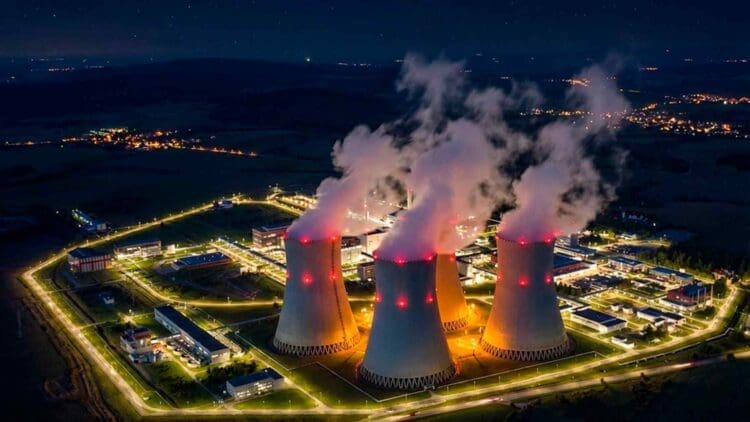
The United States concedes the victory to China when it comes to the overall capacity of other energy sources, such as hydrogen, solar, and wind. However, when it comes to nuclear, the nation is reluctant to relinquish the sizable advantage that it has over the rest of the world. A perfect representation of this is seen through Westinghouse, Brookfield, and Cameco, which have all combined to back an $80 billion U.S. nuclear buildout plan in coordination with federal authorities.
Understanding the strategy behind the partnership of Westinghouse, Brookfield, and Cameco
It is always interesting when three powerhouse companies decide to unite with the common objective of executing an energy project. The initiative, pursued by these three entities, was announced in late October 2025, showing that the U.S was eager to get off to a flying start in 2026.
The primary theme behind their collaboration was to accelerate the deployment of nuclear infrastructure and increase domestic power capacity. Some people might question why now is the appropriate time for such an initiative.


The U.S energy landscape is going through a period where there is a continued rise in the demand for reliable and low-carbon electricity. The biggest nuclear-producing nation can afford to take significant risks with the intention of giving the people what they want.
Out of all the nuclear projects that have been made public in 2026, this one will be one of the most observed and studied, as it has the ability to transform how companies produce nuclear energy in the future completely.
Analyzing how an $80 billion investment is expected to assist the U.S in achieving national goals
One of the most interesting aspects about this particular collaboration is that it is being done in coordination with federal authorities. This is essential because it shows that it is not just private companies that are seeking to generate clean energy, but the U.S. government is also playing its part to ensure that fossil fuel reliance is significantly reduced.
The federal government will assist in sorting out the financing, speed permitting, and regulatory approvals. Additionally, it will support the construction of new reactors using Westinghouse technology.
The Trump administration approves the construction of nuclear reactors
Much has been made of the Trump administration’s decision to suspend wind energy initiatives because the president dislikes them. However, there has not been much of a spotlight on the priority that the president and his team have placed on nuclear energy initiatives.
This particular partnership came about as a result of actions from President Trump’s administration, which is determined to expand advanced nuclear energy. The highest level of resources will be dedicated to making this objective a reality. For instance, Westinghouse’s AP1000 pressurized water reactor design will facilitate the initial projects.
The economic and industrial impacts of Cameco, Brookfield, and Westinghouse’s partnership
Since none of the facilities have materialized, it is necessary to take the upcoming reports with a grain of salt. Various outlets speculate that the buildout could create more than 100,000 construction jobs in the U.S. Each two-unit Westinghouse AP1000 project is projected to create approximately 45,000 jobs in engineering and manufacturing.
In terms of where the initiative is set to progress from here, when the government finalizes investment decisions and completes the construction contracts, it will receive an equity stake. This means it will now be eligible to gain 20% of cash distributions by Westinghouse above a certain limit.
With such a significant collaboration between three powerhouses of the U.S nuclear energy landscape, the future of America’s nuclear initiatives is in very safe hands. This is not to mention the number of groundbreaking projects that have already come out this year. At this rate, the United States will continue to dominate the nuclear energy landscape convincingly.