
Wind energy is growing fast, but experts now target at new farm designs to protect birds and bats flying near the turbines
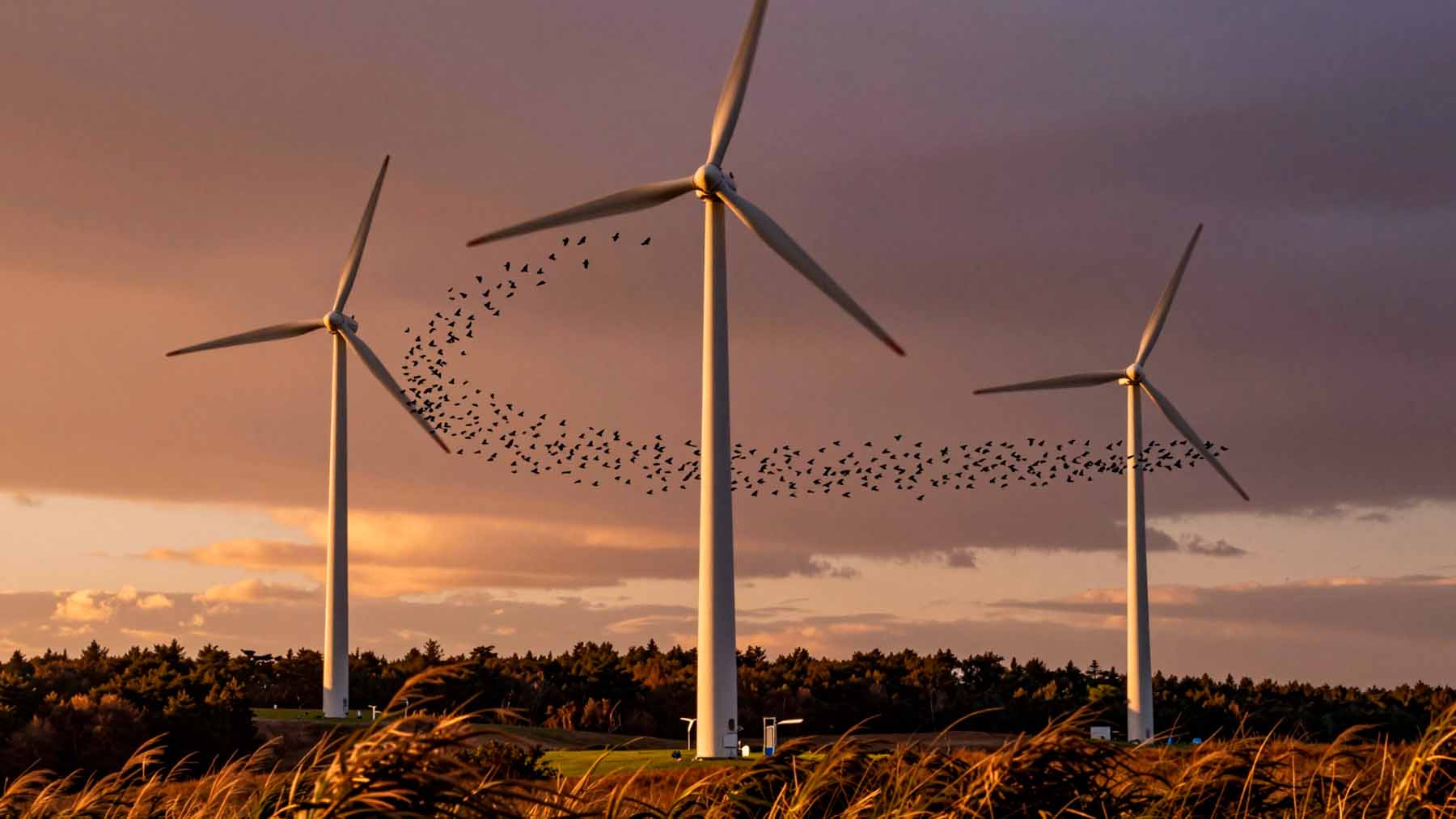 Image generated with artificial intelligence
Wind energy is one of the cleaner success stories of the past two decades — capacity has grown steadily, costs have dropped, and turbines now dot landscapes from Texas to Tasmania. But alongside that growth, a quieter problem has persisted: birds and bats continue to die in collisions with spinning blades, and the industry has never fully solved it.
A major new review has now examined every tool the wind sector currently uses to address those deaths. Its findings challenge assumptions that have shaped wildlife protection policy for years.
A problem that has grown alongside wind energy itself
Wind energy’s rapid expansion has brought turbines to an increasingly wide range of landscapes — coastal plains, forested ridges, open farmland. Birds and bats share airspace with spinning blades, and collisions have been a persistent feature of the industry since its early days. The problem hasn’t disappeared as technology improved. More turbines across more terrain simply means more exposure for more species, and the cumulative pressure on local wildlife keeps building with each new installation.
A strategy that reduces collisions on a coastal plain may offer little protection on a forested ridge where different species fly at different heights and times.
That scale makes the search for solutions genuinely urgent. Regulators setting environmental approval conditions and operators designing new farms both need reliable guidance — without it, wildlife protection risks becoming a box-ticking exercise rather than a meaningful safeguard.
What the review actually examined
Elena Kuzovnikova and Trish Fleming, researchers at Murdoch University’s Harry Butler Institute, led what they describe as the first comprehensive assessment of collision mitigation methods available to the wind industry. The team drew on expertise across engineering, technology, and ecology — a deliberately broad foundation for a problem that doesn’t fit neatly into any single discipline.
Their scope was wide. The review evaluated 52 separate mitigation strategies and tools, covering radar and acoustic sensors, physical deterrents, and operational adjustments. The breadth alone is telling: the industry has generated a large and varied toolkit. But quantity isn’t the same as quality. Fewer than half of those 52 approaches had undergone any independent testing, leaving decision-makers working largely on faith for most available options.
Every tool has a blind spot
The review’s central finding is direct: no single technology works well enough on its own. Radar systems, cameras, acoustic sensors, curtailment, and physical deterrents each have documented strengths — but each also carries clear limitations that prevent it from functioning as a standalone fix.
Turbine curtailment — temporarily slowing or stopping blades during high-risk periods — stands out as one of the few approaches with solid evidence behind it, particularly for reducing bat deaths. Even so, the review positions curtailment as most effective when it forms part of a broader, layered strategy. Detection systems present a different kind of limitation: a system calibrated to identify one species in one terrain type may fail entirely with a different species elsewhere. That inconsistency is a fundamental constraint, and the evidence base across the full toolkit remains deeply uneven.
Why location changes everything
Perhaps the most important insight from the review is how dramatically location shapes what works. Terrain, local species composition, and site-specific conditions all influence whether a given tool performs as expected. A strategy that reduces collisions on a coastal plain may offer little protection on a forested ridge where different species fly at different heights and times.
This variability is precisely why the researchers reject any universal solution. “What we have found is that wind farms need combined, site-specific strategies to be truly effective,” Fleming said. Australia presents a particular challenge — the country still lacks sufficient data to determine which strategies suit its unique landscapes and native wildlife. Off-the-shelf technology packages applied uniformly across different sites are unlikely to deliver consistent results.
What this means for policy and industry practice
The review’s findings carry direct implications for how governments and operators design wildlife management plans. By mapping which tools are evidence-backed and which remain largely unproven, the study gives planners a clearer foundation for site-specific decision-making — and a sharper picture of where further research is needed most.
Professor Lazaro Roque-Albelo, Chair of Responsible Mining and Biodiversity Stewardship at the Harry Butler Institute, framed the project as a model for researcher-industry collaboration. “Industry-supported research can generate the scientific evidence needed to inform policy, legislation, guidance materials and ultimately, better environmental outcomes,” he said. The study is published in Renewable and Sustainable Energy Reviews, positioning it as a credible reference for regulatory and compliance contexts.
Wind energy will keep expanding. The pressure to get wildlife protection right grows with it, and the key question now is whether this evidence-based framework actually translates into updated approval requirements — and whether the industry commits to testing the many tools that still lack independent validation.
The complete study can be found here: Kuzovnikova, E., Whale, J., Shephard, J. M., & Fleming, P. A. (2026). Mitigating wildlife collisions with wind turbines: A review of techniques, evidence, knowledge gaps and avenues for future research. Renewable and Sustainable Energy Reviews, 242, 117333.

Carlos is an engineer with strong expertise in technical and industrial topics. He previously worked at international companies such as Siemens and is multilingual.
