
Thousands of years before modern technology existed, ancient civilizations were already finding smart ways to use nature to their advantage. The ancient Egyptians, in particular, learned how to work with the wind long before wind turbines or electricity were ever imagined. Today, that same ancient idea is inspiring a new wind energy design off the coast of France — one that looks to the past to solve modern energy challenges.
Egypt harnessed wind power 7,000 years ago
Ancient Egyptians were certainly ahead of their time, as they were the founders of significantly complex cultures and tools nearly 7,000 years ago, all of which served as the groundwork for their monumental structures, such as the famous pyramids. However, they were also one of the first civilizations to use wind power for functional purposes, specifically transport.
According to the U.S. Energy Information Administration (EIA), approximately 5,000 BC, Egyptians used wind energy to set their sailboats in motion, which had a strategic impact on their economy thanks to the ability of transporting goods. Around 1,300 BC, wind power was also used in architecture to enable natural cooling and ventilation in buildings.
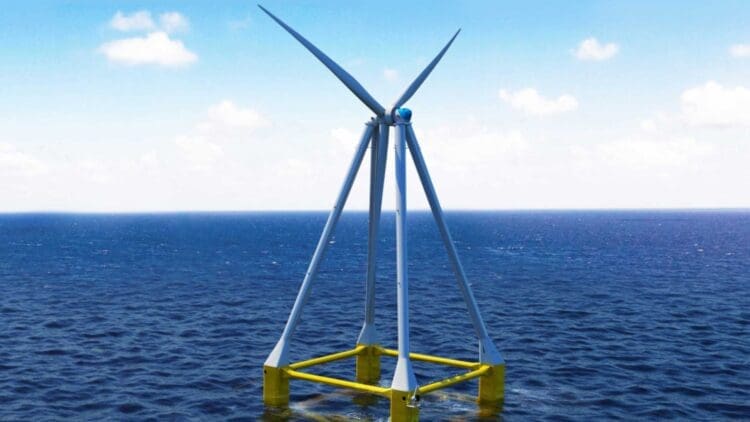
Now, France has drawn inspiration from the ancient Egyptians, more specifically, the famous pyramids, to create a 65-foot prototype over the ocean, reimagining the way we harness wind energy.
France draws on the pyramids
In modern times, we have seen several pioneering renewable energy technology concepts come alive, both on land and sea. However, a French company called Eolink has reimagined the way mankind harnesses wind power over the ocean, as its prototype addresses the structural challenges traditional offshore turbines usually face.
According to Eolink’s website, while offshore designs are purposely created to survive marine environmental stressors in the long term, the base of the floating turbine usually faces the most mechanical stress. Considering how great the impact of wind and waves’ force can be, and the significant amount that the base structure must support, it makes sense.
That is why Eolink has created a 65-foot prototype shaped like a pyramid to float over the ocean. Compared to China’s offshore wind turbine, the size of a 67-story New York skyscraper, this one is significantly smaller, but its impact is substantial.
65-foot prototype over the ocean
Creating a prototype shaped like a pyramid is so simple, yet so ingenious. Eolink’s pyramid design allows the forces of both wind and waves to be distributed evenly and efficiently over four columns/masts. This prevents the floating turbine’s base from tilting. In addition, the entire prototype’s mass has been reduced by 45% compared to traditional offshore turbines.
As the Eolink team explained:
“When an object at sea undergoes repeated little forces, such as those waves, the structure is gradually damaged. This fatigue phenomenon is modeled during design. Eolink’s structure does not present any highly constrained areas thanks to the distribution of forces between the 4 masts, unlike the mast foot of conventional architectures.”
Another benefit of Eolink’s prototype is its higher wind power harnessing efficiency, thanks to the incorporation of longer, yet lightweight and durable blades into the design. The prototype reportedly boasts a 10% higher wind power harnessing efficiency.
Since the launch of the company’s first design concepts, a 5 MW prototype was commissioned in Spring 2025. This prototype will form part of the “France-Atlantique Project,” with the primary goal of testing its feasibility as a cost-effective offshore option for large-scale wind power production. According to Fondation OPEN-C, once it has been connected to the grid, it will power nearly 6,500 homes. Another pioneering offshore wind turbine project includes the Polish 1.2 GW Baltic Power farm, which will be a first for Poland.