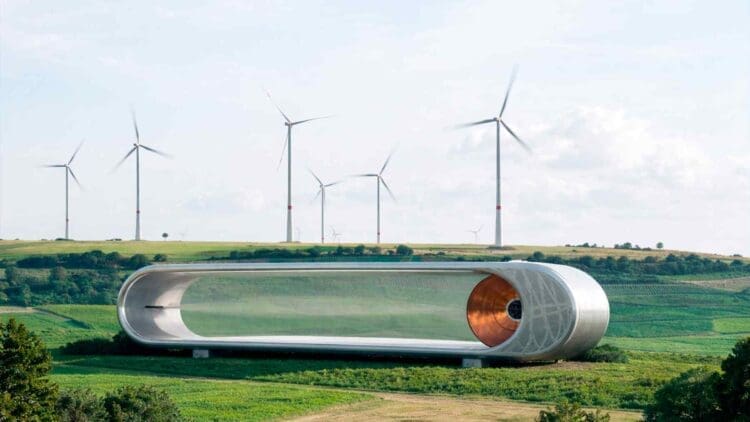
Some designs never go out of fashion, even making comebacks, and no, we are not talking about actual fashion.
We are talking about renewable energy designs, focusing on the wind industry’s truly unique and remarkable wind power designs.
Such designs include everything from a wind shaker to a true “Windbelt.”



Both essentially use the vibrations of airflow energy to produce power, but only one could reshape the wind energy industry.
How wind power is getting a fashion do-over
Some fashions are completely new and bold, while others are improved, modern versions of older styles. Sometimes, fashion do-overs are necessary to align and redefine looks with current lifestyles.
With that being said, wind power is undergoing a significant fashion do-over, and has been for a few years.
Current lifestyles have become more focused on intentional, conscious living, and more technologies are now aligning with it.
Wind power technologies are becoming smaller, more aesthetically pleasing, affordable, and quieter. However, creating designs that meet these beneficial characteristics requires true innovation.
The funny thing is, you never know when inspiration for innovation will strike.
For Shawn Frayne, inspiration struck in 2004 during a visit to one of Haiti’s villages. This particular village was not connected to the grid and still relied on kerosene lamps.
A lightbulb went on, and Frayne knew that combining LEDs with affordable small-scale wind energy was the answer.
Good vibrations replace bad traditional ones
If you have never been to Haiti, you should add it to your travel bucket list. Imagine rugged, panoramic views, crystal-clear turquoise waters, and long pristine white-sand beaches.
It is no wonder that Frayne opted to stray away from the gigantic towering wind turbine designs. Regardless of which nation you consider, the disadvantages of conventional wind power remain relatively the same.
As of late, the latest style trend in wind-based energy technologies involves fewer blades or none at all. Some designs do not even use turbines.
Bladeless wind turbine designs address the disadvantages faced by conventional designs. However, the modern versions are mainly large-scale.
Frayne’s prototype was scaled down to 2 feet and oriented horizontally rather than vertically. This prototype does not rotate at all; instead, it vibrates to generate clean power.
The concept is simpler than you’d think, and some have even recreated it at home.
The true “Windbelt”: How clean power is created from shaking in the wind
Frayne’s wind harvesting prototype is called the Windbelt. He used a flexible polymer ribbon, connected it laterally, and added magnets.
The Windbelt uses vortex shedding to generate electricity. This is possible as airflow causes the ribbon vibrate, shaking the magnets and inducing a current in the coils.
Vortex shedding to produce renewable energy is not a new concept. However, Frayne’s design was one of the first to demonstrate it.
This design is highly cost-effective and can power LEDs, clocks, and radios – albeit separately.
An Instructables member who goes by the name “Tool Using Animal” is known for practical DIY projects. Among these projects, he replicated the Windbelt twice.
The second version for home use is placed by windows and generates an alternating current up to 1.5 V. Tool Using Animal added that hand-winding the coil or stacking coils could increase the voltage.
Small-scale wind power without the actual blades is truly a marvel.
Yet, the highest tree gets the most wind. Windbelts have faced criticism for their low energy output and extremely low efficiency.
Nonetheless, the number of application options is attractive. Further enhancing the tech could give conventional wind technology a run for its money.
Wind power solutions with completely new designs may as well be the best thing since sliced bread.