
A town under 20 miles from Port Harcourt lives beneath gas flaring that runs 15 times heavier than it did four years earlier, and the field above it changed hands in a sale the seller booked as an emissions cut
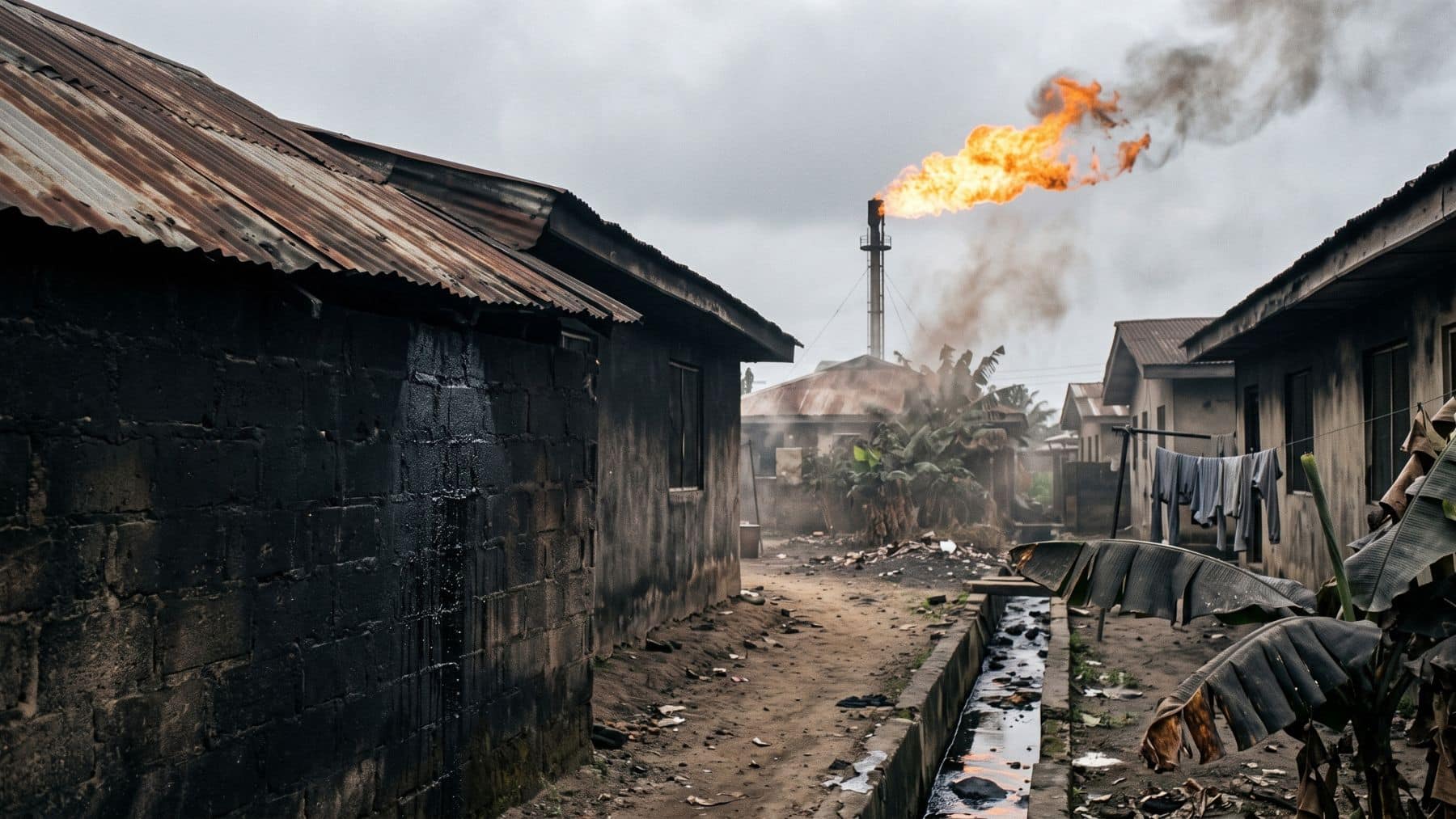
In Oyigbo the air stops people at their own front doors.
A sulfurous wall rolls off the nearby oil facility before the town is fully awake.
The exterior walls of homes and shops here have gone matte black from years of settled particulate.
Flare volumes move with production rates, with equipment outages and with how much gas a given well makes, and a rise does not by itself prove a decision was taken.
The flame that does it is bigger than it used to be, and the company that owned it reported a lower number the year after.
How does the same flare get smaller on paper while it grows in the sky?
How a sale moves the smoke but not the fire
There is nothing mysterious in it, though it took satellites to make it visible.
A corporate emissions ledger only covers the assets a company owns or operates.
Sell a producing field and every flare on it leaves that ledger the day the paperwork clears. The flare does not move.
The second half is why the flare is there at all. Gas comes up with the oil whether anyone wants it or not.
Where no gathering pipeline exists, that gas has nowhere to go, and burning it off is cheaper in the short run than building the pipeline.
A buyer with thinner capital than the seller faces that arithmetic on day one and tends to reach the same conclusion.
So the physical situation stays put and the reported number improves, because the owner changed and not the field.
A town of darkened walls and corroded pipes
Oyigbo sits in Rivers State, under 20 miles from Port Harcourt, inside one of the most productive oil regions on earth.
Active flare stacks stand within a few hundred yards of houses.
Reporters visiting the town found crude seeping from a corroded underground line near a primary school and pooling on a path children walk daily.
Residents who used to collect rainwater during the wet season say soot has made that water unusable.
Daytime temperatures sit around 95 degrees before the flares are counted.
One resident described the effect in plain terms, saying that what you inhale changes your body and everything else along with it, and a local physician told reporters that soot exposure does to a person what smoking does and then more.
What the satellite record shows field by field
The numbers come from a nonprofit research group working with infrared data collected by the Earth Observation Group at a Colorado university, shared with a climate news outlet.
At the field beside Oyigbo, 15 times more gas was burned in 2024 than in 2020.
Across the whole lease that field sits in, gas flaring grew sevenfold over the same four years.
That lease was sold in early 2021 for 533 million dollars. Within one field on it, flaring doubled straight after the sale and doubled again the following year.
At another field on the same lease it ran nearly four times higher in the year after the handover.
The pattern is not confined to one deal. Flaring across the Ogoniland lease tripled between 2021 and 2024, and a creek field sold back in 2015 was still burning 54 percent more in 2024 than it had a decade before.
What the satellites cannot settle
Infrared brightness is not a signed confession.
Flare volumes move with production rates, with equipment outages and with how much gas a given well makes, and a rise does not by itself prove a decision was taken.
Ownership is also messier than a headline allows. On these leases the state oil company holds 55 percent and the operator only 30, with two European majors splitting the rest.
What did not break is the commercial thread. The largest sale of all closed in March 2025, moving 18 more leases for 2.4 billion dollars.
Since that completion the seller has kept trading the crude, roughly 11 million barrels through the Forcados and Bonny terminals, worth about 759 million dollars at last year’s average price.
Nigeria and eight other countries account for 83 percent of global flaring, and the wasted gas has a published price.
The satellite investigation lays the series out block by block.
Where the argument goes next
A human rights group put the objection bluntly, saying the seller was able to cut and run while communities kept the polluted land, the poisoned water and no justice.
Two of those communities filed a legal action in the United Kingdom in 2015. It is listed for hearing in March 2027.
The Nigerian regulator has acknowledged its own capacity limits on measuring and verifying methane, which is the gap every flare number in the country sits inside.
Buyers are not obliged to be worse. A local operator with gas customers next door has every reason to capture rather than burn, and new upstream gas developments show what that looks like when the offtake exists.
The condition is an offtake route, and building one costs money that a divestment does not automatically provide.
Until then the ledger and the sky disagree, and only one of them is visible from Oyigbo, as the trading record makes clear.
Hugo is an engineer with strong technical expertise. Multilingual from an early age, his writing combines technical clarity with a strong interest in science and energy.
