
Burning at $54 billion a year above 9 countries’ oil wells, a flame nobody owns has grown larger than all the gas Africa burns in a year, and the World Bank just put a price on stopping it
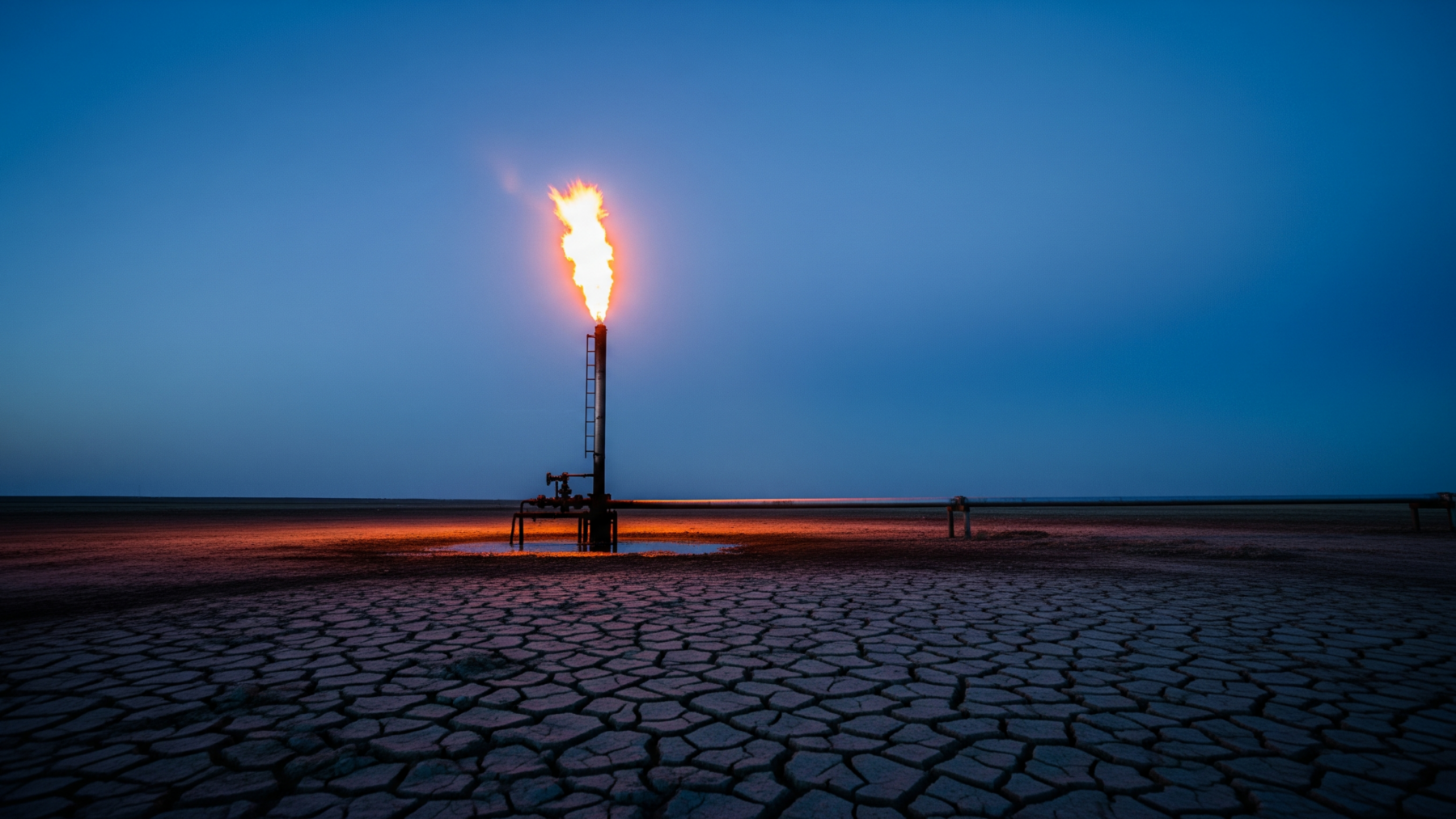
Every few seconds, somewhere above an oil field, a gas flame tears open the sky. It has no owner, no buyer, no destination. It simply burns, day and night, because the gas arrived with the oil and nobody built a pipe to catch it. Nine countries are responsible for most of it. And the number behind that flame, revealed this summer by the World Bank, is almost impossible to hold in the mind.
A fire that never made the news
Gas flaring is one of the oldest habits in the oil industry. When a well strikes oil, natural gas almost always comes up with it, dissolved in the crude and released under pressure at the surface. Operators who lack the infrastructure to capture that gas have, for a century and more, simply lit it.
Satellites track it continuously, measuring the infrared heat of tens of thousands of individual flares scattered across Russia’s west Siberian plain, Iraq’s southern fields, Venezuela’s Orinoco basin and the Permian Basin of Texas. The flame is visible from space and has been for decades. What makes 2025 different is the scale.
Flaring volumes in 2025 wasted an estimated $54 billion worth of natural gas that could otherwise support energy security, economic growth and lower emissions.
The World Bank Group’s annual Global Gas Flaring Tracker, released in June 2026, confirmed that global gas flaring reached 167 billion cubic meters in 2025, the highest recorded volume since 2019 and the third consecutive annual increase.
The arithmetic of waste
Flaring volumes in 2025 wasted an estimated $54 billion worth of natural gas that could otherwise support energy security, economic growth and lower emissions. That figure is not a modelled projection. It is the market value of gas set on fire above wellheads, in real time, across a full calendar year.
Fifty-four billion dollars is roughly the annual GDP of a mid-sized African nation, gone in flame and carbon dioxide. The report estimates that flaring generated 429 million tons of carbon dioxide equivalent emissions in 2025, including about 50 million tons from unburned methane, which warms the atmosphere far more powerfully than carbon dioxide over a 20-year horizon.
The real climate cost may be higher still, because satellite sensors cannot always confirm how much gas escapes unburned before ignition.
Nine countries, four fifths of the problem
Nine countries accounted for 83 percent of global gas flaring in 2025 while producing only 46 percent of the world’s oil. Russia, Iran, Iraq, Venezuela, Mexico, Libya, Algeria, Nigeria and the United States appear on the list year after year, and more than 60 percent of the global increase in 2025 came from just three: Russia, Mexico and Iran.
Together those three countries increased flaring by about 6 billion cubic meters, nearly three times the total reductions achieved by every country that cut its flaring that year. The United States, which appears largely because of Permian Basin associated gas, shows that flaring is not purely a problem of less regulated producers. Pipeline bottlenecks, low gas prices relative to oil prices and slow permitting all conspire against capture even in sophisticated regulatory markets.
The pipe is simply not there.
What that flame could light instead
Here is the reveal that changes the shape of this story. The 167 billion cubic meters flared in 2025 matches Africa’s entire annual gas consumption, a continent where energy poverty remains a genuine barrier to economic development. Every barrel of oil pulled from a top flaring country carries, attached to it, a portion of gas that could be lighting homes or powering factories in communities that currently have neither.
The World Bank put it plainly: the gas currently flared could be captured to power industries and businesses, create jobs, and strengthen energy security. Readers following crude trade or the infrastructure deals being signed across the Middle East will recognize the dissonance: billions in new capacity, yet no pipe for the gas already rising out of the ground.
The price of the fix, and a country that found it
The total investment required to eliminate routine flaring worldwide is estimated at between $70 billion and $100 billion, yet the gas being destroyed is worth more than half that figure every single year. The payback period on full elimination would be less than two years at current valuations, an arithmetic that has not yet unlocked the capital, largely because the gas belongs to nobody with an immediate financial incentive to capture it.
One country has shown the math works in practice. Kazakhstan reduced gas flaring by 87 percent since 2012, including an additional 16 percent reduction in 2025, by combining national targets, regulatory pressure and sustained investment in gathering infrastructure. That record proves the economics are real.
The World Bank’s Zero Routine Flaring by 2030 initiative has attracted dozens of government and company signatories, and the 2026 report makes clear the gap between pledge and practice remains wide. But the trajectory is not fixed. Every cubic meter captured is gas that can warm a home rather than dissolve into the atmosphere above a drill pad. The flame is not a symbol of industrial power. It is a century-old habit the world has finally agreed is too expensive to keep.
Hugo is an engineer with strong technical expertise. Multilingual from an early age, his writing combines technical clarity with a strong interest in science and energy.
