
At a 2,979 foot peak in Quebec, skiers climb on skins and descend through birch trees beside spinning turbines, and the two uses have quietly shared the same slope for over a decade
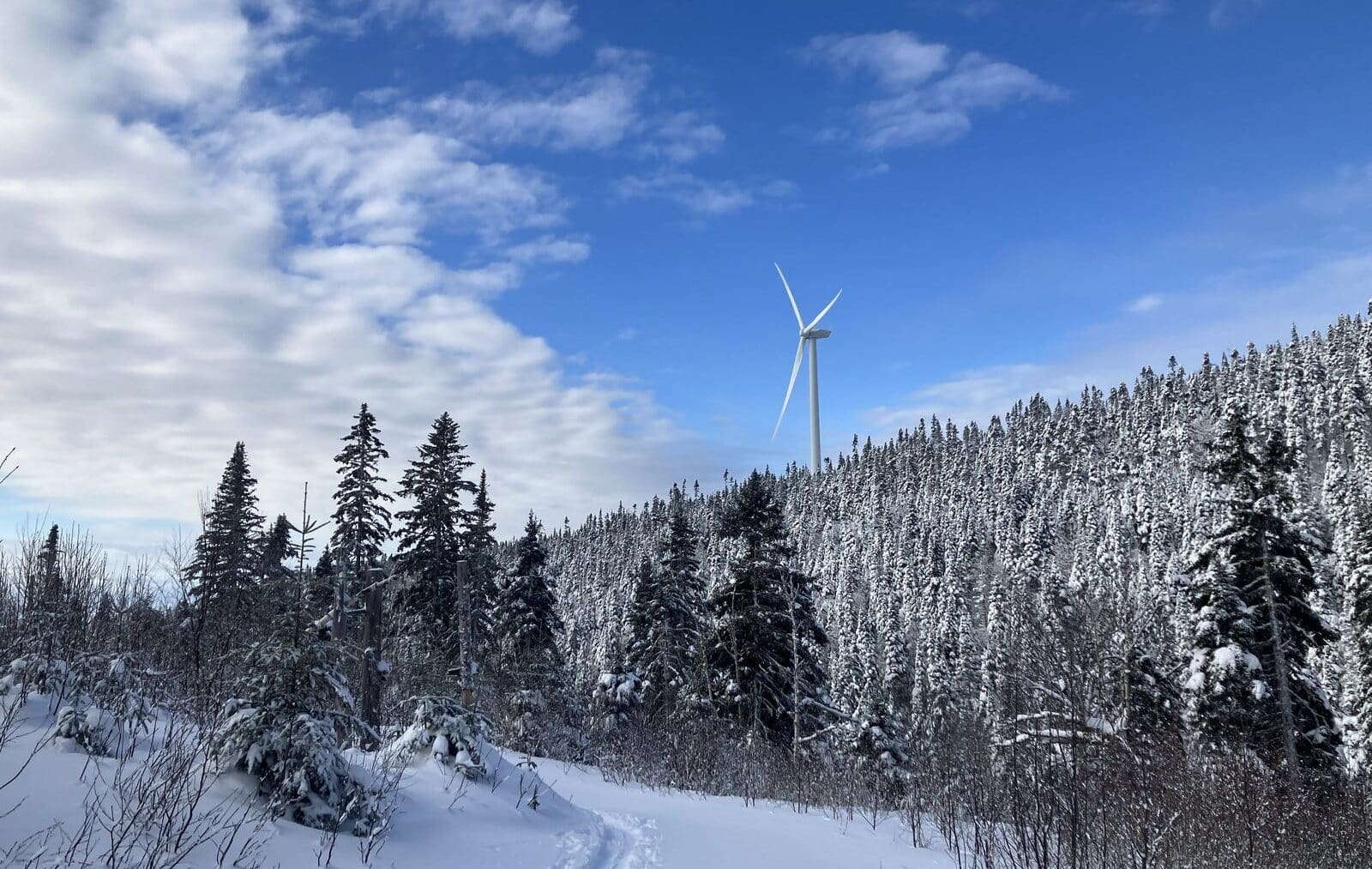
The climbing skins go on at the bottom of a gravel lot in a village of 400 people.
Above the tree line, something hums.
It is not wind through branches.
From there they cover several miles to the mountain, make their way up and then descend through the prized powder, skins peeled off at the top for the run back down.
It is three blades, each longer than a city bus, turning over a slope that skiers are about to climb on foot.
Nobody built this mountain to be strange.
It just turned out that way.
Why a ski slope and a wind farm ended up on the same ridge
Montagne Saint-Pierre rises 2,979 feet at the edge of the Gaspésie, a stretch of eastern Quebec known for strong, steady coastal winds. The ridge had exactly the steady, unobstructed wind exposure that turbine engineers look for.
It also had exactly the kind of open alpine terrain that backcountry skiers crave. Nobody designed the mountain to carry both uses at once.
The wind farm came first, built to feed the regional grid, and the ski culture grew up underneath it afterward, drawn by the same slopes the turbines needed to stand on. That overlap is the whole story, two completely different operations claiming the identical patch of rock because the same geography that makes a good power source also makes a good run.
The result is a working arrangement rather than a planned one.
What it actually looks like to ski beneath a spinning blade
After each snowfall, skiers converge on La Rédemption, a small village of 400 residents near Mont Joli. From there they cover several miles to the mountain, make their way up and then descend through the prized powder, skins peeled off at the top for the run back down.
The turbines are not a backdrop glimpsed from a distance. Skiers descend among the turbines of the Lac Alfred wind farm, close enough that the blade wash is part of the descent.
One longtime rider, Nicolas Tremblay, has skied the birch forests of the mountain for years, and judges that the turbines, which are rather quiet, “don’t harm” the skiing. That is a notable admission from someone whose sport depends on silence and open sightlines, and it suggests the arrangement works better in practice than it would on paper.
The numbers behind an unlikely coexistence
The project traces to a calendar year early in the last decade, when the wind farm first began operating. The backcountry ski area followed soon after, created in 2014, and skiers and turbines have shared the same patch of terrain ever since.
It is a modest operation by any commercial standard, running on a budget of about $10,000 a year, covered by the regional county municipality and Quebec’s Mountain and Climbing Federation. The site draws an estimated 800 visitors a year, a trickle compared with a lift served resort.
That low volume is part of why the arrangement has never drawn serious friction. A modest visitor count keeps the pressure low on both sides.
A Le Devoir dispatch that documented the setup called it a singular case in the worlds of outdoor recreation and renewable energy, and that framing holds up. The Gaspésie has hosted wind development for more than two decades, chasing the same coastal gusts that make the descent worthwhile.
Where the arrangement gets complicated
None of this means the mountain is free of tension. The main constraint associated with the turbines is the risk of ice being thrown from the blades.
At risk wildlife shares the same ridge as the turbines and the skiers, a reality any wind site in sensitive alpine habitat has to weigh against the species living there. The backcountry designation also means there is no lift, no grooming and no formal avalanche control.
So the mountain stays small and self leveling almost by accident rather than by design. That informality is precisely what let the coexistence happen, since a commercial resort chasing lift ticket revenue would likely have pushed harder against turbine placement.
A skin track operation with 800 annual visitors never generated the leverage to object. The ski area’s president has said the loss of terrain to turbines is not a major issue because the skiable domain is large, and the current challenge is simply maintaining it.
What one small ridge says about bigger turbines coming
Quebec continues to expand wind capacity across the Gaspésie, often with turbines considerably taller than the machines spinning over Montagne Saint-Pierre today. That raises a real question about whether a small, informal arrangement like this one can scale.
The lesson from research elsewhere on aging turbines is that older, shorter machines often behave differently from the newer generation now being proposed across the region, including in ground clearance and noise. And the same logic that lets engineers model airflow probabilities around new builds, the kind of work behind turbine wake modeling, will eventually decide whether future ridgelines can host skiers underneath taller rotors.
For now, Montagne Saint-Pierre remains a small, working example that the two uses do not have to cancel each other out. Skiers still climb the gravel lot in La Rédemption each winter, and the turbines keep turning above them, proof that a mountain can do two jobs at once without either one losing much.

Hugo is an engineer with strong technical expertise. Multilingual from an early age, his writing combines technical clarity with a strong interest in science and energy.
