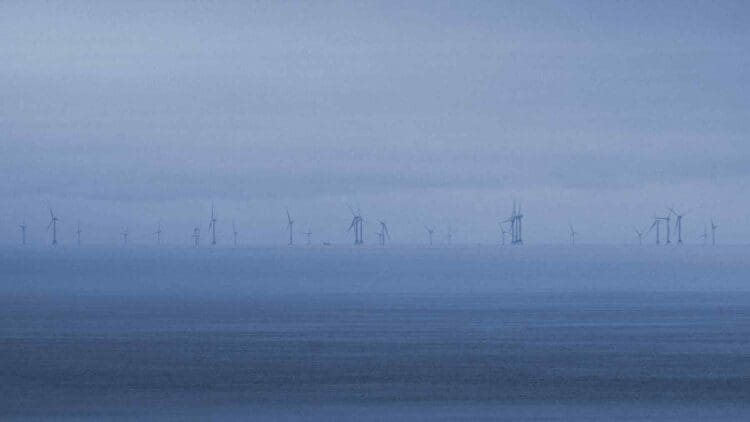

White giants are rising in the North Sea, but their secret weapon lies underneath the surface.
Vast amounts of clean energy are no longer restricted to the shoreline, and millions will soon benefit from full capacity.
One by one, they are growing, but good things take time, especially with the layout of the turbines’ “heart chamber.”
Will the beating hearts of these giants light up the homes of people soon?
How the North Sea is becoming a powerful wind energy hub
Slowly but surely, renewable energy installations are rising worldwide. Among all of them, the Dogger Bank Wind Farm is quickly proving to be the powerhouse of the North Sea.
The region is pushing to accelerate offshore wind capacity as part of a greater strategy.
The labor that goes into making the strategic shift a reality is intensive and extremely precise. Fortunately, the fruits of this labor are energy security and economic resilience.
These Dogger Bank giants will harness constant, high-velocity wind to lower reliance on fossil fuel imports. As a result, millions of homes will benefit from stable electricity prices.
The wind farm is specifically located between 80 and 118 miles of the North East coast of England. Dogger Bank is presently the biggest offshore wind project under construction.
Naturally, such a large-scale project requires careful planning, layout, and significant materials.
It takes a village to grow something into its full potential
The project’s construction is divided into three phases, namely Dogger Bank A, B, and C. Altogether, the Dogger Bank Wind Farm will be 3.6 GW at full capacity.
On the surface, the project will reach its full potential with 277 GE Vernova Haliade-X wind turbines. The scale truly is a testament to modern engineering, enabling the power to homes for nearly 6 million people.
However, before anyone would reap the benefits, an immense “village” of partners had to collaborate.
The partners behind this joint venture to reshape the nation’s energy landscape include:
- SSE Renewables
- Equinor
- Vårgrønn
Proserv and Synaptec also shared a landmark contract on Dogger Bank A and B.
One of the largest jack-up installation vessels ever, Voltaire, was utilized to raise these giants.
Little by little, the project is nearing its full potential. However, without its secret weapon below the surface, it all would become moot.
The “veins” that keep the turbine heart beating
No offshore wind farm can become fully operational without a supply of specialized cables to transmit the power. This means the “real energy” of the project actually comes from the inter-array cables.
The intricate network of subsea cables “pumps” the wind power from the 277 turbines to offshore converter platforms.
Connecting the network with specialized experts
Phase 1’s 200-mile inter-array cable laying was completed in July 2024.
In September 2025, a cable-laying vessel named Viking Neptun also began installing the subsea cables for phase 3. This phase consists of 250-mile-long cables laid across the seafloor.
Norside Cetus provided support to specialized pull-in teams to secure the cables to the foundations.
Once trenching and burial for protection are completed, the intricate network of the North Sea will power the UK grid.
Of course, this will not be possible without Hitachi Energy’s HVDC converter technology, which forms part of each phase.
Thanks to these underwater cables and the HVDC platforms, electricity is effectively transmitted over long distances. No energy is lost, ensuring a reliable, efficient power supply.
The region can thus enjoy clean electricity and be one step closer to national energy security.
It goes to show that with a little innovation and strategy, ambitious green energy projects are easy to complete. Of course, you would also need substantial investments to kick it all off.