
Aker BP and DeepOcean complete Norway’s first fully shore-controlled subsea operation at Idun Nord field
 AI-made
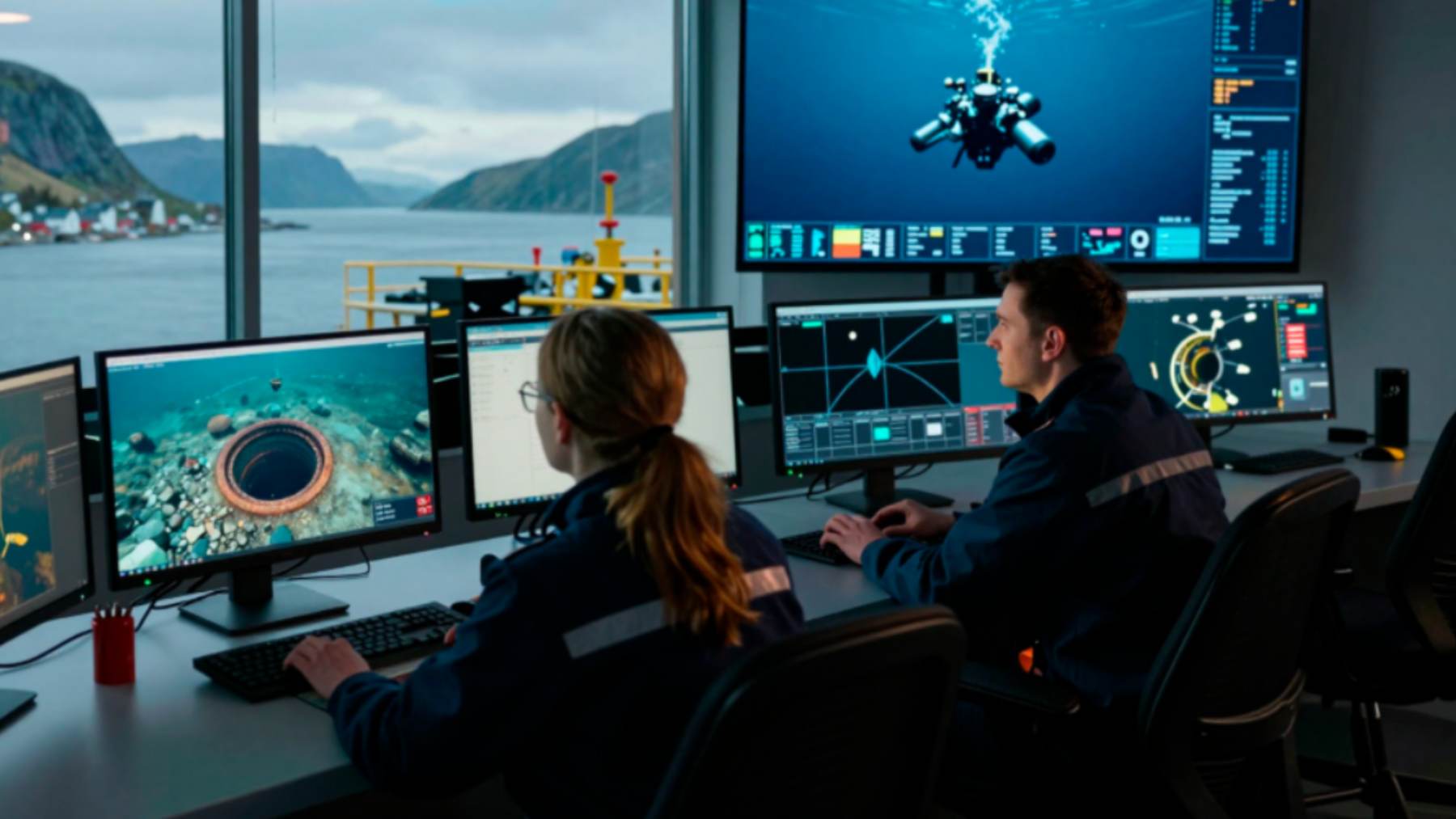
Aker BP and DeepOcean have completed what they describe as Norway’s first fully shore-controlled advanced subsea operation — stabilizing a well at the Idun Nord field in the Norwegian Sea without sending key engineering personnel offshore. The entire operation was managed in real time from DeepOcean’s Remote Operations Center in Haugesund, while the vessel Dina Star remained on location. The physical seabed work was executed using a dual-ROV setup: a work-class ROV was controlled directly from the shore facility in Haugesund, while a second ROV was operated locally from the vessel..
Shore-based team stabilizes well in Norwegian Sea
The Idun Nord field sits in the Skarv area of the Norwegian Sea, where Aker BP holds operational responsibility for a cluster of subsea wells. When one of those wells required stabilization work, the standard response would have been to mobilize a dedicated offshore team and send engineers out to sea. This time, that did not happen.
DeepOcean’s Remote Operations Center in Haugesund took full operational control instead. Engineers coordinated the job in real time from shore while the vessel Dina Star remained on location and an ROV performed the physical seabed work under their direction. Critically, the Dina Star had not been deployed for this purpose—it was already on site conducting seabed mapping around Skarv. The team adapted the mission on the fly.
Because the Dina Star was already present for a separate mapping mission, mobilizing an additional vessel and rotating a full offshore crew became unnecessary.
Why the operation was moved onshore
The task itself was not unusual. Stabilizing the well involved filling the borehole with gravel—a routine IMR procedure the offshore industry performs regularly. What distinguished this instance was the decision about who would manage it and from where.
Because the Dina Star was already present for a separate mapping mission, mobilizing an additional vessel and rotating a full offshore crew became unnecessary. The ROC in Haugesund offered a practical alternative. Stable communication infrastructure between the shore facility and the vessel allowed the onshore team to coordinate with the offshore crew in real time—with a level of integration that the companies describe as working almost side by side.
That communication reliability was not incidental. It was the enabling condition that made eliminating the offshore management layer feasible at all. Without it, the operational risk of directing a subsea intervention entirely from shore would have been difficult to justify.
Task completed in 12 hours instead of 14 days
The efficiency gap is hard to ignore. A traditional offshore rotation requires sending a supervisor and engineer to sea for a full 14-day trip just to oversee a short operation. By handling the leadership from shore, the work at Idun Nord wrapped up in a single 12-hour shift, allowing the onshore team to go home at the end of the day.
Much of that compression comes down to logistics. When key engineers do not travel offshore, the planning and mobilization timeline shortens considerably—no crew-change windows to schedule, no offshore safety inductions to coordinate, and no waiting on weather windows for personnel transfers.
Aker BP Operations Manager Jarle Marius Solland pointed to several specific advantages the approach delivered: fewer personnel sent offshore, more flexible planning, reduced time and costs, and the ability to deploy specialized expertise across multiple projects simultaneously from a single onshore location. That last point carries particular weight. A senior subsea engineer based in Haugesund can, in principle, contribute to operations at more than one field in a single day—something structurally impossible when that same engineer is aboard a vessel in the Norwegian Sea.
Where this fits in Aker BP’s broader operational strategy
This operation did not emerge from a single good idea on a single project. It reflects a deliberate direction Aker BP has been building toward for some time. The company’s stated operational strategy calls for drones, robots, and ROVs to function as an integrated part of offshore inspection and maintenance—operating autonomously or via remote control, either locally or from shore.
Thomas Øvretveit, SVP Operations at Aker BP, said the Skarv result confirms the company is making progress on that roadmap. “The successful advanced remote ROV operation in the Skarv area in the Norwegian Sea confirms that we are well on our way to delivering on our strategy as the oil and gas company of the future,” Øvretveit said.
Both companies have indicated that shore-controlled subsea operations will become more frequent rather than remain a one-off achievement. Industry observers note that if this model scales, it could meaningfully reshape workforce planning and vessel utilization across the Norwegian offshore sector—fewer personnel rotations required and more operational capacity concentrated at onshore hubs.
12 hours instead of 14 days
Norway’s first fully shore-controlled advanced subsea operation demonstrated that a standard IMR task—gravel-filling a borehole at Idun Nord—can be managed entirely from an onshore remote operations center without sending key engineers offshore. The job took roughly 12 hours, compared to a traditional offshore rotation of up to 14 days. Personnel travel was reduced, costs came down, and specialized expertise could be applied more flexibly across projects. For Aker BP and DeepOcean, the result is not a milestone to be noted and set aside—it is a proof point for a working model both companies intend to expand.
Kelly is an experienced writer with 15 years of experience exploring the big stories that shape our world, from tech breakthroughs and space exploration to climate, energy, and the fascinating quirks of science. She has a talent for turning complex ideas into sharp, memorable insights that stay with readers long after they’ve finished reading.
