
An AI model learned to “feel” the wind around turbines and solar panels faster than any supercomputer ever could
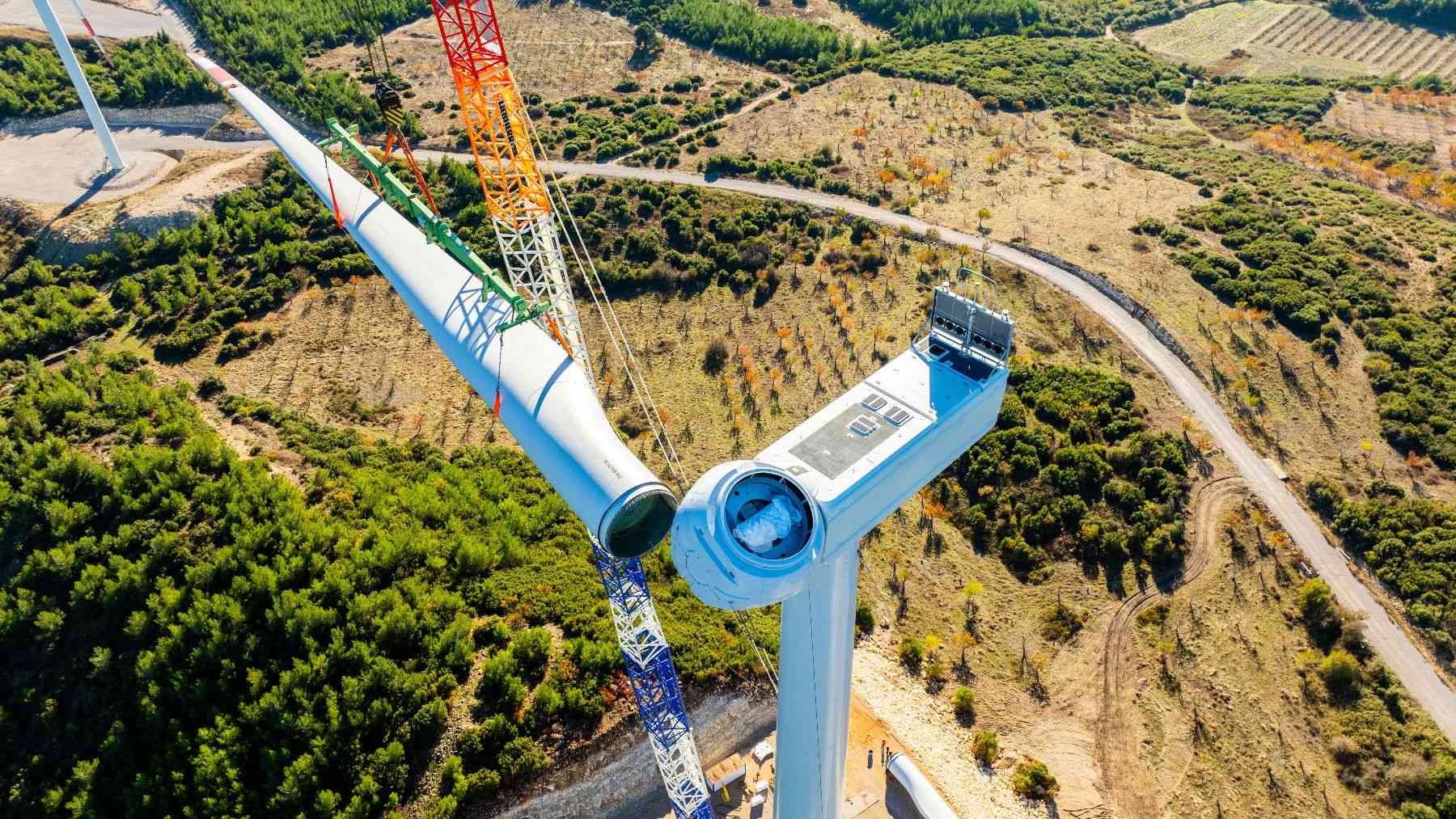
Placing a wind turbine in rugged terrain sounds simple enough — until you need to know exactly how air accelerates over a ridge, curls around a hillside, or stalls against a blade at half-meter precision across a 3-kilometer landscape. Simulations that can answer those questions in full detail are so computationally expensive that engineers can realistically run only a handful before a project deadline forces a decision. That constraint has long meant turbine placement and structural load estimates rely on incomplete wind data — or costly guesswork.
The computational wall blocking smarter wind siting
Detailed wind velocity and pressure fields determine where turbines generate power most efficiently, how structural loads will stress a blade or solar panel frame, and whether a layout will create turbulent wakes that hurt neighboring units. Reynolds-averaged Navier-Stokes simulations (RANS), using tools like OpenFOAM, are the current gold standard.
A single RANS run for complex terrain can take hours — repeating that across dozens of candidate layouts quickly becomes impractical. Capturing terrain-level airflow demands a domain roughly 3 × 3 kilometers at 30-meter resolution, while resolving what happens around a turbine blade requires 0.5-meter resolution. Bridging those scales affordably has stayed an open problem for the field.
Researchers started with 120 simulation domains and expanded to 292 by strategically selecting the most informative new simulations rather than sampling randomly.
Teaching a neural network to respect the laws of physics
A new surrogate framework tackles that dual-scale problem with two distinct model families. The first is a hybrid model: a point-wise coordinate multilayer perceptron paired with 2D convolutional encoders that process terrain geometry. The second is a 3D grid-based U-Net operating directly on volumetric data.
Both share a two-stage cascade architecture — a terrain-scale background model predicts broad airflow, then a structure-scale residual refiner adds fine detail around turbines and solar installations. Physics regularization penalizes predictions that violate mass conservation, momentum conservation, and boundary conditions, steering the models away from results that break fundamental fluid dynamics principles.
What the models actually get right — and where they still struggle
With a training budget of 292 simulation domains, both models reach wind speed normalized RMSE values of roughly 0.16–0.17 for global background and structure regions alike. Pressure RMSE for structure regions lands around 0.12 after gauge correction.
Physics regularization’s clearest contribution shows up in physical consistency: continuity and momentum residuals are roughly halved in structure regions, and terrain-scale residuals drop 15–65% compared to data-only training. The two model families split on one important detail — the hybrid model achieves the best aggregate errors and allows flexible point-wise inference, while the U-Net better captures channeling jets between closely spaced structures, a distinction that standard error scores tend to understate for structural load analysis.
Active learning: getting smarter with fewer simulations
Training a reliable surrogate still requires CFD data, but active learning can dramatically reduce how much. Researchers started with 120 simulation domains and expanded to 292 by strategically selecting the most informative new simulations rather than sampling randomly.
Terrain-scale test error dropped approximately 30%, with wind speed RMSE falling from 0.26 to 0.18. At a matched simulation budget, score-based active learning consistently outperformed random selection. Every avoided CFD run represents hours of compute time saved — a surrogate that prioritizes the most uncertain or novel cases means engineers can build a reliable model with far fewer expensive runs, without sacrificing meaningful accuracy.
From seconds of inference to smarter renewable energy design
Once trained, the surrogate returns full 3D wind velocity and pressure fields in seconds. That’s a stark contrast to the hours a comparable RANS simulation demands, and the gap transforms what’s feasible during a design study. Engineers could realistically compare dozens of turbine layouts, test micro-siting adjustments across a ridge, or run preliminary structural load estimates for several panel configurations — all before committing to even one full CFD run for final verification.
The next step is testing generalization: the surrogate was trained on a specific distribution of terrain types and structure configurations, and how it performs on landscapes outside that training distribution remains an important open question as the technology moves toward real-world deployment.
You can discover more about this AI-model here: Gasser, J., Frischholz, Y., and Lehning, M.: Physics-regularised neural network surrogates for fine-scale wind and pressure fields over complex terrain and structures, Wind Energ. Sci. Discuss. [preprint], https://doi.org/10.5194/wes-2026-179, in review, 2026.
Daniel García is an Editor-in-Chief with strong expertise in structural work and engineering principles. He combines this technical foundation with deep knowledge of energy, spatial design, and emerging technologies, bringing a forward-thinking and analytical approach to editorial leadership.
