
Drone cameras can now spot turbulent airflow on spinning wind turbine blades without ever stopping the machine
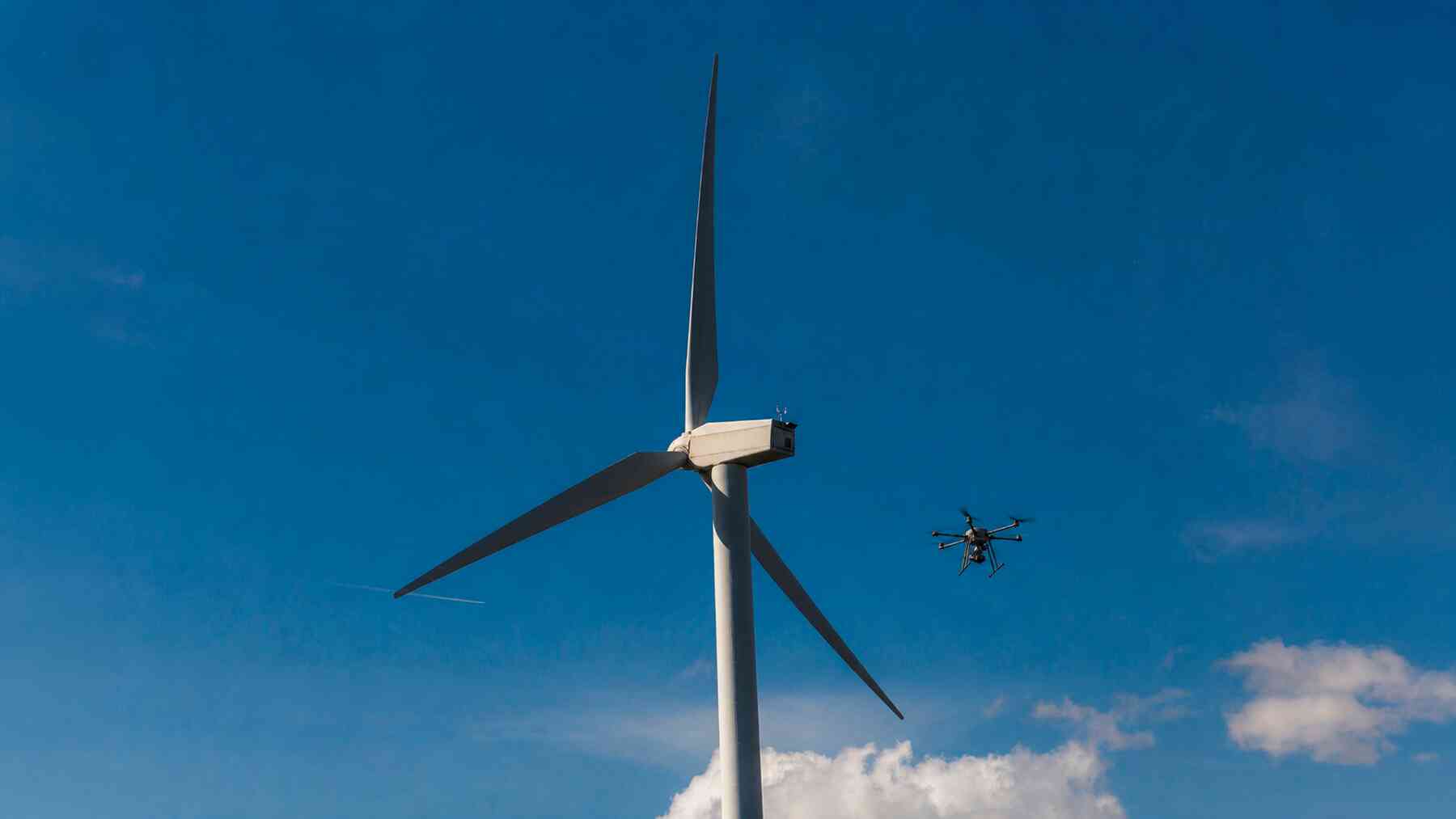 Edited, representative image.
Drones with infrared cameras can now see exactly where smooth airflow turns turbulent on spinning wind turbine blades.
Previously, making this measurement was incredibly difficult. You couldn’t do it without interfering with the turbine itself.
A new study in Wind Energy Science tested this technique on a 1.5 MW turbine.
Instrumented test blades require expensive hardware modifications, and ground-based cameras need fixed vantage points and short distances.
The researchers identified a hidden obstacle that had been quietly undermining their measurement accuracy.
Fortunately, the team found a way to reduce localization errors by roughly five times.
But how do you perfectly track invisible, spinning air when the camera lens keeps blurring your view?
What a fivefold accuracy boost means for wind power
The core discovery is beautifully simple.
Drone-mounted infrared cameras can easily capture thermal signatures on a spinning blade. These signatures mark where laminar airflow breaks down into turbulence.
Why does this exact spot matter so much? The transition point directly affects how efficiently a blade generates lift.
Pinpointing it under real operational conditions has long been a major practical challenge.
Engineers want to do this without attaching physical sensors or stopping the turbine.
The field study confirmed the technique works under normal operating conditions.
However, motion blur emerged as the biggest factor limiting accuracy. The faster a blade section sweeps past the camera, the more the thermal image smears.
This smearing widens temperature gradients and makes precise tracking harder.
The team fixed this with a clever deblurring algorithm.
It reversed much of the blur caused by the camera’s slow thermal response. At high speeds, this step reduced transition-location uncertainty by a factor of five. That is a massive improvement for high-speed blade regions.
What makes high-speed motion blur such a persistent headache for drone operators?
The problem of motion blur endures
It all comes down to the specific camera gear.
Microbolometer detectors are standard for drone-mounted infrared systems. They are lightweight and do not require complex cryogenic cooling.
This makes them highly practical for drone deployment.
The tradeoff is a relatively slow thermal response time.
This slow response triggers a massive headache with fast-moving subjects.
When a turbine blade sweeps past at high speed, the detector cannot update fast enough. Sharp thermal gradients end up spreading across multiple pixels.
This broadening grows progressively worse as blade velocity increases. It creates a compounding problem in the regions where blades move the fastest.
Researchers used a mathematical model to localize blade edges and transition features.
At moderate speeds, this approach works reliably.
At higher speeds, the blurred profiles deviate from the model shape. Edge detection loses robustness, and pinpointing the exact transition becomes unreliable.
The team ran controlled laboratory experiments before any field work. This let them isolate the blur effect from other field variables.
How did the team actually use math to undo this high-speed camera distortion?
A new deblurring technique that actually works
The engineering team deployed a classic signal-processing math trick called Wiener deconvolution. It reverses a known blurring process using a point-spread function.
Researchers derived this function directly from the camera’s known physical response.
This clever approach avoids the need for separate calibration targets in the field.
Camera response behavior is a fixed physical property. Operators can apply deblurring using information they already have. No extra hardware or additional setup is required.
The result: After deblurring, the edge-fitting procedure became markedly more stable. Hidden transition features became clearly visible in high-velocity regions.
At the highest speeds, deblurring does not eliminate all uncertainty.
Minor model deviations become the dominant remaining error source.
This sets a practical lower bound on precision, even with processing applied.
What does this hard-won precision mean for the future of commercial wind farms?
Why this matters for green energy
Mapping this invisible boundary line is the holy grail for aerodynamic design. Computer models predict these locations to calculate turbine performance.
Field measurements provide a great way to check those predictions against reality.
Accurate data supports better blade design and more reliable efficiency estimates, and drone-based infrared thermography offers massive advantages over existing methods.
Instrumented test blades require expensive hardware modifications, and ground-based cameras need fixed vantage points and short distances.
A drone can reposition freely and observe blades at operational speeds. It does all this without any physical contact.
The new framework also lets operators estimate how much blur affects their data.
This type of uncertainty quantification is essential for engineering confidence.
The authors have defined practical limits for airborne thermal measurements. Their work creates a foundation for standardized drone inspection protocols worldwide.
It moves this tech from an experimental tool to a routine field solution.
As wind power expands globally, can these airborne data collectors unlock the ultimate blueprint for maximum blade efficiency?
Kelly is an experienced writer with 15 years of experience exploring the big stories that shape our world, from tech breakthroughs and space exploration to climate, energy, and the fascinating quirks of science. She has a talent for turning complex ideas into sharp, memorable insights that stay with readers long after they’ve finished reading.
