
China just sent a wind turbine taller than the Eiffel Tower into one of the world’s most dangerous seas to power an oil field
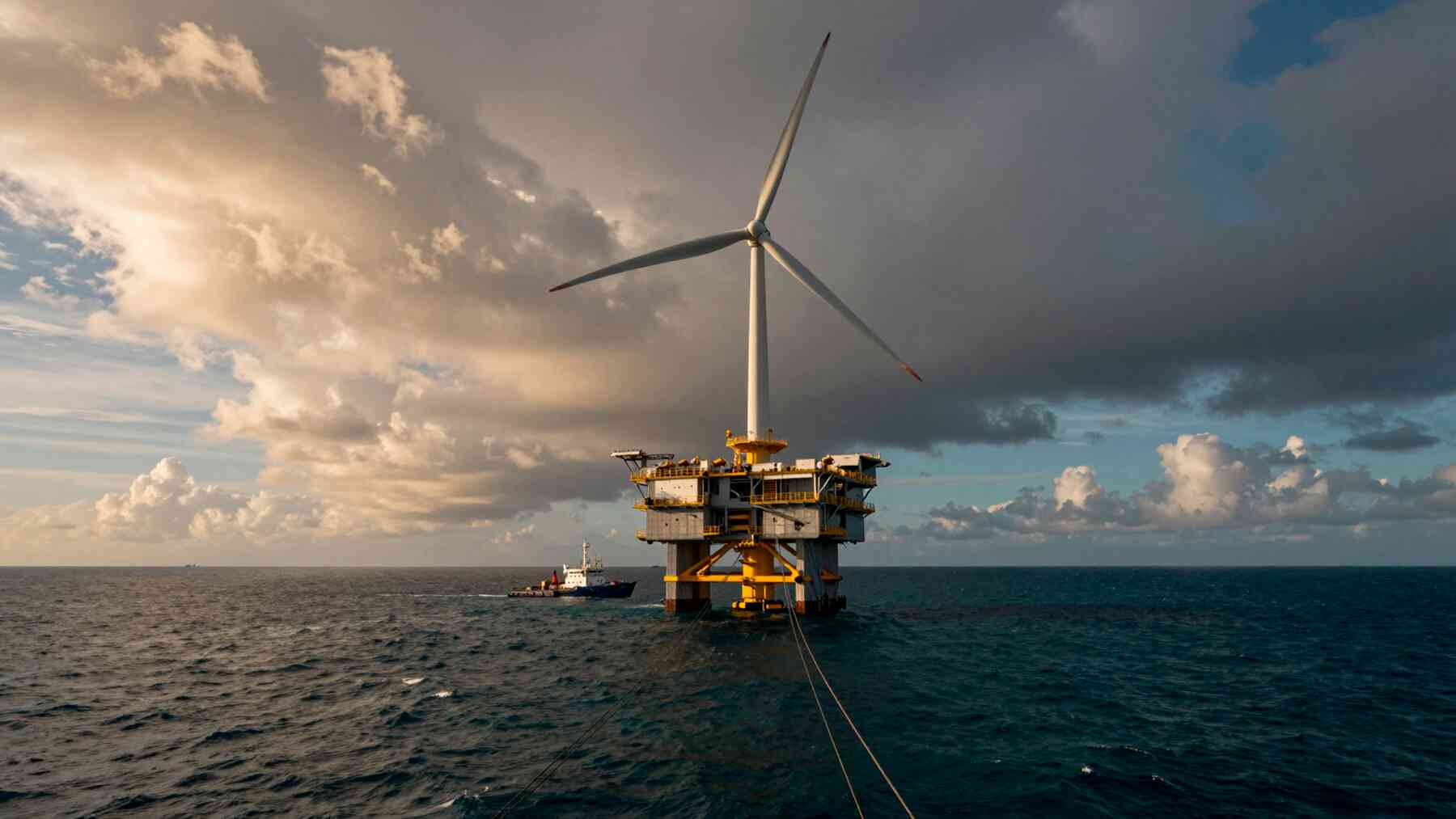
A structure taller than the Eiffel Tower and weighing nearly 8,000 tonnes recently sailed out of Gaolan Port in southern China, headed for one of the world’s most cyclone-prone stretches of open ocean. Its destination: a patch of the South China Sea sitting 330 meters deep, roughly 250 kilometers southeast of Hong Kong, where active oil fields dot the seafloor below.
The platform isn’t just large — it’s the biggest floating offshore wind installation ever built to support a single turbine. And what it’s meant to power makes the whole thing stranger still.
A record-breaking platform heads into deep water
The numbers are hard to ignore. Standing more than 307 meters tall — over 1,007 feet — and weighing close to 8,000 tonnes, the platform was assembled at Gaolan Port in Zhuhai before departing on June 28. It’s designed to support a single 16 MW turbine, making it the largest tension-leg floating offshore wind platform ever built for that purpose.
Most of the world’s best wind resources sit over deep water, far from coastlines where fixed-bottom turbines can reach.
The deployment site compounds the engineering challenge. At 330 meters of water depth, conventional fixed-bottom foundations aren’t an option, and once operational, the turbine is expected to generate around 54 million kWh annually — enough to meaningfully offset electricity demand from nearby offshore operations.
Why tension-leg platforms matter for deep-sea wind
A tension-leg platform, or TLP, is a buoyant structure held in place by vertical tethers anchored to the seafloor. Unlike fixed-bottom turbines — which rely on steel monopiles or jackets driven into the seabed — TLPs float, making them viable at depths where fixed foundations simply can’t go.
At 330 meters, fixed-bottom technology is off the table entirely. The South China Sea adds another complication: tropical cyclones sweep through the region regularly, placing serious demands on both the mooring system and the turbine itself. Chinese officials framed this installation as part of an accelerated push beyond demonstration-scale projects and into full commercial deployment — a threshold the industry has been chasing for years.
Powering oil fields with wind: an unusual pairing
The turbine won’t feed a national grid onshore. It will supply electricity directly to the Lufeng oilfield cluster via subsea cables, making it China’s first integration of floating offshore wind into active oil and gas operations.
The concept has a precedent. Norway’s Hywind Tampen, launched in 2022, did something similar — 11 turbines rated at 8.6 MW each, supplying power to Equinor’s Snorre and Gullfaks fields in the North Sea. Smaller in individual turbine scale, but it proved the model could work.
The strategic logic is straightforward enough. Offshore oil platforms consume significant electricity, typically generated by diesel or gas turbines onsite. Replacing even part of that load with wind cuts both emissions and fuel costs. Pairing a renewable source with fossil fuel extraction may seem contradictory, but operationally it makes sense — and it hands floating wind a near-term commercial use case while the broader market matures.
China’s offshore wind dominance by the numbers
China’s lead in offshore wind isn’t marginal. As of May, the country’s total installed wind power capacity surpassed 660 million kilowatts — up more than 17% year-over-year — with the offshore segment alone reaching 47 GW.
To put that in context: China accounted for 78% of newly added global offshore wind capacity in the latest reporting period and holds more than half the global offshore wind market overall. Plans call for adding as much as 63 GW of additional offshore capacity going forward. This single turbine is one data point in a much larger build-out.
What comes next for floating offshore wind
Chinese officials have been explicit about the goal: commercialize deep-sea floating wind at scale. The gap between demonstration and commercial deployment is where many promising technologies stall — sometimes permanently. The fact that this project is operational, not just planned, matters.
The broader implication extends well beyond China. Most of the world’s best wind resources sit over deep water, far from coastlines where fixed-bottom turbines can reach. Floating platforms could open up vast ocean areas that have been effectively off-limits until now.
Performance data from this installation will be worth watching closely. How the platform holds up under cyclone conditions, how reliably it delivers power to the oilfield grid, what the maintenance picture looks like over time — all of it will shape how quickly the rest of the industry follows.

Carlos is an engineer with strong expertise in technical and industrial topics. He previously worked at international companies such as Siemens and is multilingual.
