
The sewage flowing beneath your city could soon power homes and feed livestock thanks to a new sunlight-powered breakthrough from Singapore
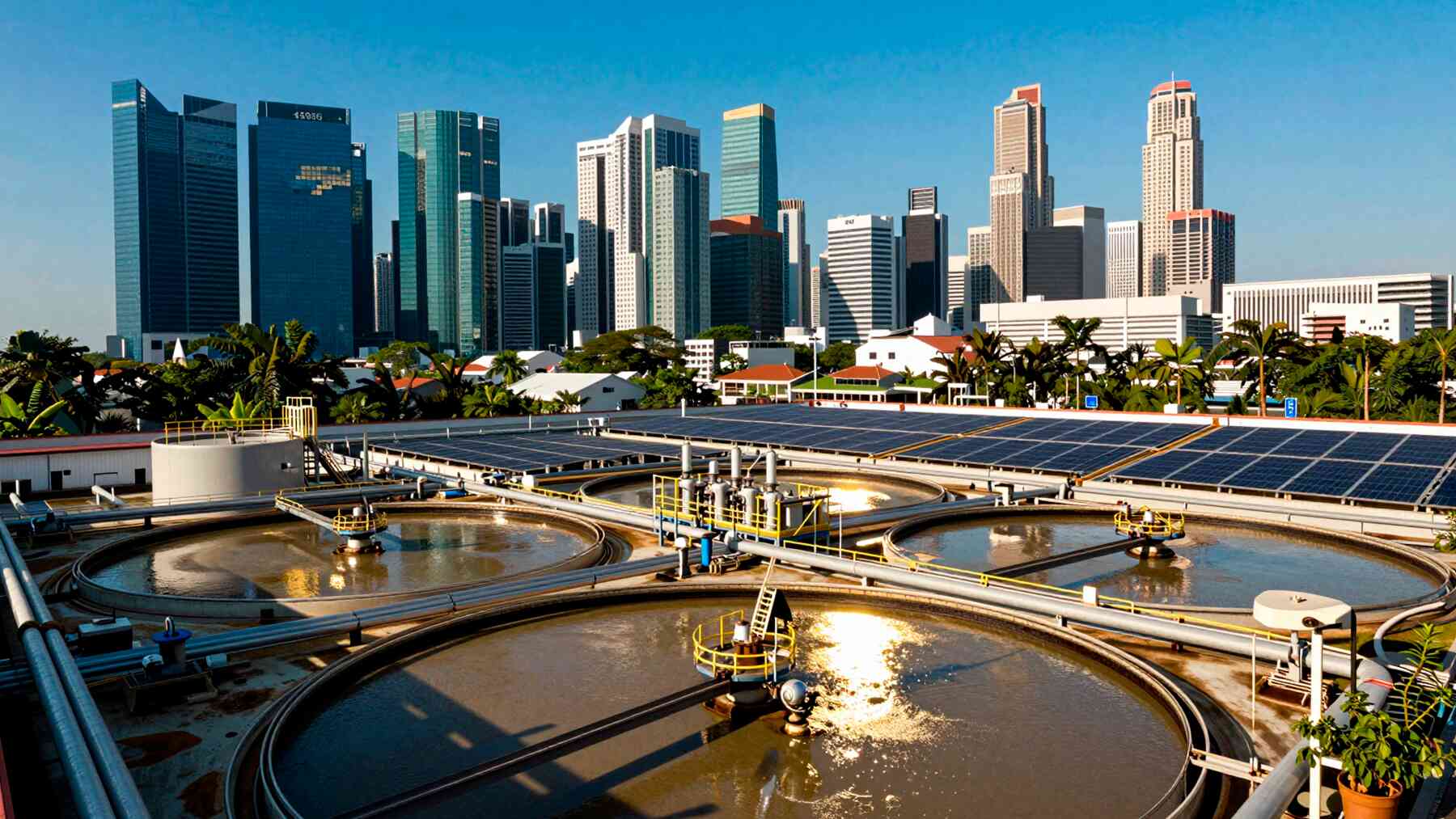
Every day, cities around the world produce millions of tonnes of sewage sludge — a dense, contaminated byproduct of wastewater treatment that’s notoriously hard to process and even harder to dispose of cleanly. More than 100 million tonnes accumulate globally each year, and as urban populations keep growing, that number keeps climbing.
Researchers at Nanyang Technological University in Singapore think this stubborn waste stream may be far more useful than the world has given it credit for.
A waste problem with no clean exit
The scale of the sewage sludge problem is staggering — and it’s getting worse. The UN estimates that 2.5 billion more people will move into cities by 2050, each adding to the wastewater stream that treatment plants must handle. More urban residents means more sludge, and current infrastructure is already struggling to keep pace.
Hydrogen output reaches up to 13 litres per hour using sunlight, at roughly 10% energy efficiency — about 10% better than conventional hydrogen generation methods.
Disposing of that sludge cleanly is genuinely difficult. Incineration burns energy and releases pollutants. Landfill buries the problem rather than solving it. Neither approach is efficient or cheap, and the sludge itself makes things harder still: it contains a complex mix of heavy metals, pathogens, and organic materials that resist simple treatment. That combination — rising volume, inadequate disposal methods, and inherent chemical complexity — is exactly what makes the NTU team’s approach worth paying attention to.
Three steps from sludge to fuel and food
The NTU process works in three sequential stages, each building on the last. Raw sewage sludge is first mechanically broken down to prepare it for further treatment — a physical step that makes the material easier to work with chemically. A chemical treatment then separates the heavy metals from the organic fraction, the proteins and carbohydrates locked inside the sludge. That separation is crucial: it clears the path for what follows without metals interfering.
The final stage is where sunlight takes over. A solar-powered electrochemical process uses specialized electrodes to convert organic materials into acetic acid — useful in food and pharmaceutical production — and hydrogen gas. Light-activated bacteria are then introduced to the liquid stream, converting available nutrients into single-cell protein suitable for animal feed. Mechanical, chemical, and biological techniques are integrated throughout, all driven by solar energy.
Numbers that set it apart from conventional methods
The performance figures from lab testing are what distinguish this process from existing alternatives. The NTU method recovers 91.4% of the organic carbon in sewage sludge, while traditional anaerobic digestion — the current industry benchmark — typically recovers around 50%. That’s a significant gap.
Of the carbon recovered, 63% is converted into single-cell protein without generating harmful by-products. Hydrogen output reaches up to 13 litres per hour using sunlight, at roughly 10% energy efficiency — about 10% better than conventional hydrogen generation methods. Compared to traditional treatment, the NTU process reduces carbon emissions by 99.5% and cuts energy use by 99.3%. Those aren’t marginal improvements. They represent a fundamentally different idea of what waste treatment can look like.
Eliminating the hidden danger: heavy metals
Heavy metals are one of the core reasons sewage sludge is so hazardous to handle. Conventional disposal methods — incineration and landfill — often leave metals untreated, releasing them into the air or allowing them to leach into soil and groundwater over time.
The NTU process completely removes heavy metals during the chemical separation stage, and that matters for more than one reason. It makes the outputs — hydrogen and single-cell protein — safe and commercially viable; contaminated protein can’t go into animal feed, and contaminated hydrogen has limited use. Clean outputs open real markets. It also prevents those metals from entering broader environmental systems at all, something the researchers specifically highlight as a meaningful departure from both incineration and landfill.
Promising, but scaling up remains the challenge
The researchers are careful not to overstate where the technology stands. These are proof-of-concept results from lab-scale testing. Whether the process can be replicated at the scale of an industrial wastewater treatment facility remains an open question.
Cost is the most immediate obstacle. Electrochemical breakdown of organics and full extraction of heavy metals are both expensive processes, and integrating them into a single coherent system — then engineering that system for a real treatment plant — adds considerable complexity. The team frames the work as a shift in perspective as much as a technical achievement. First author Dr. Zhao Hu put it plainly: the goal is to show that sewage sludge can be seen as a resource rather than a liability. If further studies confirm the process can scale, cities dealing with mounting sludge volumes may eventually have a cleaner, more productive option. That’s the transition worth watching.

Carlos is an engineer with strong expertise in technical and industrial topics. He previously worked at international companies such as Siemens and is multilingual.
