
Vanzetti Engineering launches ESK-IMO cryogenic pump series targeting small-scale LNG terminals and marine bunkering markets
 AI-made
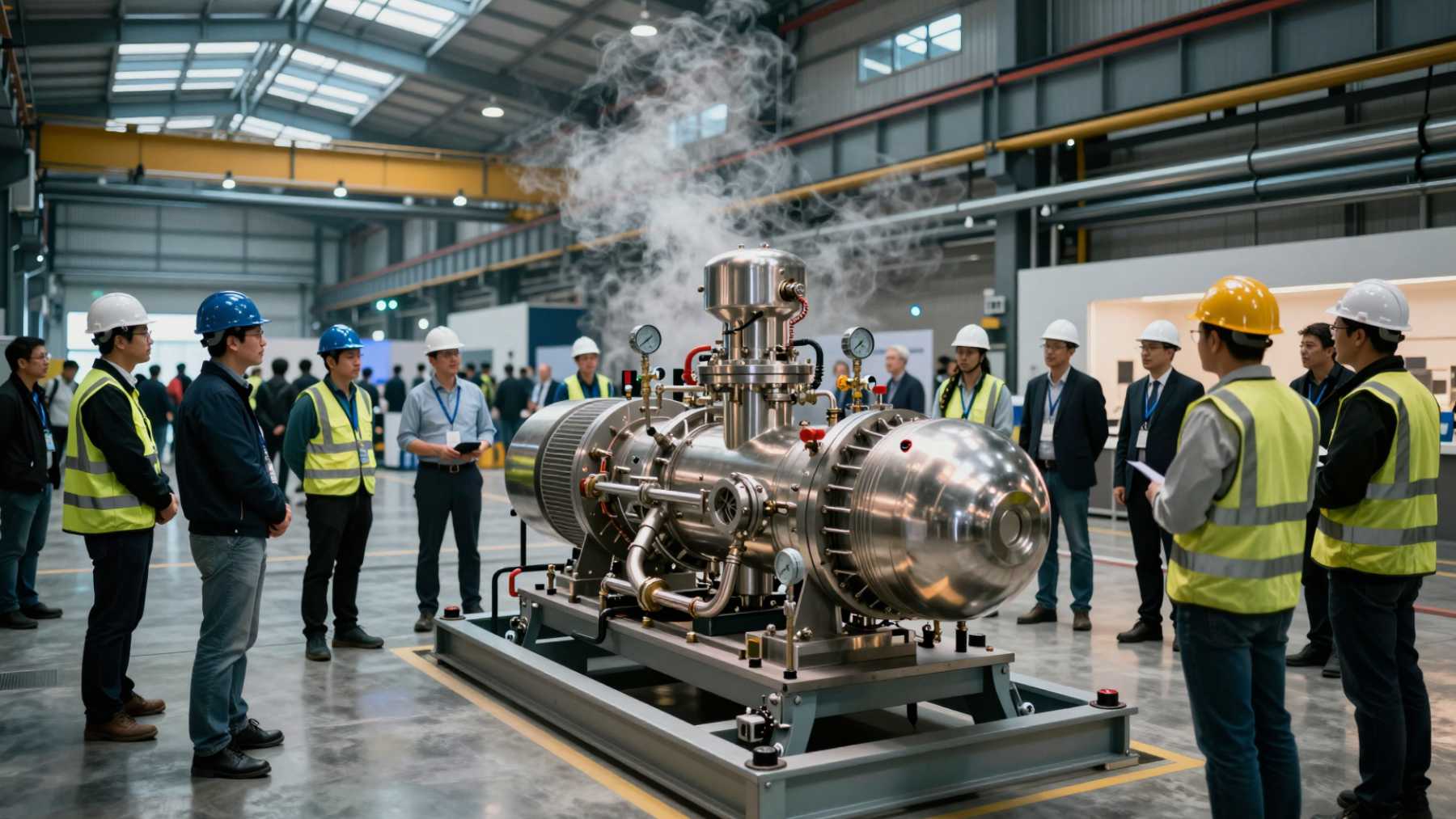
On June 8–9, 2026, Vanzetti Engineering gathered industrial partners, LNG associations, and maritime analysts at its Cavallerleone headquarters in northern Italy for an event that doubled as a product milestone: the public unveiling and live demonstration of the ESK-IMO, a new series of removable submerged cryogenic pumps built for small-scale LNG terminals, FSRUs, and marine bunkering operations.
The launch marks the Italian manufacturer’s direct push into some of the fastest-growing segments of the global LNG market.
Vanzetti Engineering demonstrates new ESK-IMO pump at international LNG event
The two-day gathering pulled together a notably diverse crowd — industrial partners, customers, and reps from Assogasliquidi, the International Gas Union (IGU), EPRINC, and Clarksons Research. Operators, trade bodies, and market analysts don’t often end up under one roof for a product launch.
Shorter permitting timelines and lower capital requirements are accelerating deployment, particularly in emerging markets like India, Indonesia, and parts of Africa.
The live demo took place on June 9 at Vanzetti’s Cavallerleone facility, where participants watched the ESK-IMO run in real operating conditions rather than some controlled lab setting disconnected from actual use.
The ESK-IMO series spans three models covering a wide performance range. The ESK-IMO 230 delivers flow rates up to 85 m³/h, the ESK-IMO 300 reaches up to 300 m³/h, and the ESK-IMO 400 tops out at 550 m³/h—together covering the main pump requirements across small-scale LNG terminals and marine bunkering operations.
Design rationale: addressing operational demands of fast-growing LNG segments
The ESK-IMO wasn’t designed for large-scale baseload terminals. Its target is narrower: small-scale LNG terminals and marine applications where the pump works as a cargo or stripping pump.
One practical function stands out above the rest. The series is engineered to enable tank emptying when a vessel’s main cargo pumps malfunction or go offline for maintenance — a capability that addresses a genuine vulnerability in marine LNG handling, keeping cargo moving even during equipment failure.
Vanzetti didn’t start from scratch. The ESK-IMO builds on the company’s ARTIKA submerged cryogenic pump platform, which has accumulated more than 1,500 installations in marine applications worldwide. That installed base provides engineering credibility a genuinely new product simply wouldn’t carry.
Validation was treated as a design priority from the outset. Vanzetti built a dedicated test bench specifically for the ESK-IMO range—not adapted from existing infrastructure—ensuring all three models hit certified, consistent performance before reaching customers.
A growing LNG fleet and infrastructure expansion drive demand for the new pump
The market Vanzetti is targeting is expanding fast. More than 1,500 vessels are currently LNG-fuel-capable, and the global LNG-powered fleet is projected to exceed 3,500 vessels by 2030 — more than a doubling in under five years.
Bunkering infrastructure is scaling up alongside fleet growth. The dedicated LNG bunkering fleet is expected to reach roughly 80 vessels by 2028, which means reliable pumping capacity needs to be in place at both the vessel and terminal levels.
New vessel orders reinforce the trend. Around 60% of all new orders for alternative-fuel vessels involve LNG, according to data discussed at the event — a share that reflects IMO emission reduction targets pushing shipowners toward cleaner fuel options, with LNG remaining the most commercially viable at scale.
On the infrastructure side, IGU data presented at the event showed that approximately 40% of liquefaction plants currently under construction globally fall into the small-scale category, defined as capacity up to 3 million metric tons per year. Shorter permitting timelines and lower capital requirements are accelerating deployment, particularly in emerging markets like India, Indonesia, and parts of Africa.
Global LNG trade growth and energy transition context
The backdrop for Vanzetti’s launch is a global LNG market that has nearly doubled over a decade. Trade volumes grew from approximately 240 million tons in 2015 to more than 440 million tons in 2024 — a trajectory that has reshaped energy supply chains and raised LNG’s profile in energy security planning.
The US sits at the center of that shift. US LNG export capacity currently stands at around 150 million tons per year and could reach 250–270 million tpy by 2031, according to projections discussed at the event, with that expansion expected to keep reshaping global supply dynamics and pricing.
A newer demand driver is also coming into focus: AI-driven data center expansion is creating significant new appetite for natural gas, as tech companies seek dedicated, reliable energy supplies to power facilities with continuous high electricity loads. Speakers at the event flagged this as an increasingly important factor in long-term gas demand forecasting.
The energy transition framing at the event was notably broad. Discussions positioned conventional LNG alongside bio-LNG, biomethane, synthetic methane, and hydrogen—treating them as complements rather than competitors within a longer-term decarbonization trajectory.
Vanzetti’s ARTIKA platform
Vanzetti Engineering has introduced a purpose-built cryogenic pump series targeting two of the LNG sector’s fastest-growing segments: small-scale terminals and marine bunkering. The ESK-IMO 230, 300, and 400 cover flow rates from 85 to 550 m³/h and are designed for cargo and stripping functions, including emergency tank emptying during main pump failure.
The series draws on Vanzetti’s ARTIKA platform—more than 1,500 units installed globally—and was validated on a dedicated test bench built specifically for the range. Market data presented at the launch points to a global LNG-powered fleet expected to exceed 3,500 vessels by 2030, a bunkering fleet approaching 80 dedicated vessels by 2028, and roughly 40% of new liquefaction construction falling into the small-scale category. Global LNG trade volumes and US export expansion provide the broader commercial backdrop driving infrastructure investment in the segments the ESK-IMO is built to serve.
Kelly is an experienced writer with 15 years of experience exploring the big stories that shape our world, from tech breakthroughs and space exploration to climate, energy, and the fascinating quirks of science. She has a talent for turning complex ideas into sharp, memorable insights that stay with readers long after they’ve finished reading.
