
Scientists turned a 100-year-old Tesla valve inside out, and the swirling air it created made water evaporate at a record rate without pumps or fans
Water evaporating from a surface seems almost too simple to matter — yet this quiet physical process drives Earth’s entire hydrological cycle and sits at the heart of technologies ranging from solar desalination to building cooling systems. For decades, engineers have struggled to push evaporation rates higher, only to run into the same stubborn obstacle: an invisible resistance layer at the boundary where liquid meets air.
The solution, according to a new study published in Nature Communications, came from an unlikely source — a valve that Nikola Tesla patented more than a century ago, now redesigned and turned, in effect, inside out.
The invisible wall slowing water evaporation
When water evaporates, it doesn’t happen in open, unlimited space. Right at the liquid-air interface, a thin layer of stagnant air builds up — warmer, more humid, and far less cooperative than the surrounding atmosphere. This boundary layer acts like a lid, slowing both heat transfer and the escape of water vapor.
The researchers report energy savings of 414 GJ m⁻³ month⁻¹ through evaporative cooling, a figure pointing to significant potential for building climate systems.
Solar steam generation, evaporative cooling systems, and freshwater harvesting all depend on moving water molecules from liquid to air as quickly as possible. The boundary layer caps how fast that can happen, regardless of how well-designed the rest of the system is.
Engineers have spent decades trying to work around it. Most approaches focus on interfacial engineering — tweaking surface materials, applying specialized coatings, or restructuring evaporator surfaces to expand the contact zone between liquid and air. These strategies have delivered real gains, but returns are diminishing. Water scarcity and energy consumption are tightly linked, and cracking the evaporation rate problem could ease pressure on both fronts at once.
Tesla’s forgotten valve, turned inside out
Nikola Tesla patented his fluidic diode — now widely called the Tesla valve — in 1920. The device used a cleverly shaped channel to allow fluid to flow freely in one direction while resisting flow in the other, all without any moving parts. The geometry itself did the work.
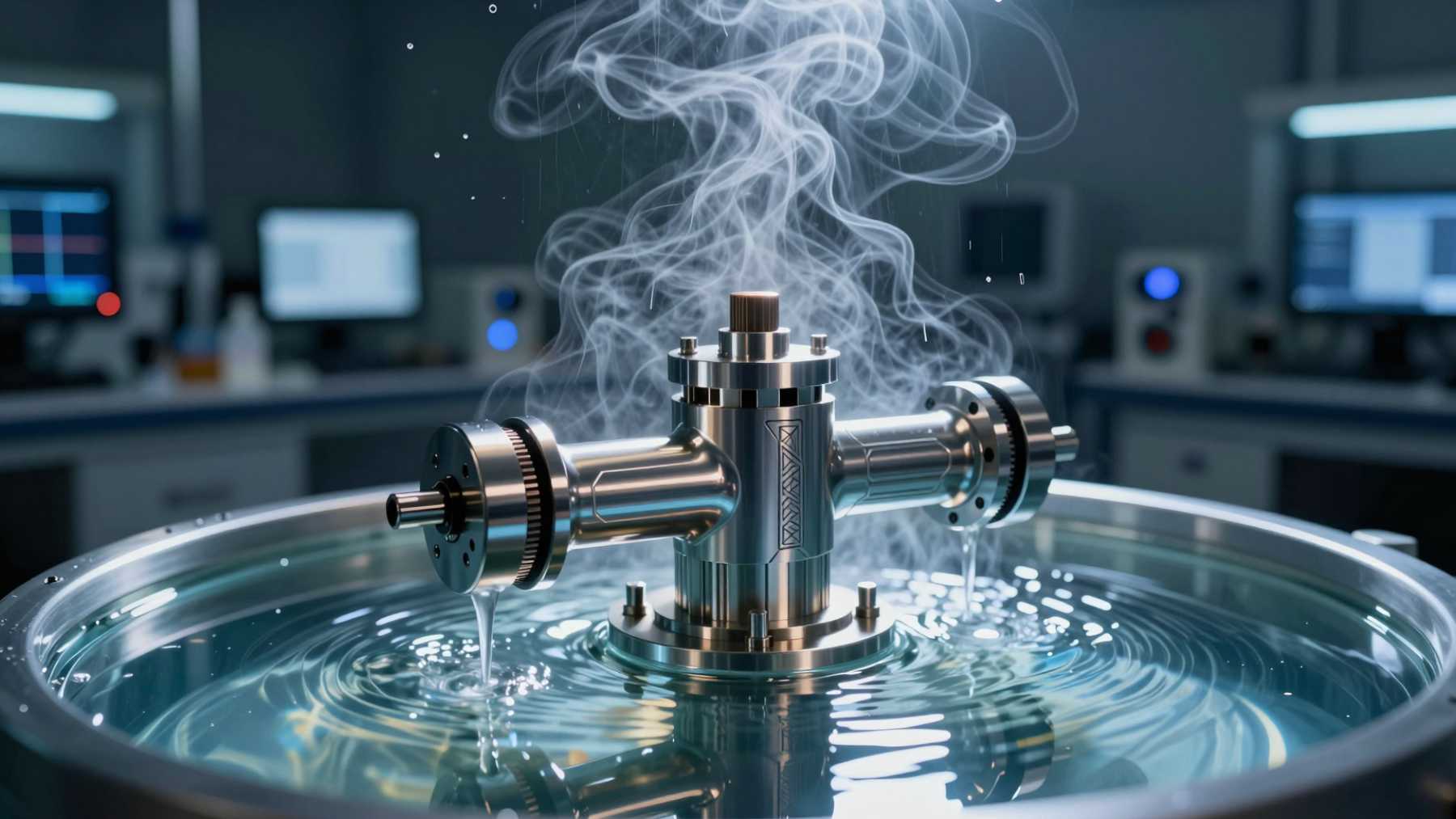
The research team didn’t use Tesla’s design as-is. They reversed it. By flipping the valve’s geometry, they created a structure that deliberately generates vortex airflow rather than channeling fluid smoothly — a swirling, turbulent air pattern that actively breaks up the boundary layer instead of letting it settle.
This is the core insight of their system, which they call BEES — the Bulk-Effect Evaporation System. The structure-induced vortex disrupts both the thermal boundary layer and the mass transfer boundary layer simultaneously. What makes it elegant is what it doesn’t require: no pumps, no fans, no exotic materials. The geometry does the work, just as Tesla originally intended, only now applied in a completely different direction.
Record-breaking numbers: what BEES achieved
The headline result is stark. BEES achieved an evaporation rate of 21.29 kg m⁻² h⁻¹. Conventional solar evaporators typically operate at a fraction of that figure. This isn’t an incremental improvement — it represents a qualitative jump in what the researchers describe as previously unattainable evaporation dynamics.
The system also recorded a total energy and solar efficiency of 627%. That figure sounds counterintuitive, but efficiency above 100% is possible here because the system draws on energy beyond direct solar input — including ambient heat from the surrounding environment — making total energy harvested greater than solar energy alone.
This connects to the paper’s broader concept: bulk-effect evaporation. Traditional evaporators work at the surface; BEES drives evaporation throughout the liquid volume, not just at the interface, so more water actively participates in the process at any given moment. Prior benchmarks in solar evaporation research have improved steadily through interfacial engineering. BEES doesn’t nudge those benchmarks — it establishes a new framework operating on a different principle entirely.
All-day freshwater and massive energy savings
One practical advantage of BEES is continuity. The system supports all-day freshwater harvesting using solar energy, meaning it doesn’t rely on peak sunlight hours alone. The vortex-driven evaporation mechanism keeps working as long as there’s airflow and ambient energy available — a meaningful distinction for off-grid applications.
The cooling performance is equally notable. The researchers report energy savings of 414 GJ m⁻³ month⁻¹ through evaporative cooling, a figure pointing to significant potential for building climate systems. Water-scarce regions could use the system for off-grid freshwater production, urban buildings could reduce air conditioning loads, and remote communities without reliable infrastructure could access both cooling and clean water from a single, mechanically simple device.
What comes next for this technology
Promising lab results and real-world deployment are separated by a long road. Before BEES could operate at scale, researchers and engineers would need to address manufacturing processes, long-term material durability, and cost — none of which the current study resolves.
The research team frames bulk-effect evaporation as complementary to existing interfacial engineering rather than a replacement for it. Engineers now have an additional design dimension to work with, and the two strategies could potentially be combined. The work comes from a China-based team, supported by the National Natural Science Foundation of China, the Heilongjiang Outstanding Youth Science Foundation, and the Fundamental Research Funds for the Central Universities. It was published in Nature Communications.
If the approach proves scalable, the implications extend well beyond any single application. Water stress and cooling energy demand are both projected to worsen as global temperatures rise. A geometry-based solution that costs little to operate and requires no moving parts could prove especially valuable in exactly the places — and under exactly the conditions — where those pressures hit hardest.
The complete study offers a more detailed review: Wang, W., Gao, S., Wu, H. et al. Reverse Tesla valve modulated efficient water evaporation and cooling. Nat Commun (2026). https://doi.org/10.1038/s41467-026-75062-0

Carlos is an engineer with strong expertise in technical and industrial topics. He previously worked at international companies such as Siemens and is multilingual.
