
A hotel in the Maldives installed solar panels in its lagoon, and young fish discovered a new place to hide from predators
 Credits: AI-made
The Maldives became a blueprint for innovation after a hotel installed offshore solar panels.
Worldwide, nations are rushing to meet fast-approaching international climate goal timelines.
For isolated islands, certain challenges complicate the green shift, strengthening the need for diesel imports.
The hotel partnered with Swimsol and bypassed land constraints by installing twelve “SolarSea” floating platforms in the lagoon.
This is why secluded communities still have significantly large carbon footprints, but one hotel could help them overcome this.
Its panels moved to the lagoon, but did they end up impacting local marine ecosystems?
How urgent targets do not always speed up the renewable transition
Global governments have sounded the alarm over the rapidly accelerating changes to the climate.
Earth’s temperatures are rising, which is triggering immense consequences worldwide.
To prevent the planet from warming above the agreed-upon threshold, international climate mandates tightened.
Nations must now halve the world’s greenhouse gas emissions by 2030.
Consequently, major economies have been actively investing in and deploying utility-scale green infrastructure.
Solar energy has been leading this significant shift.
By mid-2025, the combined global solar capacity reached roughly 2,900 GW.
The total was achieved after 647 GW of solar infrastructure was installed.
This has made it the fastest-growing source of new power generation globally.
Despite this major accomplishment, some communities are still excluded from this growth.
Isolated island territories face a different reality, as they do not have access to mainland electrical grids.
Most island nations must remain self-sufficient, but solar panels are not normally the answer to resilience.
Abundant sunlight, but a lack of solar capacity
While it is possible, developing large-scale solar facilities on islands remains highly complex.
This is especially true in the Maldives. There are almost 1,200 islands scattered across 35,000 square miles of ocean.
This means that each island is responsible for its own energy security and must operate as a self-contained microgrid.
These small tourist resort islands have limited land available for standard solar panels.
Fertile land is a primary resource, and preference is given to housing, agriculture, and tourism. Clearing pristine forests and displacing natural habitats is not ideal.
For this reason, most islands rely on imported diesel fuel to power generators.
Imports are extremely expensive, often using up to 20% of a community’s gross domestic product.
Rooftop solar installations proved to be a game-changer, providing significant relief from volatile international oil markets.
But even the space on rooftops is eventually exhausted.
That is why one hotel looked beyond the shoreline.
Lagoon solar panels: Serving a dual-purpose
Floating solar is rising in popularity across the world, yet many remain concerned about aquatic impacts.
However, the five-star resort LUX* South Ari Atoll proved that solar panels do more than generate clean energy.
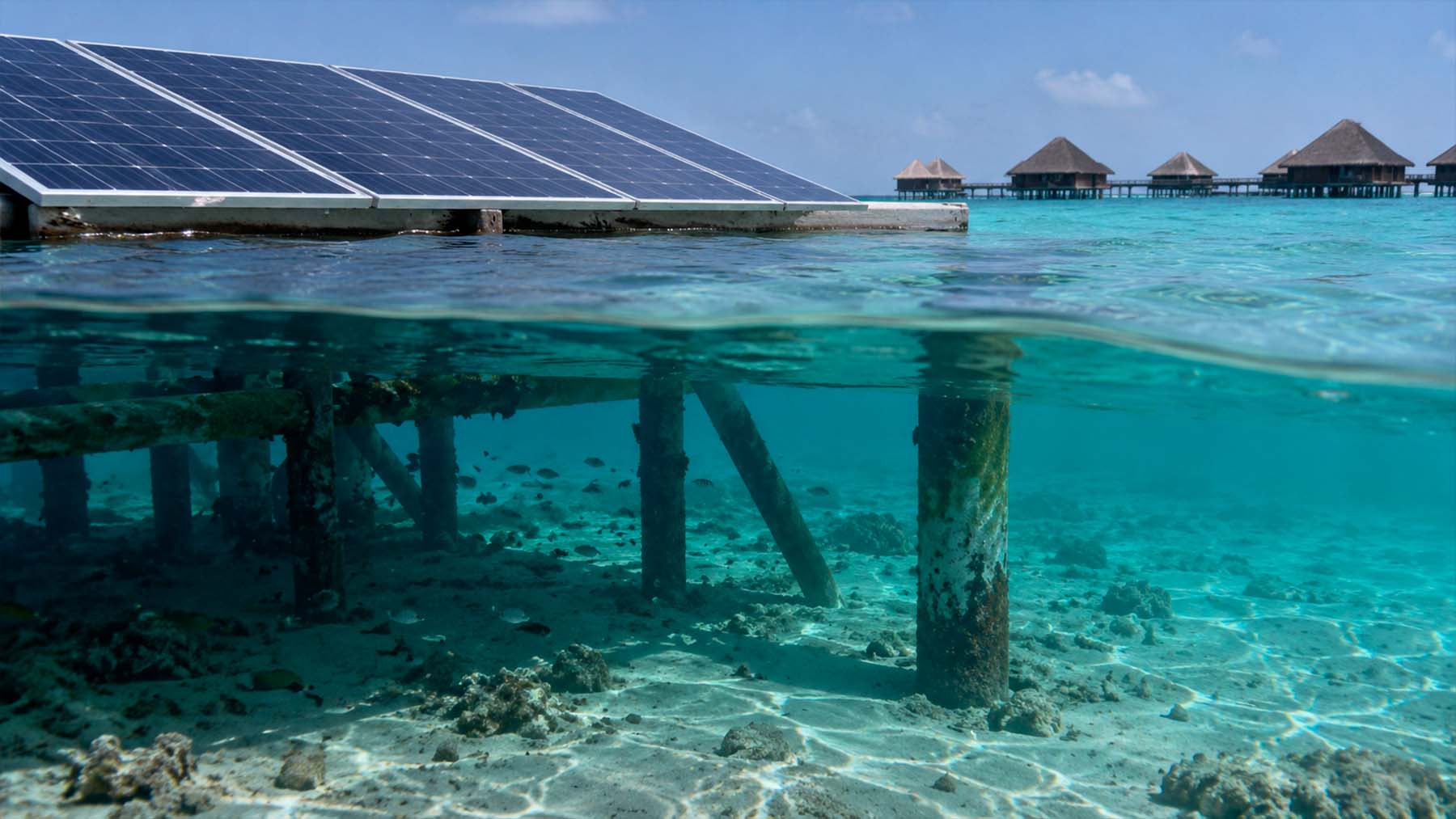
The hotel partnered with Swimsol and bypassed land constraints by installing twelve “SolarSea” floating platforms in the lagoon.
This boosted the resort’s clean energy capacity by 40%. All guest villas now benefit from solar power during peak daylight hours.
The platforms are also highly durable. Marine-grade, corrosion-resistant materials were used for construction.
Furthermore, they are secured to the ocean floor with heavy-duty, flexible mooring lines.
Most importantly, the floating solar panels triggered an unexpected ecological impact.
A sanctuary for juvenile fish
The platforms serve as artificial reefs on the barren sand.
They cast shadows that create a cool, protected shelter in the open water.
For schools of young fish, it became an ideal hiding spot from larger predators.
The hotel’s lagoon solar panel installation has enjoyed long-term success.
Operation has continued for years, with the platforms surviving tropical storms and corrosion.
For the region, the project served as an important proof of concept.
Other resort islands in the Maldives soon followed suit, rapidly expanding floating solar systems. This innovation proved that marine-based renewables can raise clean energy resilience while protecting local ecosystems.
Anke Maree is a writer with a clear and engaging editorial style. Her work focuses on making complex topics accessible, informative, and relevant for readers across different areas of interest.
