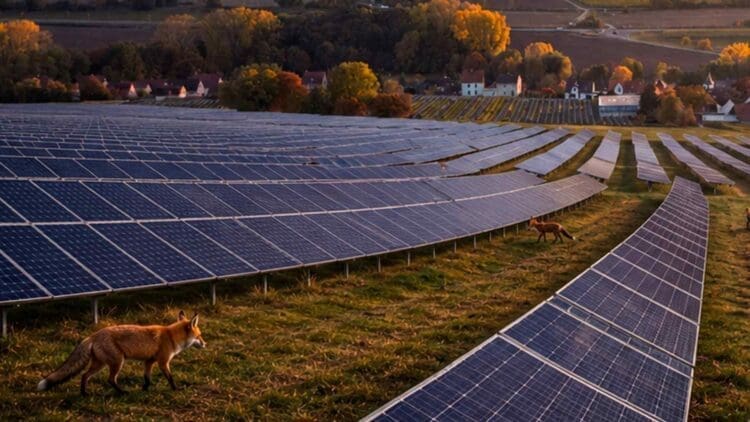

Solar farms are becoming unexpected sanctuaries for North America’s rarest predators.
Global solar capacity is exploding to meet massive net-zero climate goals. Yet, these giant arrays consume millions of acres of sensitive habitats.
Traditional developments completely displace vulnerable wildlife, slicing vital migration corridors.


But maybe green energy doesn’t have to kill biodiversity.
Can engineering turn industrial power plants into thriving wildlife havens?
How can we save the climate without sacrificing the species living right beneath our panels?
Energy vs. ecosystems: How the modern world’s needs are endangering wildlife
Society has shifted toward full digitalization as AI, cloud computing, and giant data centers continue to expand.
As the modern world evolves with these expansions, its insatiable demand for electricity has become inevitable.
Meeting this exponential surge while adhering to stricter climate mandates has proven to be difficult.
Large-scale renewable infrastructure, such as solar plants, is being deployed at an unprecedented pace. This high-speed expansion’s physical footprint directly overlaps with Earth’s most sensitive ecosystems.
To ensure that solar infrastructure indeed replaces the output of carbon-heavy fuels, it needs vast expanses of land.
It means that open grasslands and deserts must make way for these thousands of arrays. This serves as the final blow to species already vulnerable due to agriculture and urban sprawl.
These high-security, high-voltage sites also prevent wildlife from entering, resulting in habitat fragmentation.
We are trapped in a “green-on-green” conflict: fighting climate change while accidentally accelerating the Sixth Mass Extinction.
Engineering coexistence: Bridging the gap between energy and ecology
The survival of Earth’s most vulnerable ecosystems is at risk due to the worsening global climate crisis.
This increases the pressure to deploy large-scale renewable energy, often clashing with biodiversity protection.
Conservationists are pivoting to “Wildlife-Friendly Solar.” This design philosophy treats energy infrastructure as an artificial ecosystem rather than an industrial wasteland.
Traditionally, solar plant designs form biological shields.
California’s Topaz Solar Farm—a 4,700-acre behemoth—was the ultimate test case for this paradox.
The site sits on the Carrizo Plain, the last stronghold for the endangered San Joaquin kit fox.
Fewer than 7,000 remain. Experts feared the 9 million solar panels would trap them.
Instead, researchers from UC Santa Barbara discovered a biological breakthrough.
However, a report from Conservation Land Group indicates that the exact opposite was true.
A study conducted by the Bren School of Environmental Science & Management confirms the farm’s impact on foxes.
The permeable fortress: A solar farm sanctuary for endangered foxes
If a solar plant is developed and managed responsibly, it could end up attracting wildlife instead of displacing it.
Engineers installed “fox-permeable” fencing. They cut 4-by-4-inch openings at the base of the perimeter every 100 yards.
The perimeter was made permeable by incorporating hundreds of tiny, fox-sized “doors.”
These “fox doors” are the perfect size for a 5-pound kit fox but too small for coyotes, their primary killers.
Data-driven survival: Tracking the movement of foxes with GPS collars
GPS data from 52 tagged foxes revealed a shocking behavioral shift.
The foxes didn’t just visit; they moved in.
Survival rates inside the farm hit 65%, compared to just 49% in the unprotected “wild” plains.
This helped raise the kit fox survival rate to 65%. This was much higher than the rate in nearby wild reference sites, which was 49%.
By the end of the study, it was confirmed that the foxes were successfully raising their young in the facility.
An endangered species can now find solace thanks to this farm’s fence design, offering protection against its natural enemies.
This proves industrial sites can act as “predator-free” nurseries.
If scaled, solar farms could become the ultimate tool for species recovery.
By using responsible development and management guidelines, these “green” sites can function symbiotically with nature.
How do we scale this model globally before the window for both climate action and wildlife conservation completely slams shut?
Anke Maree is a writer with a clear and engaging editorial style. Her work focuses on making complex topics accessible, informative, and relevant for readers across different areas of interest.