
Researchers taught a wave generator to correct for the ocean’s chaos in real time, and it produced 140% more power than a conventional system
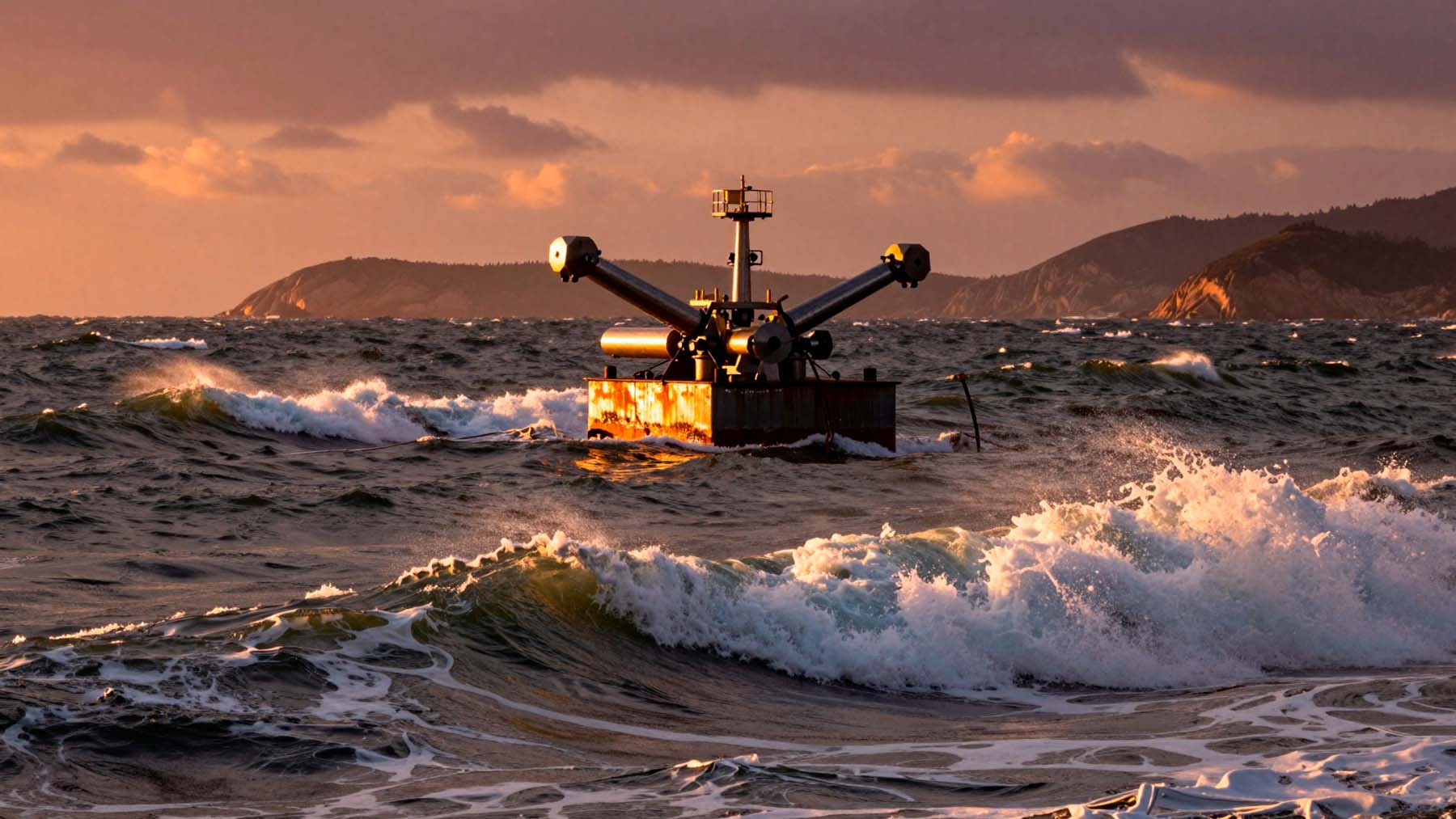 AI-made
Ocean waves are powerful, endless, and completely free. Yet, we still struggle to harness them.
The main issue isn’t a lack of energy. It’s the absolute chaos of the ocean. Waves constantly shift in height, speed, and force. Most control systems just can’t keep up with that unpredictable rhythm.
The problem with taming the ocean
Wave energy offers massive potential across thousands of miles of coastline. It has higher energy density than wind or solar. It is also generally easier to predict. Even so, large-scale wave farms are extremely rare. The gap between theoretical energy and actual power output remains massive.
Researchers taught a wave generator to correct for the ocean’s chaos in real time, and it produced 140% more power than a conventional system.
The technical barriers are well documented. Random waves hit conversion systems with unpredictable forces. Meanwhile, the machines themselves feature complex, non-linear dynamics. Throw in saltwater corrosion and heavy turbulence. You get a quick recipe for ruined equipment and lost efficiency.
Previous control strategies have all hit strict walls. Sliding mode control causes heavy vibrations that degrade power quality. Passivity-based methods break down when ocean conditions shift.
Standard proportional-integral (PI) control relies heavily on exact mathematical models. That approach fails when the ocean constantly changes the rules.
There is also a massive gap in project planning. Most resource assessments only measure wave height, period, and energy flux. That raw data is useful, but it doesn’t help grid engineers. They need concrete answers on system capacity, deployment distance, and grid integration.
How active disturbance rejection control changes the equation
A research team off the coast of eastern Asia set out to fix this problem. They turned to Active Disturbance Rejection Control, or ADRC. Instead of guessing with a static model, ADRC uses an extended state observer. This tool calculates both internal system errors and external ocean chaos in real time. It then cancels those disturbances out before they can tank performance.
The team applied ADRC to an oscillating buoy direct-drive system. The controller targets maximum power output by precisely tweaking the electrical current inside the generator. This direct adjustment controls electromagnetic thrust, which dictates how much power the buoy captures.
Two extra tools make the control even sharper:
-
A tracking differentiator: It smooths out wild wave signals before they reach the controller. This removes the harsh whiplash of sudden sea changes.
-
A nonlinear state error feedback law: It drives the machine toward its ideal operating point and locks it there.
Under ADRC, the system tracked its target current path for over 80% of the test. Standard PI control produced constant overshoot and wild power swings.
140% more power: What the simulations showed
The researchers set up a head-to-head battle using real ocean wave data. Both control setups received the exact same simulated wave signals, system specs, and 60-second test windows.
The results were dramatic. Under conventional PI control, the system generated an average output of roughly 500 watts. With ADRC active, output skyrocketed to nearly 1,200 watts. That is a massive 140% relative jump in output.
Why such a huge leap? PI control relies on fixed rules and reacts too slowly to sudden wave shifts.
ADRC sidesteps this lag entirely. It estimates the incoming chaos instantly and counters it with forward adjustments. This turns a messy, chaotic wave input into a smooth, predictable system. To test seasonal shifts, the team ran simulations across a full year of wave data. The ADRC controller held its massive performance lead across all 12 months.
Finding the economic sweet spot: Capacity and distance
Better control algorithms are only half the battle. Knowing where to put the buoy matters just as much over a 30-year operational life.
The team created a model to balance two key factors simultaneously: generator capacity (in kW) and distance from shore (measured in feet). The goal wasn’t just chasing peak output. The goal was maximizing overall lifetime profit.
Moving farther offshore yields stronger, more consistent waves. However, laying miles of high-voltage underwater cable rapidly inflates construction costs. The economic model factors in real-world energy tariffs, construction expenses of roughly $5.80 per Watt, and cable costs around $45 per foot over a 30-year lifespan.
When you map total revenue against distance and capacity, a clear sweet spot emerges. It proves that blindly chasing the biggest waves is a losing financial strategy.
Eastern Guangdong as a test case: The numbers
The team ran their model on real-world test data from the coastal waters of eastern Guangdong. The math revealed a very specific setup for maximum return. The ideal configuration calls for a 195.59 kW system placed roughly 5,900 feet (about 1.1 miles) offshore. Over its 30-year lifespan, that single setup is projected to generate roughly $700,000 in net revenue.
The system achieved an average wave capture width of 28.2 feet across the year. That translates to an optimal installed capacity of roughly 6.9 kW per foot of wave front.
Seasonal swings were still massive. Daily generation peaked at 360 kW in December but dropped down to 90 kW in June.
That four-to-one seasonal gap proves why smart capacity sizing matters far more than peak power ratings. This model finally bridges the gap between raw ocean data and practical grid planning.
What comes next for wave energy integration
The researchers are open about what their study hasn’t solved yet. Capturing wave energy efficiently is a huge step, but feeding it into a commercial power grid is another battle entirely.
Unstable wave power can cause voltage spikes, frequency drops, and general grid instability. To solve this, the team is working on a unified “wave-control-grid” optimization model. This system will combine ocean physics, generator algorithms, and local grid capacity into a single tool.
The goal is to move beyond asking how much power we can make. Instead, it will answer how much wave energy the local power grid can safely handle.
Expanding tests to other coastlines around the globe will show if this technology works everywhere.
So, what is the ultimate takeaway from this research breakthrough? Researchers taught a wave generator to correct for the ocean’s chaos in real time, and it produced 140% more power than a conventional system.
You can check the full study here: Zhang C, Guo Z, Li S, Ma J, Qiu Z, Jia W, Li X, Zhang Y, Luo F and Chen H (2026) Generation potential assessment of offshore wave energy considering maximum power point tracking strategy from viewpoint of distribution network planning. Front. Energy Res. 14:1825091. doi: 10.3389/fenrg.2026.1825091
Kelly is an experienced writer with 15 years of experience exploring the big stories that shape our world, from tech breakthroughs and space exploration to climate, energy, and the fascinating quirks of science. She has a talent for turning complex ideas into sharp, memorable insights that stay with readers long after they’ve finished reading.
