
Nearly four-inch hailstones slammed into a Texas solar farm, where the panels tilted to 52 degrees but about 40 failed to respond
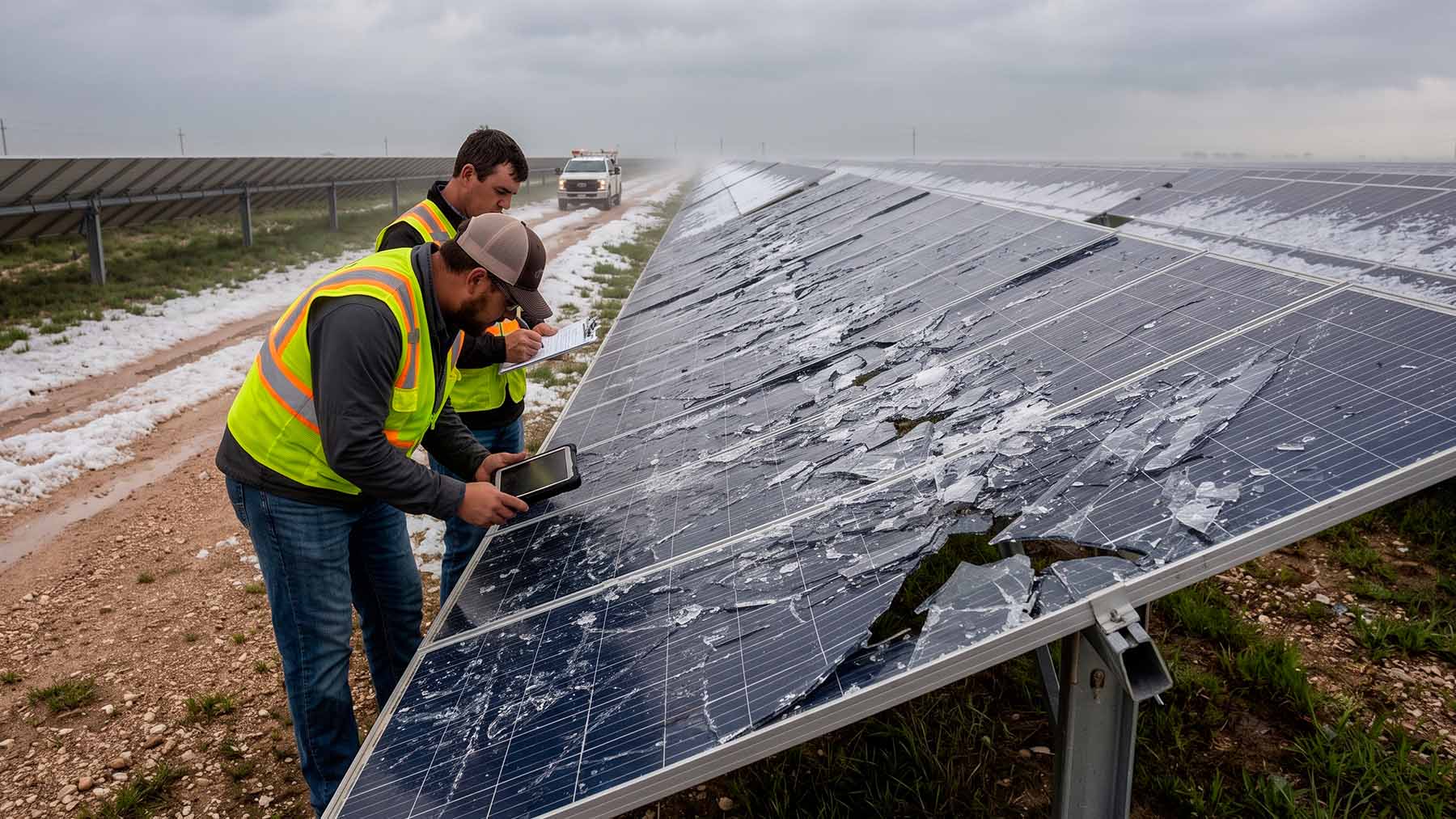 Credits: AI-madde
Solar farms are vulnerable to volatile weather, but a Texas plant showed how to shield panels against hailstones.
As atmospheric patterns shift, the risk of damage to large-scale clean energy grids will increase.
To address climate change, renewable capacity must expand to displace fossil fuels once and for all.
With weather events intensifying, operational defenses should ideally include SCADA automation for immediate, API-triggered stowing before the storm hits.
If not, continued reliance on carbon-heavy fuels will only accelerate it further.
What can truly be done to help protect solar panels against unforeseen catastrophic storms?
How green growth struggles to keep up with the pace of climate change
Today, global renewable energy capacity is over 5.2 terawatts.
It accounts for nearly 85% of the world’s capacity additions.
This growth is now faster than ever before.
It is driven by the high affordability of sources such as solar power.
Green electricity generation has also become fundamental in addressing energy security concerns.
Furthermore, government policies have become more supportive of this global transition.
Despite this substantial clean energy expansion, global warming has not begun to slow.
This is because renewables are primarily supplementary to worldwide energy usage. They are not yet replacing fossil fuels.
Rising electricity consumption, hard-to-abate sectors, and past carbon emissions are all responsible for this.
Decades of accumulated atmospheric greenhouse gases are combining with present emissions, triggering feedback loops.
Until fossil fuels are entirely retired, climate change will outpace green growth.
However, as climate change accelerates, existing infrastructure also faces more risks.
The impact of more volatile weather on renewable installations
Higher greenhouse gas emissions are trapping more heat in the atmosphere.
Consequently, Earth has recently experienced the hottest years ever recorded.
As 2026 is projected to follow this hot trend, atmospheric patterns are set to become more unstable.
More moisture due to the warmer air intensifies storms.
Additionally, the frequency of extreme weather events has increased.
Catastrophic atmospheric conditions now lead to powerful wind gusts, heavy rain, floods, and giant multi-inch hailstones.
These volatile conditions lead to higher physical risks for utility-scale clean energy grids.
Solar farms are especially exposed, as the glass installations often cover thousands of acres.
Standard panels have been certified against one-inch hailstones. When supercell storms drop four-inch hail, these arrays fail.
In March 2024, this was evident after three extreme hailstorms swept through Fort Bend County, Texas.
One solar project suffered severe damage, while three others had virtually zero damage.
A solar farm with a smart panel orientation
While storms are tearing apart standard solar panels, active operational defense can lead to a different outcome.
Standard, single-axis trackers arrange panels horizontally to maximize sunlight absorption.
The flat glass remains highly vulnerable to direct, vertically falling hailstones.
However, the nearby plants, Cutlass I, Cutlass II, and Old 300, received automated warnings of the incoming storms.
Operators triggered hail stow protocols, rotating panels into a 52-degree defensive angle.
This prevented direct, shattering blows, as the four-inch hailstones harmlessly bounced off the glass of tilted panels.
At the Old 300 plant, this protocol was put to an isolated, definitive test.
A failure to respond that led to severe ice damage
The majority of the site’s panels stowed successfully.
However, one tracker motor failed, leaving 40 solar panels locked in a flat layout.
While the tilted panels survived, the 40 unstowed panels were shattered by the hailstones.
The findings of the Fort Bend County incident offer important lessons to secure renewable infrastructure in the future.
Manual responses alone are no longer sufficient to protect fragile installations.
With weather events intensifying, operational defenses should ideally include SCADA automation for immediate, API-triggered stowing before the storm hits.
Ultimately, routine tracker motor testing, stronger module glass, and default overnight tilting could be future best practices for solar protection.
Anke Maree is a writer with a clear and engaging editorial style. Her work focuses on making complex topics accessible, informative, and relevant for readers across different areas of interest.
