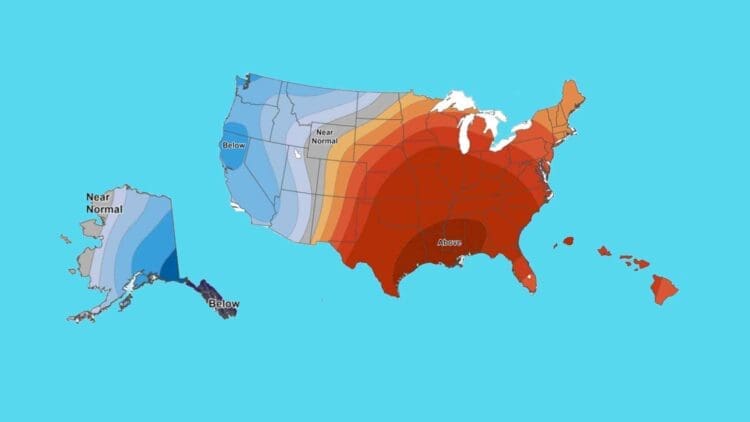

The National Oceanic and Atmospheric Administration (NOAA) has sounded the warning bell. In some regions, citizens should brace themselves for extreme weather conditions alternating between heavy rainfall and extreme droughts. These conditions are resulting from changing atmospheric patterns, and while some believe these changes are to be expected, NOAA has released a new index to account for climate change impacts. Now the question remains, will your region be hit with rain or with a drought?
Adapting to the effects of climate change
The U.S. is no stranger to extreme weather conditions, but as of late, these conditions are increasing in frequency and intensity. The reason for this is none other than climate change, which has impacted atmospheric patterns. As a result, weather predictions are becoming more complex compared to previous years, which is why NOAA introduced a new index, made official on February 1st.
Historically, La Niña and El Niño timelines, which entail the length of the eastern and central Pacific Ocean having extreme ocean temperatures, have been observed to predict cold or warm events. La Niña usually indicates “cooler-than-normal” ocean temperatures, and El Niño indicates ocean temperatures a minimum of 32.9 degrees Fahrenheit above normal.
Seeing as climate change has led to ocean temperatures rising, NOAA is now using the Relative Oceanic Niño Index, and the new weather predictions are in, and as atmospheric patterns change, some U.S. regions should start preparing for the extremes.
NOAA’s warning: Atmospheric patterns are changing
This winter, citizens in the central and northern U.S. experienced the combined wrath of a significant La Niña and Arctic Blast. The impact of the seasonal La Niña alone led to significant snowfall in the North, while the South experienced drought conditions. As the Arctic Blast events struck the U.S., colder temperatures made their way to the South, resulting in record-low temperatures and more extreme droughts for this time of year.
Infrastructure was disrupted, with the energy, agriculture, and travel sectors impacted by extreme conditions. Citizens in some regions even became witnesses to a rare phenomenon known as “ice tsunamis.” Now, the latest NOAA data predict a strong likelihood that all of this is about to change soon, as atmospheric patterns are moving towards a neutral state that may have extreme conditions in store for some regions.
These regions should expect rainfall and droughts
The latest data from NOAA predicts a 60% likelihood for La Niña changing to El Niño-Southern Oscillation (ENSO) -neutral conditions. This change is predicted to occur between February and April, and this condition will most likely continue throughout the Northern Hemisphere’s entire summer. This means that weather patterns are more variable and difficult to predict, but it does indicate a shift towards increased drought risks and heavy rainfall across some U.S. regions.
Regions likely to be struck by heavy rainfall
Regions in the Southeast, northern Midwest, and Pacific Northwest are at risk for heavy rainfall and flooding due to the ENSO-neutral conditions, especially in Florida and surrounding areas.
Regions likely to be struck by drought risks
Should ENSO-neutral conditions persist, the Southwestern regions of the U.S. will be at higher risk of experiencing prolonged droughts due to the absence of the El Niño moisture, with the impact spreading toward the Southern Plains. These regions include:
- California
- Arizona
- New Mexico
- Nevada
- Utah
- Texas
- Oklahoma
As weather conditions become unpredictable for the foreseeable future, citizens are advised to remain up to date on the latest weather forecasts and to prepare for extreme conditions, as in some cases, regions burdened by prolonged droughts may experience sudden bursts of rainfall that may lead to dire consequences. As these extreme conditions worsen, parts of the U.S. have been identified to be hit the hardest by the UN’s newly declared “bankruptcy” warning.