
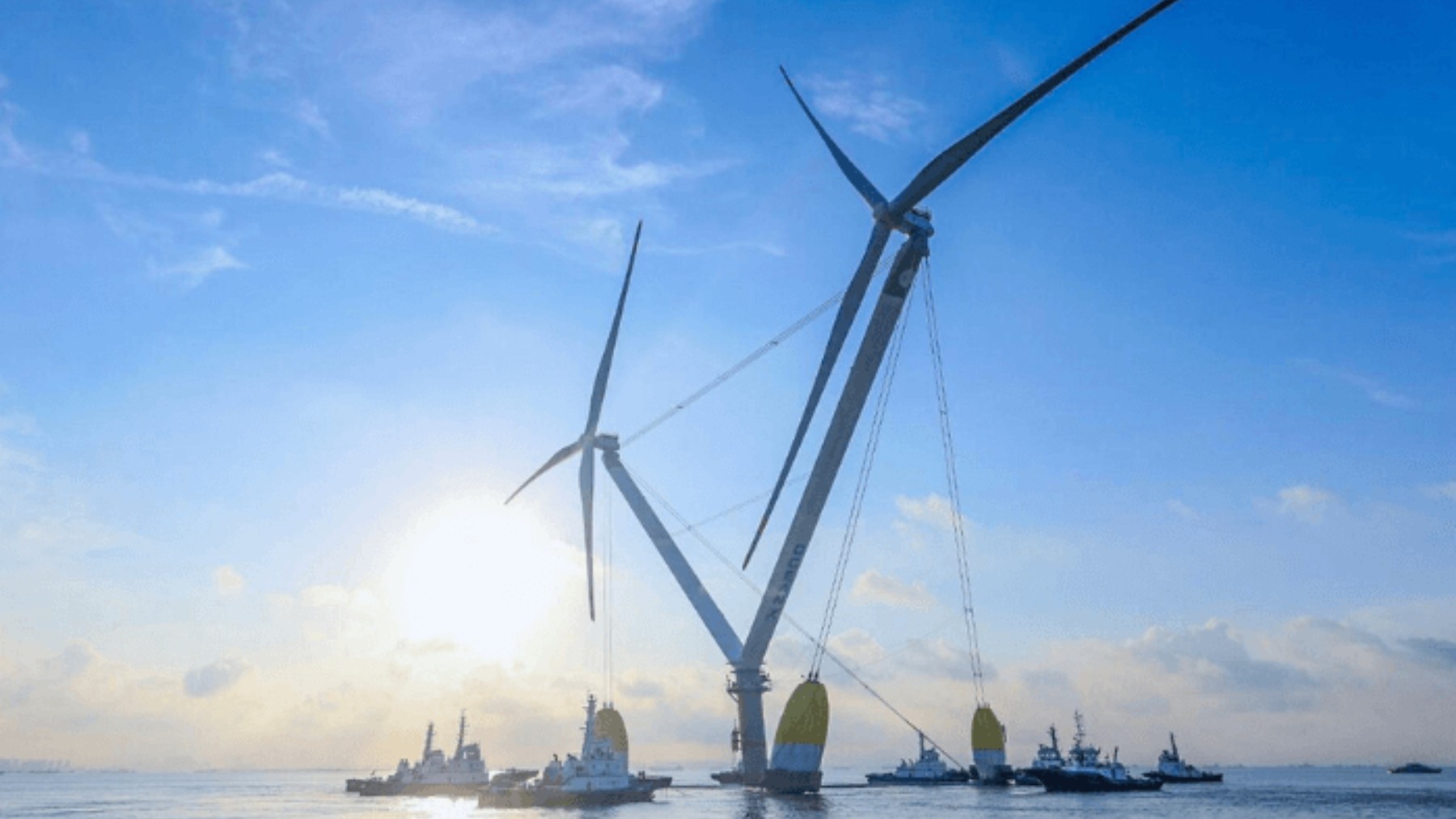
In China, a wind turbine at sea with two rotors joined in a ‘V’ shape is generating as much electricity as 15 turbines running at full power
 Credits: Mingyang Smart Energy
The Chinese are tapping energy in deeper waters using a “V-shaped” wind turbine with two rotors.
Worldwide, the need for clean power is rapidly rising, and onshore technology is no longer sufficient.
As wind technology moves further offshore, developers are pushing to harness even stronger, more consistent wind.
Furthermore, the dual-rotor technology on one platform sets a transformative benchmark for harnessing commercial deep-sea clean power.
But deep-sea progress requires a design innovative enough to withstand extreme marine conditions.
Will reimagining turbine platforms help nations generate unprecedented electricity?
How global clean energy demand has escalated
The modern world has rapidly evolved over the years.
The expansion of industrialization and growth in digitization are key drivers of this evolution.
While these advancements are necessary, they have triggered a significant demand for clean energy.
Global power demand is rising 50% faster than the average growth rate over the past decade.
Digital consumption is outpacing new generation deployment.
As this imbalance grows, utilities are trying to overcome it by burning fossil fuels for backup power.
This has driven up greenhouse gas emission levels, proving that the global transition is no longer just a long-term goal.
As urgent climate targets and rapid economic expansion collide, decarbonization becomes more critical.
Both issues can be addressed by accelerating the scaling up of clean energy production.
However, major population centers present significant land constraints, rendering traditional onshore renewables less ideal.
That is why offshore electricity generation is rising in popularity.
Seeking deep-ocean wind for higher power generation
The advantages of offshore wind over land-based wind turbines are distinct.
Ocean winds are stronger, far more reliable, and consistent than winds on land.
This allows a higher output, especially as the technology scales and advances.
Furthermore, deploying turbines miles off the coast overcomes visual pollution and bypasses spatial limitations.
However, conventional offshore infrastructure relies on fixed-bottom foundations.
These foundations disrupt the seafloor’s sediment, triggering a chain of events.
Additionally, the design restricts installation to shallow waters under 197 feet.
But over 80% of offshore wind resources are located in depths much deeper.
Nonetheless, deployment in uncharted deep waters presents significant challenges.
Marine storms, ocean currents, and wave heights are more extreme deeper offshore.
Turbine designs must be equipped to withstand these conditions, adding complexity to engineering.
Furthermore, installation, operation, and maintenance are highly expensive.
The Mingyang Smart Energy Group addressed these challenges with its flagship V-shaped wind turbine.
A unique wind turbine design to harness more offshore wind power
China is tapping into the wind potential of the deep sea using floating wind turbines.
Mingyang Smart Energy specifically designed a floating platform for these harsh environments.
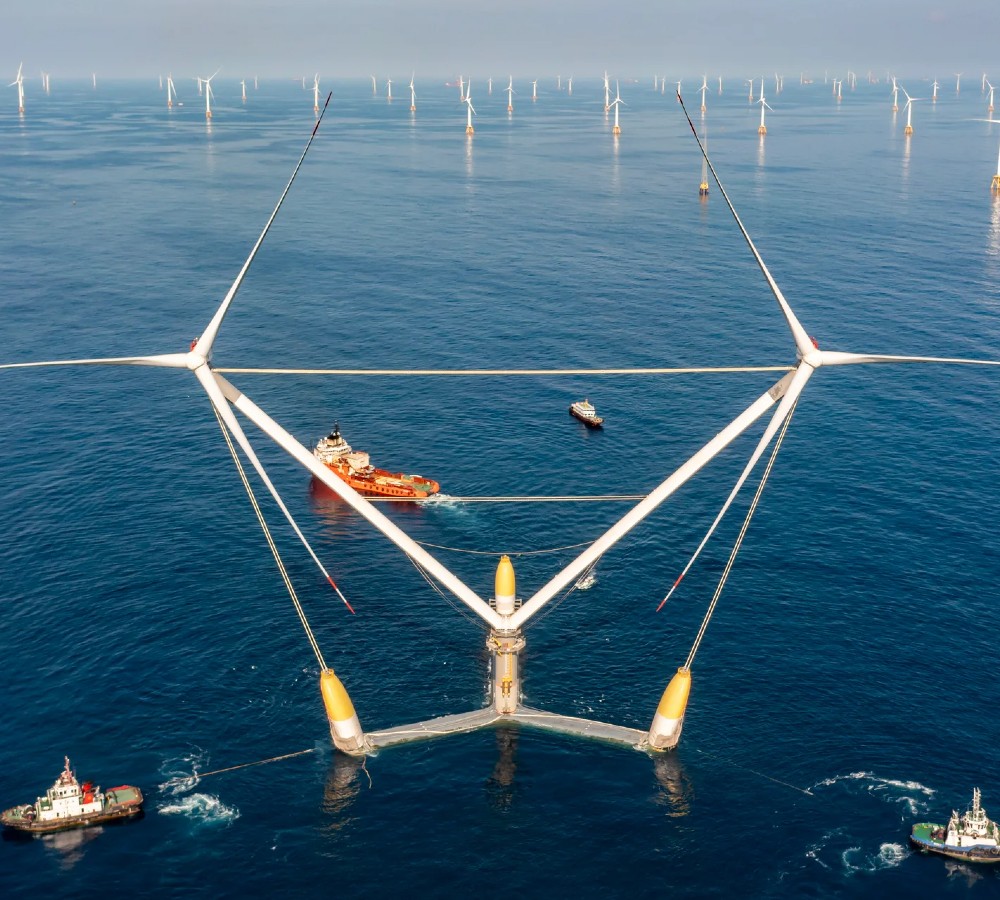
It is called the OceanX and features two 8.3 MW turbines mounted on one V-shaped tower structure.
The single floating platform produces 54 million kWh of clean electricity annually.
That is enough power to supply 30,000 three-person households for an entire year.
Key innovations of the OceanX floating wind turbine
The dual rotors counter-rotate, sweeping over 560,000 square feet of air.
This design creates a coupled vortex effect, boosting electricity production efficiency by over 4%.
The floating foundation is made from specialized concrete, which is four times stronger and significantly lowers manufacturing costs.
A single-point mooring system enables natural rotation with shifting winds.
The adaptive mechanism helps the wind turbine endure typhoons with 178 mph winds and 98-foot waves.
OceanX has been successfully deployed at the Qingzhou IV wind farm in China and is now fully operational.
By using floating wind turbines, vast offshore energy potential can be unlocked while withstanding harsh open ocean conditions.
Furthermore, the dual-rotor technology on one platform sets a transformative benchmark for harnessing commercial deep-sea clean power.
Ultimately, innovative floating turbine designs are reshaping the future, helping to meet climate targets and global energy demands.
Anke Maree is a writer with a clear and engaging editorial style. Her work focuses on making complex topics accessible, informative, and relevant for readers across different areas of interest.
