
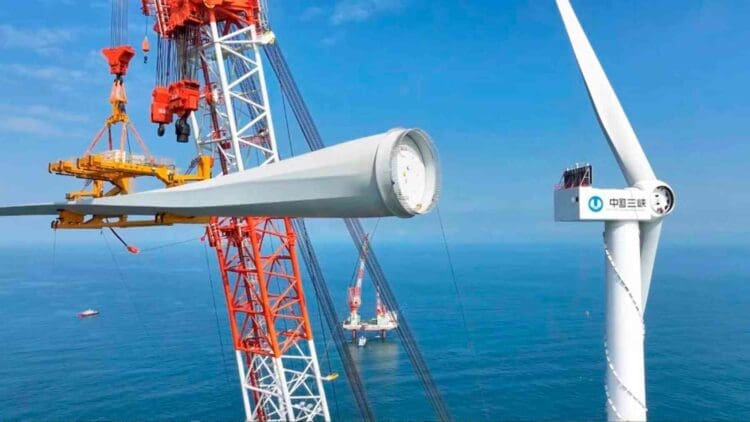

Off the coast of southern China, a structure taller than most skyscrapers now floats in waters too deep for any conventional wind turbine to stand. Its rotor stretches more than 800 feet across, and its blade tip climbs nearly 900 feet above the surface of the South China Sea.
China’s newly installed Three Gorges Pilot isn’t just an engineering record. It may signal a turning point for offshore wind — one that could bring commercial-scale power generation to vast stretches of ocean the industry has long had no way to reach.
A turbine built for the deep ocean
The Three Gorges Pilot is a 16-megawatt turbine mounted on a semisubmersible platform, installed off Yangjiang in Guangdong province by China Three Gorges Corp. Its rotor spans 827 feet (252 meters). The blade tip rises more than 886 feet (270 meters) above the water’s surface — taller than most of the world’s skyscrapers.

Most of the structure was assembled on land at Tieshan Port, then towed offshore and connected at its final location for testing. That land-first approach helped engineers manage the complexity of integrating a system this large before it ever faced open-ocean conditions.
The site was chosen because the water depth rules out fixed-bottom foundations entirely. Where conventional offshore turbines anchor directly to the seafloor, the Three Gorges Pilot floats — and that distinction matters enormously for where wind power can go next.
Engineering a platform that can survive Category 5 conditions
Floating in deep water means surviving whatever the ocean throws at you. The platform is designed to withstand waves exceeding 66 feet (20 meters) and wind speeds up to 164 mph (264 km/h) — the equivalent of a Category 5 hurricane.
To stay in place under those forces, the platform uses a mooring system combining suction anchors, anchor chains, and high-strength polyester lines. Ballast systems and real-time monitoring add further stability as conditions shift. The structure also incorporates design features built to absorb and distribute wind and wave forces rather than resist them rigidly — spreading loads across the platform, reducing wear, and extending its operational lifespan in a punishing marine environment.
The power cable that moves with the sea
One of the less visible but equally important innovations is how the turbine connects to the grid. The Three Gorges Pilot uses a 66-kilovolt dynamic subsea cable — a specialized underwater line built to carry high-voltage electricity while flexing continuously with the moving platform. Its wave-shaped design incorporates high-flexibility conductors, reinforced armor layers for tensile strength, and fatigue-resistant insulation.
Static cables snap. Maintaining a reliable grid connection under perpetual movement is one of the core challenges of floating offshore wind, and the dynamic cable solution is a meaningful step forward in making floating turbines not just structurally sound, but genuinely grid-ready.
Enough electricity for 4,200 homes — and a glimpse of what’s possible
At peak efficiency, the turbine is expected to generate approximately 44.65 million kilowatt-hours of electricity per year. Based on average U.S. home consumption of roughly 10,500 kWh annually — per figures from the U.S. Energy Information Administration — that output could power around 4,200 homes.
The project builds directly on a turbine deployed the previous year by China Huaneng Group and Dongfang Electric Corp., with the Three Gorges Pilot’s primary advances coming at the structural and systems engineering level. Each iteration closes the gap between a working prototype and a technology that developers can actually build a business around.
Opening up oceans that wind power couldn’t reach before
Fixed-bottom offshore wind has always been constrained by geography. Where the continental shelf drops steeply, foundations become impractical — or simply impossible. Japan, South Korea, and parts of Europe have limited shallow coastal waters, and for them, floating offshore wind isn’t a nice-to-have. It may be the only viable path to large-scale offshore generation at all.
The Three Gorges Pilot tackled four interconnected challenges simultaneously: large rotor loading, platform stability, dynamic mooring, and offshore grid connection. Each had to work — and work together — for the installation to succeed. If the deep-water test performs as expected, the implications reach well beyond China. A proven, deployable floating wind system at this scale could accelerate commercialization globally, opening up vast stretches of ocean that the wind industry has, until now, had no practical way to reach.

Carlos is an engineer with strong expertise in technical and industrial topics. He previously worked at international companies such as Siemens and speaks Spanish, German, English, and Italian.