
Max Planck Institute develops 2-MW gyrotrons to upgrade Wendelstein 7-X plasma heating system
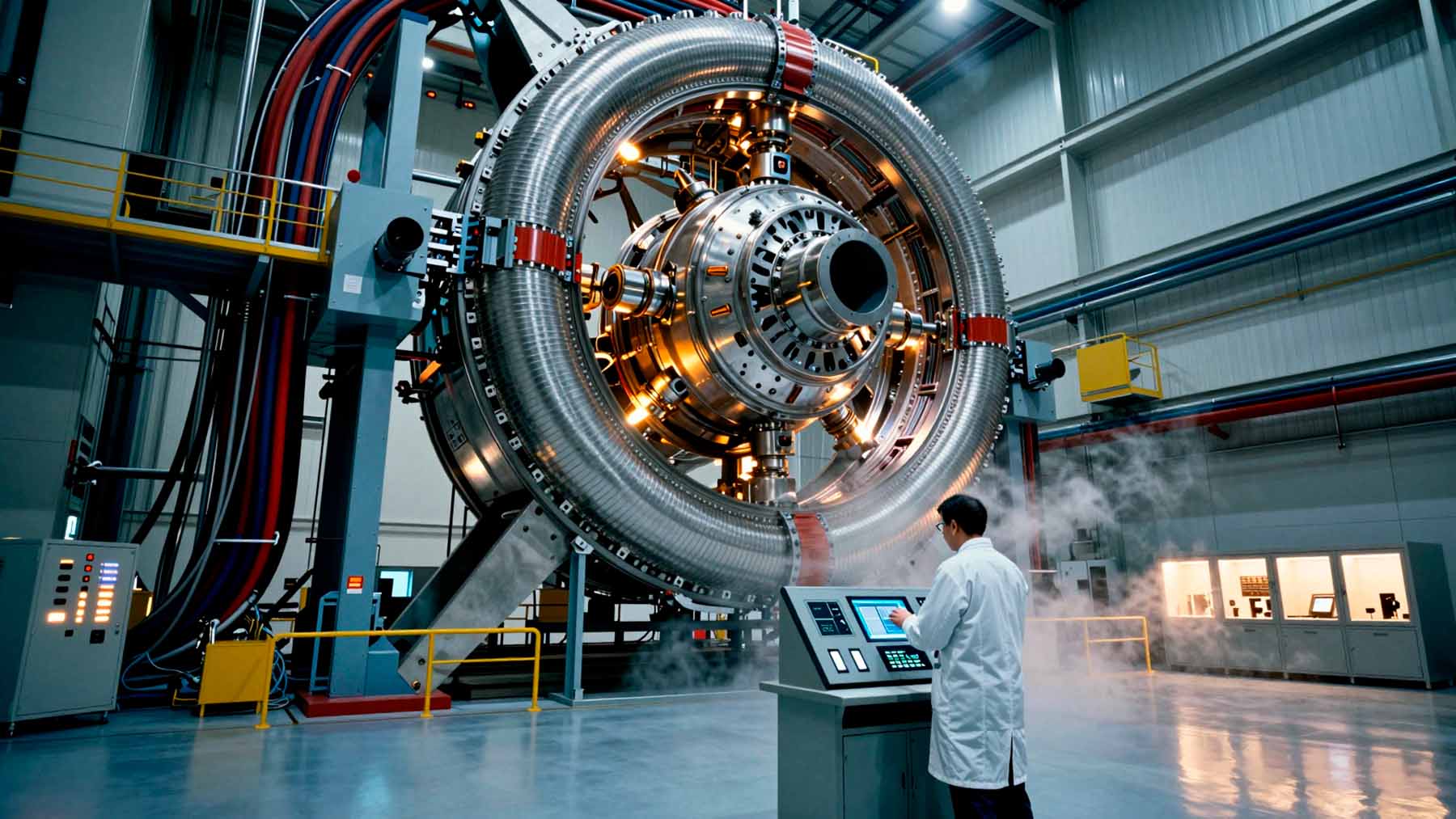 Image generated with artificial intelligence
The Max Planck Institute for Plasma Physics announced on July 27, 2025, that it’s developing 2-megawatt gyrotrons intended to become the primary plasma heating system for the Wendelstein 7-X stellarator—currently the largest superconducting stellarator facility in the world.
The upgrade marks a significant step for a device already at the frontier of fusion research.
IPP announces 2-MW gyrotron development for W7-X
On July 27, 2025, IPP confirmed it’s actively developing 2-MW gyrotrons to serve as the main plasma heating system for Wendelstein 7-X. This isn’t a minor tweak to an existing setup — it’s a deliberate push toward significantly higher heating power than what current systems provide.
But lower power means real limits: constrained discharge durations and a ceiling on how far into high-performance territory researchers can actually push the device.
The goal is straightforward: give W7-X the tools it needs to push further into fusion-relevant plasma conditions. As the world’s largest superconducting stellarator, W7-X is already operating at the edge of what the stellarator concept has demonstrated. The new gyrotrons are meant to extend that edge considerably.
Why W7-X requires more powerful heating
Plasma heating isn’t optional in fusion research — it’s fundamental. To reach the extreme temperatures required for fusion reactions, researchers need to pump enormous amounts of energy into the plasma in a controlled way. Gyrotrons do exactly that, generating high-power microwave radiation and directing it into the plasma to drive temperatures up to fusion-relevant levels.
The current heating systems at W7-X operate at lower power levels. That’s not a flaw — it reflects where the technology stood when those systems were designed. But lower power means real limits: constrained discharge durations and a ceiling on how far into high-performance territory researchers can actually push the device.
Moving to 2-MW gyrotrons changes that calculus entirely. With more heating power available, W7-X could sustain longer plasma discharges and reach conditions that simply weren’t accessible before. In fusion research, a wider experimental space means faster learning.
Expected impact on W7-X research program
More power doesn’t just mean more heat — it means more science. Higher heating capability is expected to expand the range of plasma conditions W7-X can study, letting researchers probe regimes directly relevant to what a real fusion power plant would need to operate in.
That matters because W7-X isn’t just a physics experiment. Its core mission is to close the knowledge and technology gaps standing between today’s stellarator research and a viable stellarator-based power plant. Every experiment that pushes plasma confinement closer to reactor-relevant conditions becomes a data point informing future design decisions — nothing is wasted.
With 2-MW gyrotrons, researchers could test plasma confinement at conditions closer to those a commercial reactor would require. Those results wouldn’t stay at W7-X; they’d feed directly into how future stellarator power plants get designed. The gyrotron upgrade is as much about the next generation of devices as it is about improving this one.
There’s also a broader logic at work here. In fusion research, confidence in a concept gets built by demonstrating it progressively under more demanding conditions. Each step up in performance narrows the gap between experimental proof-of-concept and a practical energy source.
Background: Wendelstein 7-X and the stellarator approach to fusion
W7-X sits at IPP’s facility in Greifswald, Germany, and has been operating since 2015. Over that period, it’s set multiple performance records for the stellarator concept—a notable achievement, given that stellarators were long considered the more technically complex alternative to the more widely studied tokamak.
The key difference between the two approaches comes down to magnetic confinement. In a tokamak, the magnetic field geometry depends partly on a current running through the plasma itself. A stellarator, by contrast, achieves its confinement geometry entirely through external control — shaped by a carefully engineered set of magnetic coils. No reliance on plasma current, which removes one of the major instability risks tokamaks have to manage.
The tradeoff is control-shaped complexity. Getting the coil geometry right in a stellarator is extraordinarily difficult, which is part of why tokamaks dominated fusion research for decades. W7-X was built to show that the engineering challenge is solvable—and that once solved, the stellarator’s inherent stability advantages become genuinely accessible. IPP’s long-term goal is to demonstrate that the stellarator concept can serve as the basis for a fusion power plant, and W7-X is the primary vehicle for making that case.
More heating power, longer plasma discharges
IPP is developing 2-MW gyrotrons to replace the current plasma heating systems at Wendelstein 7-X. The Max Planck Institute upgrade is designed to deliver significantly more heating power, enabling longer and higher-performance plasma discharges. W7-X — the world’s largest superconducting stellarator — is focused on closing the knowledge and technology gaps needed to develop a stellarator-based power plant. Higher heating power will expand the range of plasma conditions the facility can study and generate data directly relevant to future reactor design. The announcement was made on July 27, 2025.
Kelly is an experienced writer with 15 years of experience exploring the big stories that shape our world, from tech breakthroughs and space exploration to climate, energy, and the fascinating quirks of science. She has a talent for turning complex ideas into sharp, memorable insights that stay with readers long after they’ve finished reading.
