
Cattle still crossing the rangeland where 916 turbines now turn across three New Mexico counties, and the machine they form just rewrote what a single American wind farm can deliver
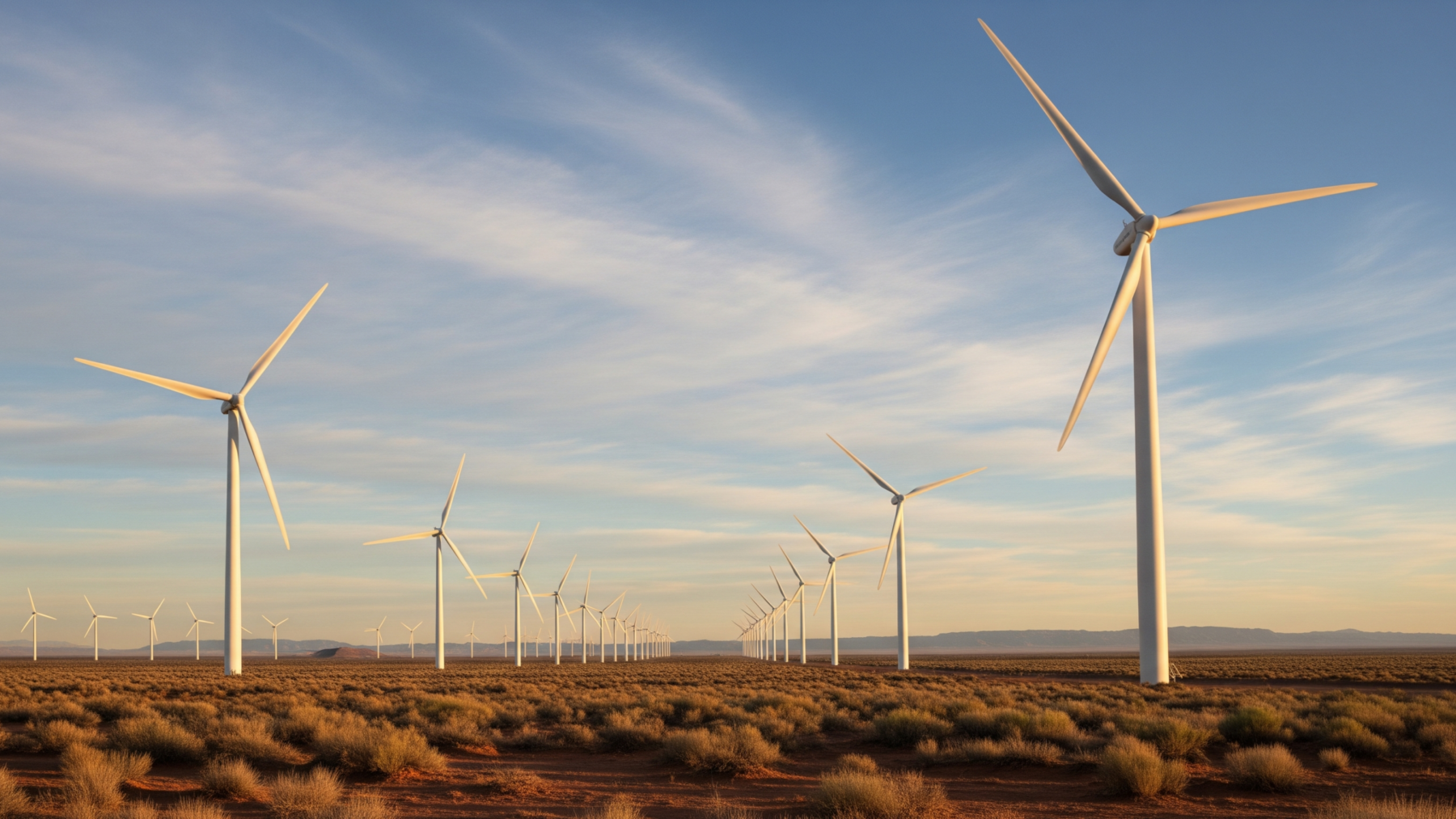
Something enormous is turning in the high desert of central New Mexico, and almost nobody living beneath its shadow fully grasps what it means yet.
Nine hundred and sixteen turbines now stand across three counties.
Each one rises from rangeland that cattle still cross every morning.
Those homes are mostly in California and Arizona, states whose residents would never guess their electricity began its life in a windy basin most have never visited.
Together they form a machine so large that it rewrote the record books for American wind energy the moment it switched on.
And the electricity it makes does something almost no one expected: it vanishes into a wire and travels more than 550 miles before reaching homes in Arizona and Southern California.
A desert nobody thought to plug in
The Estancia Valley sits in the middle of New Mexico at roughly 6,000 feet.
Most travelers pass through without stopping.
What they miss is the wind: a steady, almost mechanical flow that scours the basin day and night, unobstructed by mountains, unmarked on any tourist map.
Pattern Energy noticed it more than two decades ago.
The company began the permitting process in 2006 and spent the better part of 18 years navigating federal land reviews, environmental studies, and transmission agreements before a single foundation was poured.
Construction finally started in 2023, after almost two decades of planning.
Few energy projects in American history have taken longer to go from idea to blade spin.
What 916 turbines actually look like from the ground
Numbers on a page rarely prepare a visitor for the reality.
The wind farm spans three counties: a northern section in San Miguel and Lincoln counties with 242 turbines, and a southern section in Lincoln and Torrance counties with 674 turbines.
Stand near the southern cluster and the machines disappear toward the horizon in every direction.
The turbines are a mix of GE Vernova and Vestas machines, among the most powerful onshore models operating anywhere in the country.
Before SunZia came online, New Mexico’s total wind generating capacity stood at roughly 4,000 MW.
The new farm pushed that figure above 7,600 MW.
Wind now accounts for 45 percent of the state’s entire generating capacity mix, a share that would have seemed implausible a decade ago.
The number that makes engineers go still
The project cost $11 billion in total.
SunZia’s capacity is more than three times larger than the next biggest wind farms in the country: Alta Wind in Southern California at 1,098 MW and Great Prairie in northern Texas at 1,027 MW.
Not a little bigger, not twice the size: three times larger than the runner up.
On May 15, 2026, grid monitors recorded 7,122 MW of hourly wind generation across the region, a figure 20 percent above the prior annual record, with SunZia’s turbines already contributing during the testing phase.
That single hourly spike rewrote what American wind had ever put on the wire at once.
And the full farm had not yet reached commercial operation.
The hidden journey the electricity takes before it reaches a home
Here is what makes SunZia genuinely different from every other American wind record holder before it.
The project entered commercial operation in June 2026, connecting 3,650 MW of desert wind to Arizona and Southern California via a 550-mile high voltage direct current transmission corridor.
High voltage direct current, or HVDC, makes very long transmission possible with far less energy lost along the way than a conventional power line would waste.
The farm delivers enough capacity to power approximately one million American homes annually.
Those homes are mostly in California and Arizona, states whose residents would never guess their electricity began its life in a windy basin most have never visited.
The 550-mile corridor is the largest HVDC transmission buildout ever completed in the United States.
Wind engineers have long known that scaling output is only half the problem; getting electricity to where people live is the other half.
The ranchers, the record, and what comes next
Beneath the turbines, the land still functions as rangeland.
Cattle graze between the foundations on the same bunch grass that fed them before construction began.
Landowners receive lease payments, and the projects are expected to generate approximately $20.5 billion in total economic benefit across the life of the project.
That is a rare outcome: an energy project that leaves the underlying landscape more or less intact and puts money directly into rural schools.
The honest caveat is that permitting took nearly 20 years, revealing how hard it still is to site infrastructure of this scale in the United States.
But the machine is running now, the wire is live, and somewhere in the American Southwest a house is drawing power from a desert most of its residents will never see.
Wind caught in New Mexico, sent across a mountain range, arriving at a kitchen table 550 miles away as though nothing unusual happened at all. Learn more about how energy density shapes where the next generation of clean power gets harvested.

Hugo is an engineer with strong technical expertise. Multilingual from an early age, his writing combines technical clarity with a strong interest in science and energy.
