
Farmland outside Cedar Rapids, a county of fewer than 250,000 people signed a $1.9 million annual deal with one of North America’s largest power companies, and the document they walked away with had never existed before in American energy
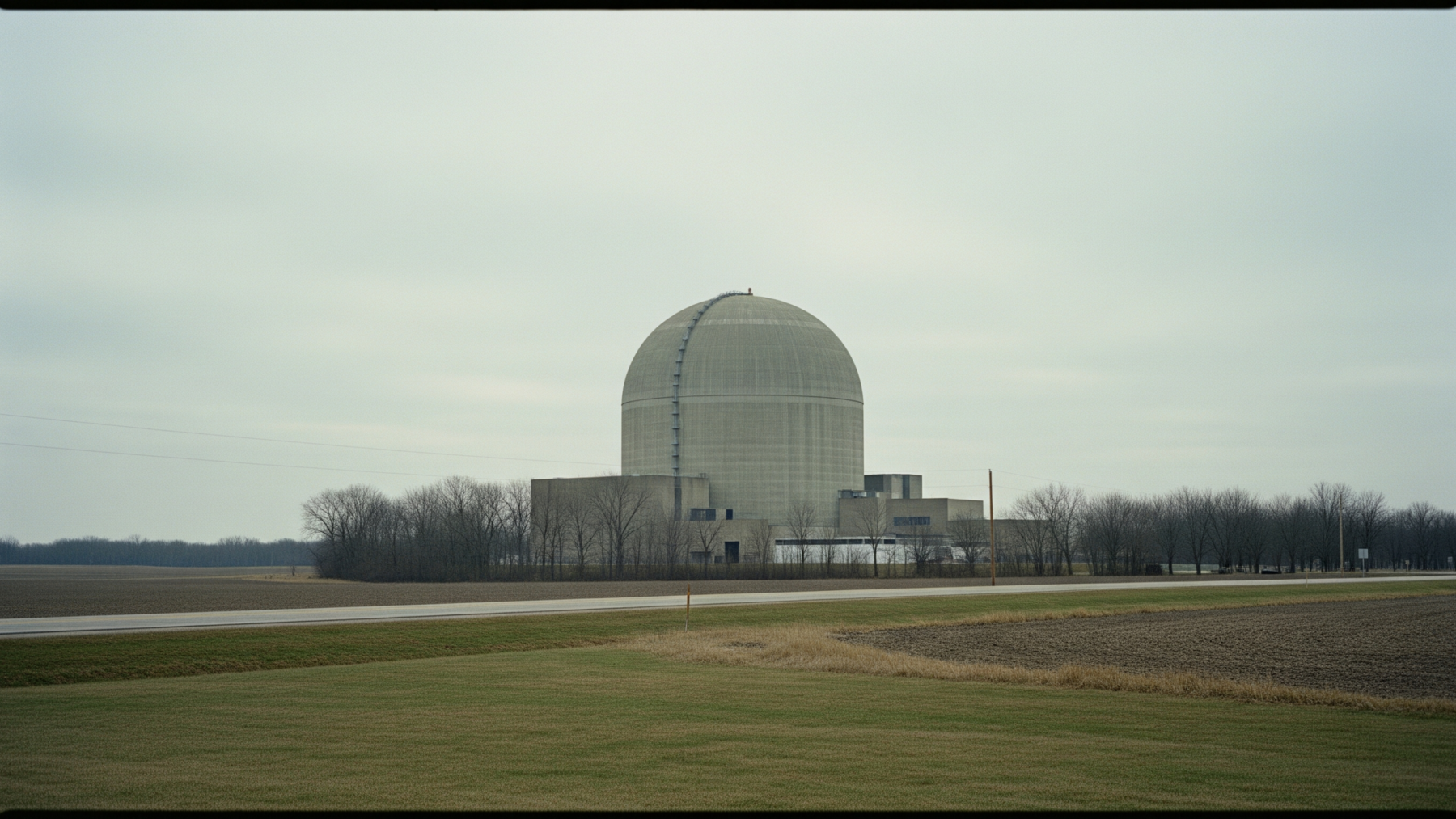
The town of Palo, Iowa counts fewer than 1,000 residents.
It sits on flat farmland northwest of Cedar Rapids, and for 45 years the cooling tower of the Duane Arnold Energy Center was as familiar a landmark as any grain elevator in the county.
Then, in the autumn of 2020, the reactor went dark.
For the first time, the town and the county around it have their names on a legal document that says: before this reactor runs again, you owe us a fair accounting.
A big utility decided the power it bought from Duane Arnold had grown too expensive, walked away from its contract early, and Iowa’s only nuclear plant entered what looked like permanent retirement.
But something was moving beneath the surface of that countryside, and by the first week of 2026 it had produced a legal document that no town living near a nuclear facility had ever held before.
A plant that ran for 45 years and stopped almost overnight
The Duane Arnold Energy Center shut down in 2020 after 45 years of continuous operation.
Its main customer, Alliant Energy, requested an early termination of its power purchase agreement, citing rising costs.
The closure left a community economically exposed.
Hundreds of skilled workers lost steady jobs.
Linn County lost a major property tax contributor, the kind of large industrial ratepayer that quietly subsidizes road repairs, school budgets and emergency services for years without anyone noticing until it disappears.
The 393-acre site fell into regulatory limbo, neither fully decommissioned nor available for another use.
For four years, Palo waited.
Then the data centers came looking for clean power
The plant is now being considered for reopening, driven in large measure by power-hungry data centers demanding firm, carbon free electricity.
NextEra, the plant’s majority owner, secured a 25-year agreement with Google to purchase most of the power from Duane Arnold.
The logic was straightforward: a reactor that had proved it could run reliably for decades, on a site with grid connections and cooling infrastructure still intact, was a faster path than building something entirely new.
In October 2025, NextEra officially announced plans to restart the plant, targeting early 2029.
The announcement set every clock in Linn County ticking.
NextEra needed the county’s blessing to rezone the site from agricultural land to nuclear energy production.
And Linn County had a rare, fleeting moment of leverage.
A county that decided leverage was worth something
Local planning officials spent months studying what hosting a nuclear plant actually costs a county government.
Emergency drills, radiological response training, extra public safety staffing, infrastructure wear from heavy equipment convoys: none of those costs appear on a utility’s balance sheet.
All of them fall on county residents.
Supervisor Sami Scheetz voiced what many felt: that communities near large energy projects often pay a real price for growth they did not choose and cannot easily stop.
He pointed directly to the explosion of AI and data centers as a reason why local communities must be shielded from bearing those costs alone.
County planning director Charlie Nichols began drafting something that had never existed before in American nuclear energy.
The talks with NextEra were hard, detailed and unusually public.
The $1.9 million agreement that rewrote the rules
Linn County’s host community agreement is a first-of-its-kind agreement to create a long-term financial partnership with a nuclear power facility.
Under its terms, NextEra will make an initial payment of $1.9 million to Linn County within 30 days of the plant resuming operations, with that amount rising 5 percent each year.
The funds will support emergency preparedness, radiological response staffing, equipment, training and public safety services tied to the plant’s operation.
Any project related financial impacts fall on the nuclear energy company, not taxpayers.
According to the official county release, planning director Nichols said the agreement is essential to give local governments a seat at the table, and that for nuclear power to have a resurgence in the United States, local communities will need exactly that seat.
Learn how one community confronted a far larger nuclear build, and what it ultimately resolved to do.
A template for every town that could be asked to say yes next
Dozens of shuttered or underused nuclear sites sit inside American counties whose residents will face a similar question in the years ahead.
Utilities, tech giants and federal agencies are pushing hard to keep reactors running or bring cold ones back to life.
Those communities now have a map, drawn by a small Iowa county that simply decided to negotiate before it said yes.
Advanced reactor projects of a very different kind are navigating related questions about local trust and safety accountability at the industry level.
The Duane Arnold restart is far from certain.
Federal licensing, NRC review and a long list of engineering inspections stand between today and the 2029 target date.
The $1.9 million annual payment only begins if and when the plant generates power again.
But for Palo, something has already changed that cannot be undone.
For the first time, the town and the county around it have their names on a legal document that says: before this reactor runs again, you owe us a fair accounting.
That is a small, durable thing, and in a county of fewer than 250,000 people negotiating with one of the largest power companies in North America, it is also an extraordinary one.

Hugo is an engineer with strong technical expertise. Multilingual from an early age, his writing combines technical clarity with a strong interest in science and energy.
