
By day, this Indiana wind farm operates like any other, but after sunset, a first-of-its-kind system switches on and saves thousands of bats
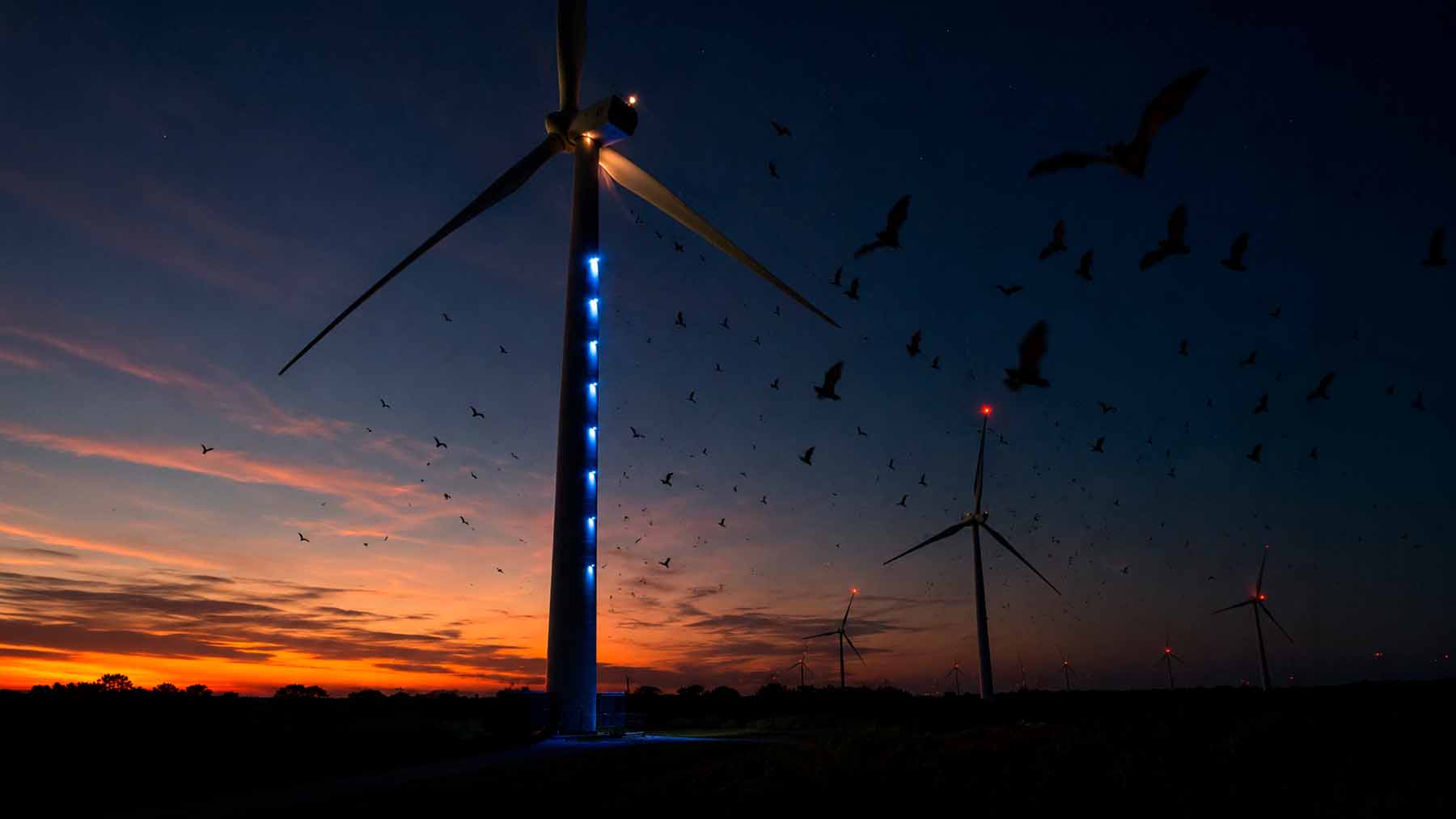 Image generated with artificial intelligence
Thousands of bats are being saved after an Indiana wind farm altered its nighttime operations.
In the United States, green energy goals are fast-tracking the expansion of renewable developments.
Across North America, onshore wind power has become a leading source in the clean energy shift.
This stops fast rotation during foraging hours, successfully protecting the vulnerable species without affecting high-wind power output.
Yet larger turbine infrastructure raises concerns about the potential risks to local wildlife.
Will implementing targeted mitigation efforts help save vulnerable species from unnecessary death?
How America’s climate targets drive green capacity growth
The United States has the world’s largest single digital economy.
The nation, along with Canada, has advanced AI research, integrated digital supply chains, and high-speed broadband.
Consequently, the national electric power sector has been working overtime to meet this increased electricity demand.
Currently, the sector is responsible for generating almost 1.5 billion metric tons of carbon dioxide per year.
This is due to the high reliance on fossil fuels to prevent power fluctuations and potential blackouts.
Without phasing out these carbon-heavy fuels, national and global temperatures will continue to rise.
In the U.S., generating 100% carbon-free electricity by 2035 and achieving zero emissions by 2050 have become crucial goals.
These climate targets have required a significant surge in renewable energy capacity.
Critical to the nation’s green transition is onshore wind.
North American investments have led to substantial growth in U.S. wind generation.
The benefits of scaling North American wind farms
The rural landscapes in North America provide ideal conditions to maximize wind output.
This is why turbine size is scaling up to capture the higher, uninterrupted wind speeds of the open plains.
The vast space also enables more turbines to be placed within a site boundary. Maintaining the correct rotor diameter distance is important to prevent turbulent airflow.
Onshore wind power has also become one of the most affordable sources of new electricity generation.
This is driven by financial incentives, such as corporate power purchase agreements and federal tax credits.
Furthermore, wind energy alone offsets 336 million metric tons of carbon dioxide annually.
Continued large-scale wind farm deployment is thus key to helping the nation meet its climate targets.
However, despite these benefits, certain environmental hazards remain of great concern.
The U.S. Fish and Wildlife Service enforces strict environmental laws that can affect the status of a wind project.
Balancing wind farm capacity growth and regulatory risks
Under the Endangered Species Act, projects that cause unlawful harm to federally protected species can face severe legal penalties.
This is why it is vital to predetermine potential on-site wildlife presence, as well as the risks tied to these animals.
Indiana’s Fowler Ridge Wind Farm illustrates this challenge.
Post-construction monitoring in 2009 and 2010 uncovered carcasses of the endangered Indiana bat. This was after initial operations kicked off.
Projections found that the wind farm’s turbines caused up to 31.71 bat fatalities per turbine annually.
This totaled roughly 10,000 bats per year.
The wind farm partnered with the U.S. Fish and Wildlife Service to create a Habitat Conservation Plan.
In 2014, an Incidental Take Permit was secured, which changed in 2023 to include the northern long-eared bat.
Introducing nighttime mitigation strategies
Automated nighttime curtailment was introduced during seasonal migration periods.
When wind dropped to low speeds where bats were most active, the blades were feathered parallel to the airflow.
This stops fast rotation during foraging hours, successfully protecting the vulnerable species without affecting high-wind power output.
Monitoring results from 2023 indicated that the curtailment strategy works.
During this period, no endangered Indiana or northern long-eared bat carcasses were found at the Fowler Ridge Wind Farm.
Consequently, the bat mortality rate decreased to 8.17 per turbine per year. This is over a 70 percent reduction compared to baseline operations.
Ultimately, this approach can save over 7,000 bats annually while ensuring clean power generation remains high.
Anke Maree is a writer with a clear and engaging editorial style. Her work focuses on making complex topics accessible, informative, and relevant for readers across different areas of interest.
