
Bloom Energy fuel cells cut water use at AI data centers to near-household levels, company says
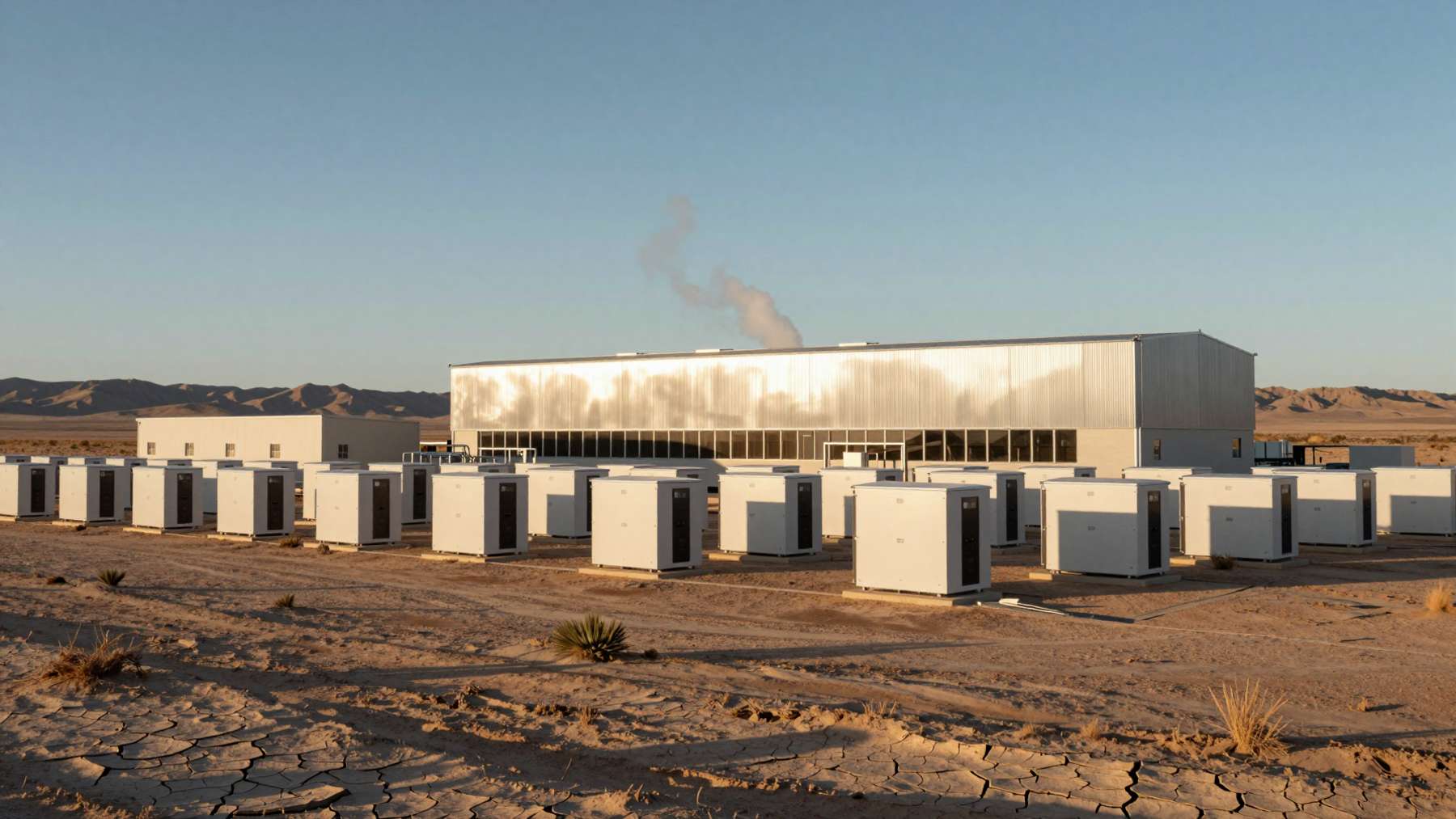 Image generated with artificial intelligence
Bloom Energy says its fuel cell systems can power AI data centers while using a fraction of the water consumed by conventional generation—and the company is backing that claim with a real project. In New Mexico, a campus being built with Oracle is designed so that neither Bloom’s fuel cells nor the data center’s cooling systems require potable water for normal operations. Over 15 years, the site’s average annual water draw is expected to match that of roughly nine U.S. households.
Bloom Energy positions fuel cells as a low-water power source for AI data centers
Bloom Energy says the low water footprint isn’t accidental—it’s built into the technology’s core design. Long before AI started driving massive demand for new power infrastructure, the company says it engineered its fuel cell systems around one principle: reliable electricity shouldn’t put unnecessary pressure on local water resources.
That design philosophy is now getting a real-world test. Bloom’s 2026 Data Center Power Report flagged water consumption as one of the top concerns developers expect to face when seeking community support for new projects. Gallup research cited by Bloom found that nearly half of Americans worry “a great deal” about the environmental impacts of AI data centers. Water has moved from a background issue to a front-and-center one.
Bloom presents that figure as a meaningful benchmark: a large-scale AI campus consuming no more water per year than a small cluster of homes on a residential street.
Bloom contrasts its approach directly with conventional generation. Coal plants, gas turbines, and diesel generators all burn fuel—and that combustion generates heat that typically requires significant water to cool. The company argues its fuel cell design sidesteps that problem at the source.
How the electrochemical process eliminates ongoing water demand
The key difference comes down to combustion—or rather, the lack of it. Bloom’s fuel cells convert fuel directly into electrical energy through an electrochemical reaction. No burning means fuel cells avoid the continuous water-cooling demands of combustion-based power plants.
That process also produces water as a byproduct. Instead of discharging it, Bloom’s systems recycle it back into the fuel cell—so under normal operating conditions, no additional water input is needed after the initial one-time fill at startup.
The contrast with combustion-based systems is significant. In a conventional plant, heat is an unavoidable byproduct of generating electricity, and managing that heat requires a continuous water supply. Bloom’s design removes that loop entirely, reducing water use across the full operational lifecycle rather than just during specific operating modes. Worth noting: these are Bloom’s own characterizations. The company hasn’t cited independent third-party verification of the water figures in the source material reviewed for this article.
New Mexico Project Jupiter: Up to 2.45 GW of fuel cell capacity with minimal potable water use
The most concrete example of Bloom’s approach is Project Jupiter in New Mexico. The campus, developed as part of an expanded partnership with Oracle and STACK Infrastructure, is designed to run on up to 2.45 GW of Bloom fuel cell capacity—a substantial deployment by any measure.
The project pairs Bloom’s fuel cells with closed-loop cooling systems at the data center level. Neither component is designed to require potable water for normal operations. On-site potable water use is expected to cover only standard employee needs—drinking and sanitation—not facility operations or maintenance.
Over a projected 15-year period, the site’s average annual water draw is expected to be comparable to that of approximately nine average U.S. households. Bloom presents that figure as a meaningful benchmark: a large-scale AI campus consuming no more water per year than a small cluster of homes on a residential street.
Community water concerns driving infrastructure decisions for AI developers
Bloom Energy frames water stewardship not just as an engineering achievement but as a prerequisite for earning community trust. Before any new data center breaks ground, communities are asking a standard set of questions—about power sourcing, electricity rates, safety, and now water. Developers who can’t answer the water question credibly face a harder path to approval.
The company argues that AI developers don’t have to treat water impact as an unavoidable trade-off. Choosing technology that minimizes local resource pressure, Bloom says, doesn’t require sacrificing performance. Project Jupiter is presented as evidence that both goals can coexist—and that the tension between infrastructure growth and resource conservation isn’t as fixed as it might seem.
Bloom’s stated position is direct: communities shouldn’t have to choose between supporting AI infrastructure and protecting their water supplies.
Potable water reserved for employees
Bloom Energy’s fuel cell systems require only a one-time water fill at startup. After that, water produced during the electrochemical reaction is recycled internally, eliminating the need for ongoing water input under normal conditions. The company contrasts this with conventional combustion-based generation, which requires active water cooling to manage heat.
Project Jupiter in New Mexico—developed with Oracle and STACK Infrastructure—is designed for up to 2.45 GW of Bloom fuel cell capacity. Over 15 years, the site’s projected average annual water use is equivalent to roughly nine U.S. households, with potable water reserved for employees rather than operations.
Bloom cites both its own 2026 Data Center Power Report and Gallup research to argue that water has become a central community concern for new AI infrastructure. Its broader claim: responsible water use and high-performance AI power aren’t mutually exclusive.
Disclaimer: Our coverage of events affecting companies is purely informative and descriptive. Under no circumstances does it seek to promote an opinion or create a trend, nor can it be taken as investment advice or a recommendation of any kind.
Kelly is an experienced writer with 15 years of experience exploring the big stories that shape our world, from tech breakthroughs and space exploration to climate, energy, and the fascinating quirks of science. She has a talent for turning complex ideas into sharp, memorable insights that stay with readers long after they’ve finished reading.
