
In the Abu Dhabi desert, a solar plant became so massive that it can deliver clean electricity every hour of every day, and 13 global banks bet $6 billion on making it happen
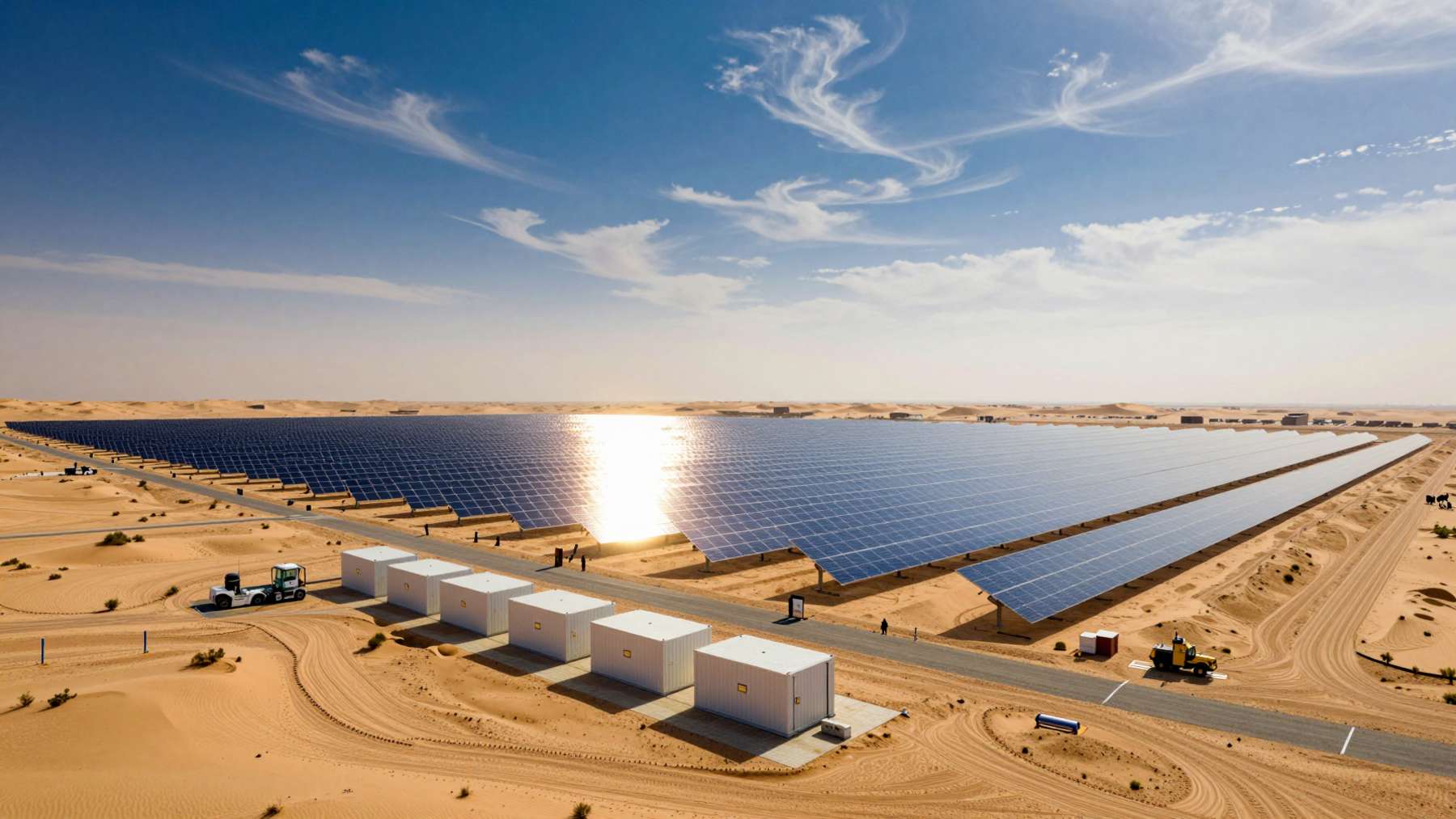 Image generated with artificial intelligence
A single energy project in Abu Dhabi just secured $6.1 billion in financing to deliver 1 gigawatt of continuous clean power around the clock. A single energy initiative in Abu Dhabi recently secured capital financing to break ground on a remarkable engineering feat. The project pairs a massive 5.2-gigawatt solar photovoltaic plant with 19 gigawatt-hours of battery storage.
Together, the integrated system is engineered to supply 1 gigawatt of clean electricity continuously—every hour of the day, every day of the week.
The sheer physical scale of the installation is vast, covering roughly 35 square miles of desert. Yet, the most significant breakthrough isn’t its physical footprint.
Abu Dhabi clean energy developer Masdar achieved financial close on what it formally classifies as the world’s first gigascale 24/7 renewable energy project.
Backed by an international consortium of 13 commercial banks, the venture serves as global proof that round-the-clock renewable generation has officially crossed a major threshold. It has evolved from an ambitious engineering concept into bankable commercial infrastructure.
A project unlike anything built before
Abu Dhabi clean energy developer Masdar achieved financial close on what it formally classifies as the world’s first gigascale 24/7 renewable energy project.
The facility’s engineering specs highlight its massive ambition. Oversizing the solar array to 5.2 gigawatts allows it to harvest surplus energy during peak daylight.
That excess solar energy recharges the 19-gigawatt-hour battery system. At night, the batteries discharge steadily to ensure an uninterrupted 1-gigawatt stream of zero-carbon power.
Most conventional solar projects only generate electricity while the sun shines. This design eliminates that fundamental limitation, utilizing utility-scale batteries to smooth and sustain power delivery without interruptions.
Groundbreaking occurred in October 2025, with full commercial operations targeted for 2027.
For infrastructure on this scale, which typically requires a decade of permitting and construction, a two-year deployment timeline is remarkably swift. It demonstrates exceptional institutional alignment and technical readiness.
The $6.1 billion bet on bankable clean energy
Securing the required capital involved assembling an unprecedented coalition of regional and international financiers.
Masdar has financing of $6.1 billion, with $1 billion in direct equity. The remaining $5.1 billion was arranged through a debt financing package underwritten by 13 major commercial institutions. The lending syndicate includes global powerhouses like HSBC, BNP Paribas, Bank of China, KfW IPEX-Bank, Crédit Agricole, Natixis, Sumitomo Mitsui Banking Corporation, Standard Chartered, and Societe Generale. Regional partners include First Abu Dhabi Bank, Abu Dhabi Commercial Bank, Abu Dhabi Islamic Bank, and Dubai Islamic Bank.
Achieving consensus among 13 institutions across Europe, Asia, and the Middle East on a novel asset class is rarely easy.
The high debt ratio demonstrates deep lender confidence in the project’s commercial structure. Co-developed alongside Emirates Water and Electricity Company, the facility secures a reliable utility-scale power buyer.
From technical ambition to commercial reality
Masdar’s financial milestone signals a profound shift in energy economics. For decades, critics of solar power highlighted intermittency as an insurmountable flaw—clean energy vanishes when the sun sets or cloud cover rolls in.
By pairing gigawatt-scale solar generation with 19 gigawatt-hours of battery storage, this development directly dismantles that criticism. Furthermore, the financing model establishes a repeatable blueprint for international markets. How utility-scale clean energy projects are underwritten and structured typically replicates globally.
A successful execution in Abu Dhabi will likely influence how future baseload storage projects are financed across North America, Europe, and Asia.
Masdar’s broader ambition and what comes next
This gigascale facility fits within a much larger international growth strategy. Masdar currently manages a global portfolio exceeding 65 gigawatts, spanning solar installations, onshore and offshore wind farms, and energy storage across dozens of countries.
The company has set an aggressive corporate goal to reach 100 gigawatts of total renewable capacity by 2030. Achieving that benchmark requires proving that complex, hybrid energy systems can operate reliably under strict commercial terms.
The ultimate operational test arrives in 2027 when the facility begins supplying power to the local grid. If it delivers 1 gigawatt of continuous power as promised, it proves that baseload solar is no longer a distant theoretical ambition.
Here is the true catalyst driving this multi-billion-dollar gamble: the rapid rise of artificial intelligence. Next-generation AI data centers require immense, uninterrupted power loads that traditional intermittent renewables could never support. By guaranteeing continuous baseload clean energy, Abu Dhabi isn’t just building a solar farm—it is constructing the world’s first carbon-neutral power grid engineered specifically to run the future of global AI infrastructure.
Disclaimer: Our coverage of events affecting companies is purely informative and descriptive. Under no circumstances does it seek to promote an opinion or create a trend, nor can it be taken as investment advice or a recommendation of any kind.
Kelly is an experienced writer with 15 years of experience exploring the big stories that shape our world, from tech breakthroughs and space exploration to climate, energy, and the fascinating quirks of science. She has a talent for turning complex ideas into sharp, memorable insights that stay with readers long after they’ve finished reading.
