
Anchored to the seafloor and flying in slow motion, these underwater kites could quietly end diesel dependency in remote coastal communities
 Credits: Minesto
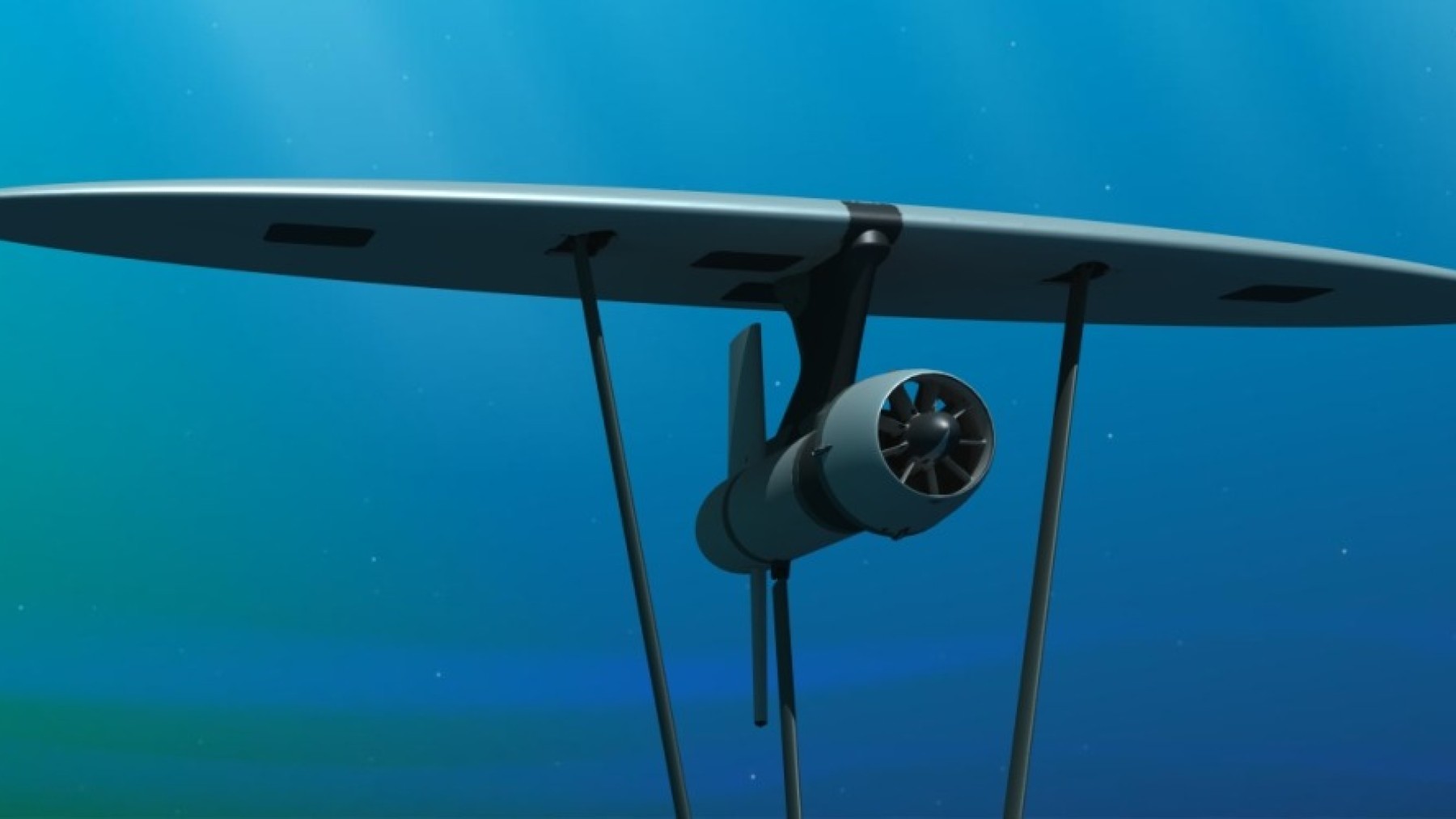
Beneath the surface of a tidal strait, a wing-shaped device sweeps silent figure-of-eight arcs through the current — not drifting, but flying, anchored to the seafloor and guided by onboard electronics. It harvests energy from the slow, steady pull of the tides.
For remote coastal communities where diesel generators run around the clock and solar panels go dark through long winters, that image carries a quiet promise. A compact, kite-like machine tethered to the seabed may offer something these places have rarely had: clean power that doesn’t depend on the weather — and never stops being predictable.
Why tides beat the wind — and why kites beat turbines
Water is about 800 times denser than air. That single physical fact shapes everything about marine energy. A tidal device sweeping through slow-moving current can harvest far more power per square meter of swept area than a wind turbine of the same size. As Evan Variano, professor of civil and environmental engineering at UC Berkeley, puts it: “Underwater kites can be smaller because water is so much denser.” For remote communities where logistics are expensive and space is tight, smaller hardware matters enormously.
By flying figure-of-eight paths across the current, a kite moves much faster than the water itself, maintaining effective power generation even at low flow speeds.
Tides follow a fixed daily cycle governed by gravity. Unlike solar output or wind speed, tidal currents don’t depend on the weather — you can predict them years in advance. That predictability is a structural advantage no solar panel or wind turbine can match.
Fixed seafloor turbines hit one consistent limitation: they only generate useful power when current speeds are high enough to spin them efficiently. Near slack tide, when flow slows before reversing, they stall. Underwater kites sidestep this entirely. By flying figure-of-eight paths across the current, a kite moves much faster than the water itself, maintaining effective power generation even at low flow speeds.
How an underwater kite actually works
The principle is elegant. A wing-shaped device placed in moving water experiences hydrodynamic lift — the same force that keeps a kite airborne in wind. Tilt the wing at the right angle, and the current pushes it sideways rather than downstream.
Onboard sensors, robotics, and an autopilot guide the kite through continuous figure-of-eight arcs without any human input. As it sweeps, the kite pulls on a tether, which spins a generator. Then, like a giant yo-yo, the system reels the kite back using only a fraction of the energy it just produced — the kite streamlines itself for the return, cutting drag.
Control is the central engineering challenge. “It must be continuously flying,” says Chris Vermillion, a mechanical engineering professor at the University of Michigan. “That periodic motion requires substantial control.” The autopilot manages six degrees of freedom on the kite itself — rudder, elevator, and aileron-like blades — plus three more on the tether. Load changes on the generator affect kite speed, which the algorithm must constantly correct. “Control algorithms are where rubber meets road,” says Variano.
SRI International’s Manta: testing in San Francisco Bay
SRI International’s Manta project adds a distinctive mechanical twist. Instead of a conventional static tether, Manta uses a twisted-string design that spins the generator directly — no high-ratio gearing required. The result is a system that’s cheaper, simpler to maintain, and more compact than competing designs.
In 2025, the team tested a prototype with a 1-meter wingspan, attached to an anchored fishing vessel in San Francisco Bay. At the bay’s typical peak tidal flow of 1.5 meters per second, the kite drew over 100 watts. Researchers tracked power output across hundreds of sweeps and multiple tidal conditions, including tow tests at a steady 1 meter per second.
A newer pilot system with a 2-meter wingspan and a 15-meter tether is now in testing. Simulations project it will generate 1 kilowatt of average power across a full tidal cycle — including the slow flows below 1 m/s where fixed turbines falter. The team holds a U.S. Department of Energy contract targeting production costs under $0.09 per kilowatt-hour. “If we were far off, we wouldn’t still be trying,” says Variano.
From the Faroe Islands to Alaska: real-world deployments
The most advanced tidal kite in operation belongs to Minesto, a Swedish company. Its 12-meter wingspan device — carrying its generator onboard the wing itself — delivers 1.2 megawatts to the electrical grid in the Faroe Islands. That’s proof the concept scales well beyond the kilowatt range, according to the Pacific Northwest National Laboratory.
“When you study tidal flows of the world’s oceans, you realize low to medium flows are in abundance,” says Minesto CEO Martin Edlund. He believes harvesting energy from mean peak flows as low as 1.5 m/s has real economic potential, though he’s careful to note the company isn’t yet “commercially successful” in the full sense.
Kilowatt-scale power meets real needs for remote off-grid communities. The Manta team plans to test in Alaska’s Alexander Archipelago alongside the Metlakatla Indian Community, drawing on traditional knowledge of local tidal straits. BladeRunner Energy is already trialing a corkscrew-style tethered device in Alaskan rivers, targeting the native village of Napaimute. “We want to integrate with the Napaimute microgrid system and replace 100 percent of the diesel they consume,” says co-founder and CEO Moriel Arango.
How far along is the technology — and what comes next
Marine energy, including tidal kites, sits at an earlier commercial stage than wind or solar. That doesn’t mean the technology is fragile or unproven. “If you compare underwater kites to other marine technologies, I don’t see them being behind the eight ball at all,” says Vermillion. “I don’t buy the idea that kites are nascent and high risk.”
Longer tidal-cycle trials are planned for July and August 2025, with full analysis expected by the end of 2026. The remaining steps are specific and measurable: efficiency validation across varying conditions, pilot deployments in remote communities, and cost confirmation against DOE benchmarks.
What makes tidal kites worth watching isn’t a single dramatic breakthrough — it’s the compounding advantage of predictability. As more communities trial the technology and more data accumulates, the case for replacing diesel with something that runs on gravity and ocean physics will only get harder to ignore.

Carlos is an engineer with strong expertise in technical and industrial topics. He previously worked at international companies such as Siemens and is multilingual.
