
Engineers want to turn a fir forest into a wind blade factory capable of producing 160 blades a year and replacing 2.54 million metric tons of fiberglass
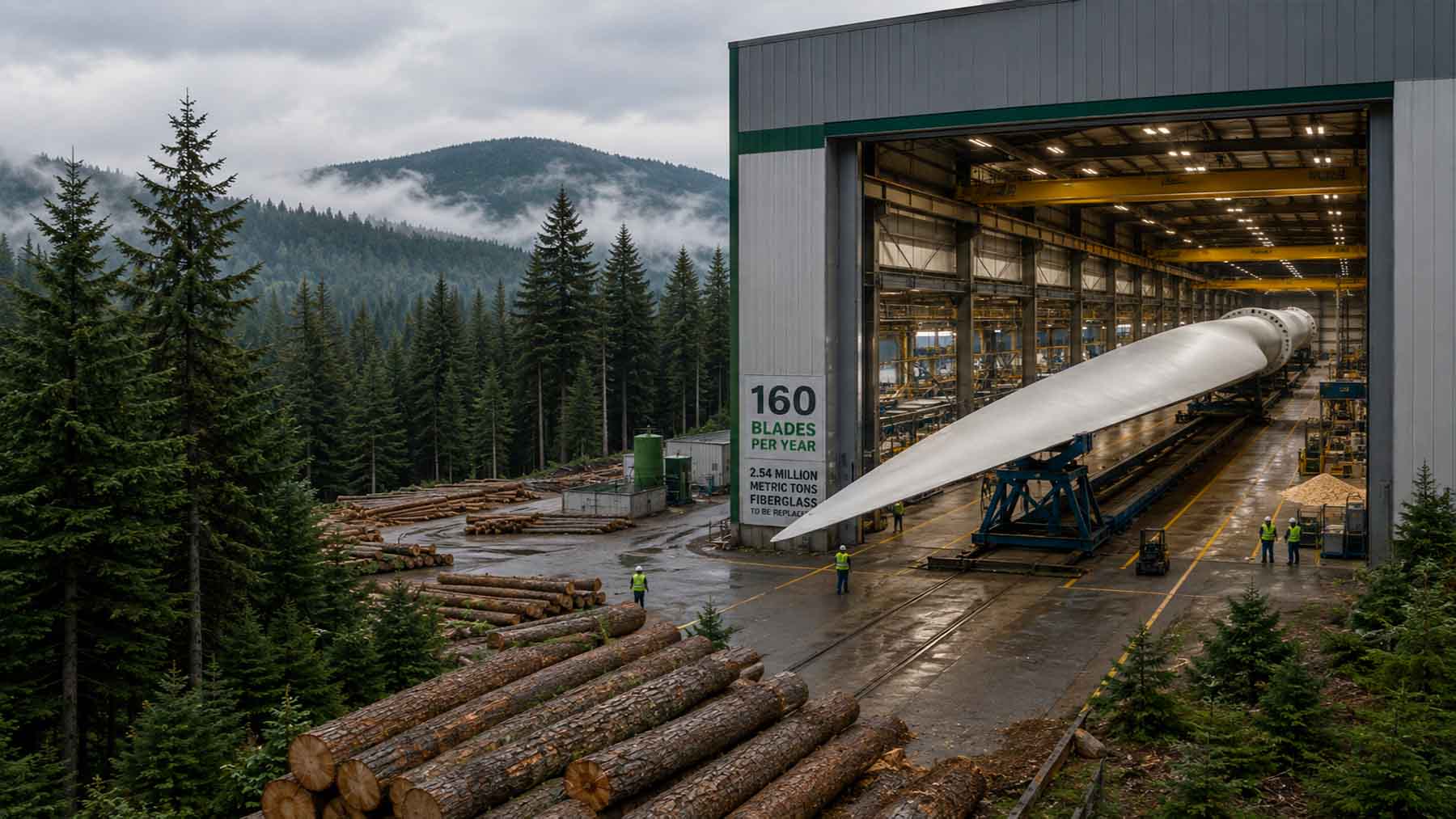 Image generated with artificial intelligence
The world’s first wooden wind turbine blade factory will address a growing environmental challenge.
Globally, turbine installations have greatly expanded over the years, with capacity projected to increase further.
While this power source is key to meeting climate targets, its components face recycling barriers.
These emissions are projected to continue increasing, leaving roughly three years before the temperature threshold is exceeded.
A German startup plans to overcome this complexity by turning to renewable wood materials.
Will this approach help create a circular, sustainable supply chain, or are fir forests now at risk?
How wind power has become a global necessity
An unprecedented rise in global greenhouse gas emissions has accelerated atmospheric changes.
In January 2026, the preliminary number of carbon dioxide equivalents reached 5.3 billion metric tons.
This was a 0.3% increase compared to the previous year.
These emissions are projected to continue increasing, leaving roughly three years before the temperature threshold is exceeded.
As a result, the global renewable energy transition is more vital than ever.
Critical to this shift is wind energy.
Replacing fossil fuels requires fast, utility-scale electrification across various sectors.
Both onshore and offshore turbines are fundamental in providing the high-density, low-carbon electricity needed at grid scale.
Current installed wind capacity has surpassed 1,000 gigawatts globally.
But as the world’s electricity demand rises faster than green power generation, more rapid deployment is needed.
This is vital to meet urgent climate goals, but will require a substantial increase in turbine component manufacturing.
In turn, environmental concerns rise.
A growing fiberglass blade waste crisis
To meet global climate targets, wind capacity must triple to more than 3,000 GW by 2030.
However, each megawatt of installed clean power will require roughly 10 metric tons of turbine blade material.
This means that manufacturers will require millions of metric tons of fiberglass over the coming years.
Unfortunately, these conventional turbine blades face a severe end-of-life disposal issue.
The blades are manufactured from glass fibers bonded with thermoset epoxy resin.
After they have cured, the composites cannot be melted down or easily separated into raw components.
Consequently, nearly 78% of decommissioned turbine blades are destined for landfills or incineration.
Globally, this collective waste is projected to reach 43 million metric tons by 2050.
This open-ended cycle is a longstanding challenge in the industry.
To overcome this, Invest in Navarra recruited an innovative German-Lithuanian alliance to the region.
The goal is to expand the nation’s green tech ecosystem using wooden blades.
Creating a wooden wind turbine blade factory
Turbine blades are becoming more recyclable, thanks to the world’s first industrial-scale wooden turbine blade factory.
The European partnership, led by German startup Voodin Blade Technology, will create this factory in Navarra, Spain.
The project is called VB1F and represents investment over €100 million (over $115 million).
Transforming a fir forest with sustainable engineering lifecycle
Certified European forests will supply Nordic spruce fir trees. Their timber stores biogenic carbon captured during the trees’ growth cycle.
The spruce is peeled into thin veneers. Then it is layered and bonded into high-density Laminated Veneer Lumber (LVL).
The LVL is structurally hard, dimensionally stable, and fatigue-resistant, which are needed for harsh wind loads.
The LVL blocks are added to automated CNC milling machines. The process is guided by digital CAD files, carving exact blade profiles.
At the end of a turbine’s lifecycle, the LVL is fully recyclable. It can return to organic or industrial lifecycles.
Should all remain on track, project VB1F will begin commercial operations in 2031.
Once it operates at full capacity, the factory will manufacture up to 160 blade sets per year.
The region will also enjoy major economic and environmental benefits. Roughly 450 local jobs will be created in Navarra.
Furthermore, over 2.4 million metric tons of emissions will be prevented in the first decade. Ultimately, it paves the way toward a circular manufacturing cycle for the wind industry.
Anke Maree is a writer with a clear and engaging editorial style. Her work focuses on making complex topics accessible, informative, and relevant for readers across different areas of interest.
