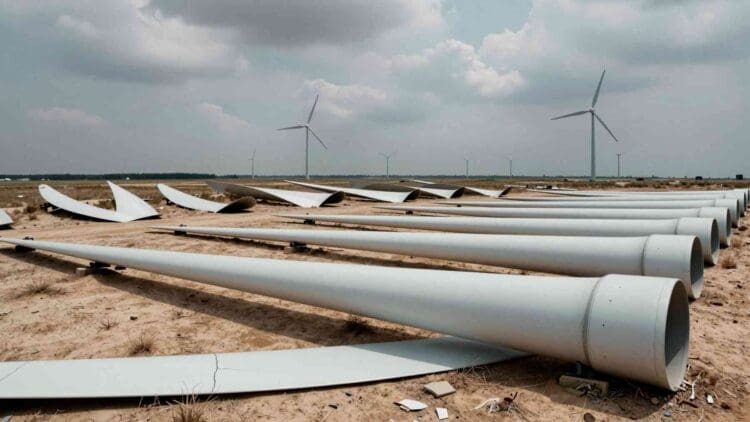

Thousands of wind turbine blades — some stretching longer than a Boeing 747 — are quietly piling up across the country. The first generation of modern turbines, built in the 1990s, is now reaching the end of its useful life, and the massive composite structures they leave behind have long resisted every attempt to recycle them.
It’s an awkward contradiction at the heart of clean energy: the same blades that generate emissions-free power are, at end of life, largely destined for landfills.
A growing graveyard of green energy
The scale of the disposal problem is easy to underestimate. Glass fiber-reinforced polymer — known as GFRP — makes up roughly two-thirds of a blade’s total weight. When thousands of turbines retire at once, the volume of composite waste becomes substantial fast.




Manufacturing adds to the burden. About 15% of blade material is wasted during production before a turbine ever spins — meaning the recycling challenge begins long before any blade reaches the end of its life.
The core difficulty is material chemistry. Unlike thermoplastics — the kind of plastic used in milk bottles — GFRP is built from thermoset composites. You can melt a milk bottle and reshape it. A wind blade does not work that way.
Why recycling wind blades has always been so hard
Thermoset composites are “cured” during manufacturing, a process that creates dense molecular cross-links locking the material into a permanent structure. Breaking those bonds without destroying the valuable fibers inside has proven consistently difficult.
Earlier recycling attempts typically relied on harsh solvents, extreme temperatures, or some combination of both — raising serious environmental concerns while often degrading the very materials researchers were trying to recover.
The economics have been just as stubborn as the chemistry. A method that is technically feasible but prohibitively expensive offers little real-world value. What the industry has needed is a process that is scalable, affordable, and environmentally responsible — all at the same time.
A bath of throat-lozenge chemistry
In a 2025 study, Washington State University researchers approached the problem differently. They cut blade material into blocks roughly two inches in size, then soaked them in a mild solution of zinc acetate — the same compound found in throat lozenges and certain food additives.
The material sat in pressurized, superheated water for about two hours. No harsh solvents, no extreme chemical treatments. Those relatively gentle conditions were enough to break the cross-linked molecular network into smaller, melt-processable pieces.
Crucially, the process does not attempt to fully separate fiber from resin. “As long as we can break the cross-linked network into smaller pieces, and they are melt processable, we can compound that with nylon and get a new composite,” said Baoming Zhao, co-first author and research assistant professor at WSU’s Composite Materials and Engineering Center. The zinc acetate catalyst can also be recovered and reused through simple filtration — a detail that meaningfully improves both cost and environmental footprint.
Stronger plastics born from recycled blades
Once recovered, the GFRP material was blended directly with nylon. The resulting composites contained up to 70% recycled glass fiber — a concentration that would be difficult to achieve with degraded or chemically damaged fibers.
The performance results were notable. The recycled nylon composite tested more than three times stronger and more than eight times stiffer than standard nylon, improvements that reflect how well the mild processing conditions preserved fiber quality.
The method also works beyond nylon. Researchers successfully reinforced polypropylene and plastics used in everyday products like milk jugs and shampoo bottles. “This recycling method is scalable, cost-effective, and environmentally friendly,” said Jinwen Zhang, the study’s corresponding author and a professor in WSU’s School of Mechanical and Materials Engineering.
What comes next for blade recycling
The WSU team is not finished. Ongoing work aims to reduce the pressurization requirements of the process, which would make it cheaper and easier to implement at industrial scale — a meaningful consideration when the goal is widespread adoption rather than a single pilot facility.
WSU’s Office of Commercialization is already involved, signaling that the path from laboratory to industry is being actively mapped. That institutional backing suggests the research is being taken seriously well outside the academic community.
The longer-term ambition is more fundamental: designing wind turbine blades that are fully recyclable from the outset. Build recyclability into the material on day one, and the disposal crisis defining today’s problem may never repeat itself. The research was funded by the U.S. Department of Energy’s Office of Energy Efficiency and Renewable Energy. As the wind energy sector grows and the next wave of turbines eventually ages out, the urgency of finding workable recycling solutions will only increase.