
Promised £5,000 per turbine megawatt and receiving barely half that sum, the villages of Cabrach and Glenrinnes sit below 59 steel rotors and are still waiting for the wind boom that passed them by
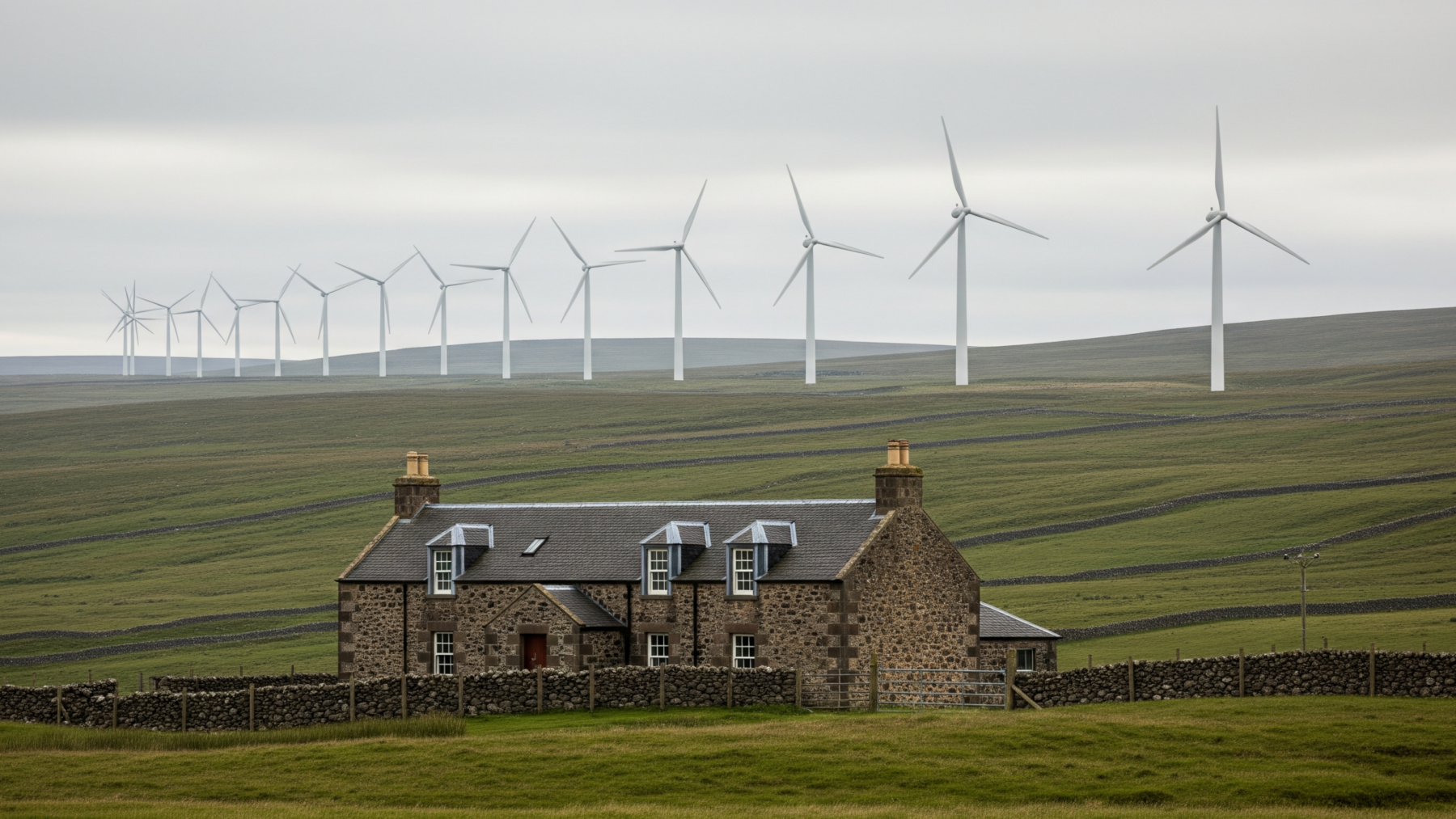
The wind arrived in Cabrach long before any turbine did, sliding off the Ladder Hills and through the narrow glen that separates this village from the rest of Moray. For centuries the land here served little more than cattle grazing and grouse. Then, in 2019, 59 steel towers rose across the moor above, and the money was supposed to follow.
A benchmark that became a promise
In 2014, the Scottish Government set a standard: any wind farm developer wishing to be a good neighbor to a rural community should pay at least £5,000 per megawatt of installed capacity every year. Community benefits are voluntary packages that renewable energy businesses provide to communities, and the Scottish Government’s energy strategy sets a clear expectation that developers should continue to offer meaningful benefits in line with its Good Practice Principles. It was not a law, but it was widely understood as the floor. Communities hosting turbines on their doorstep for 25 or 30 years deserved a share of the revenue those machines generated.
Analysis of a publicly available database shows more than 20 onshore projects built in the last decade, including some owned by European governments and global financial firms, are paying less than that figure. Investigators using official figures compiled by Local Energy Scotland identified 21 wind farms built between 2015 and 2025 that fall short, a gap that could cost Scottish communities over £50 million across the life of their projects. Developers argue that community benefit packages are difficult to change once financing is secured.
EDF power solutions began making donations in April 2019, paying approximately £447,000 in the first year, equivalent to £2,525 per megawatt of installed capacity.
Sixty villages, one ranger and a visitor center
The communities of Dufftown, Auchindoun, Glenrinnes, Glenlivet, Inveravon and Cabrach all sit within the fund area attached to Dorenell Wind Farm, with the fund provided by EDF Renewables, the majority owner of Dorenell Windfarm Limited. EDF power solutions began making donations in April 2019, paying approximately £447,000 in the first year, equivalent to £2,525 per megawatt of installed capacity. That rate is indexed to inflation but has never closed the gap to the benchmark.
Each of the four community associations receives 20 percent of the annual donation to support projects benefiting people in that area. That leaves individual villages with modest sums: enough for a footpath repair or a community hall roof, but a long way from transformational. EDF has pointed to other investment including annual contributions to the local authority, a dedicated ranger service and a visitor center as part of its wider package. Advocates for the villages see it differently: paths and a visitor center are welcome, but they are not the same as recurring annual income that lets a community build something durable over decades.
What the moor sends down the hill
The turbines standing above Cabrach are not modest machines. The 59-turbine wind farm sits off the A941, south of Dufftown, and EDF Renewables says it has the generating capacity to power up to 106,000 homes. At 177 MW, it is one of the largest onshore wind projects in Scotland, and it operates under the UK Government’s Contracts for Difference scheme, a subsidy mechanism paid for through levies on consumer energy bills.
Dorenell pays £2,525 per megawatt each year, just over half the benchmark. Eight of the projects paying below the benchmark were given planning permission in 2014 or later, long after expectations around community benefit had shifted. The communities sitting below 59 rotors have been left on the wrong side of an arithmetic settled before their representatives had much say, and over a 25-year project life that gap compounds into a very large number.
The real accounting
Court case notes show the estate landowner hosting the turbines was promised a fixed baseline lease of £6 million per year, a little over £100,000 per turbine. The actual rent scales with electricity sales and income received for turning off the wind farm when the grid is congested, so the landowner’s return grows with the farm’s earnings. The village fund does not.
The land rents paid to that estate represent 23 times the £464,625 paid to communities in 2025, already below the level the Scottish Government says projects should pay. Patti Nelson, the chair of the Cabrach Community Association, said the low funding had caused locals “sustained consternation.” She added that with a remaining lifespan of over 20 years, the association would “continue to strongly push EDF on the need to rebalance this acute injustice and purposeful underinvestment in this community.”
Learn how Scotland’s audit unfolded at Dorenell, and how those same machines can reshape a coastal community when the numbers land differently.
What a better deal looks like
Proposed updates to existing community benefit guidance would recommend that local groups receive yearly payments of £6,000 per megawatt of onshore wind capacity, up from £5,000 per megawatt, for the lifetime of a project. Industry voices have acknowledged that the sector needs to ensure payments reflect the scale of development happening across rural Scotland. That is a meaningful shift in tone from a sector that spent years treating community benefit as a goodwill gesture rather than a contractual expectation.
The Dorenell Wind Farm Fund in Moray has marked a £2 million funding milestone over the first five years of operation. The fund itself has reached real milestones: grants to local groups, walking routes restored and facilities improved. Those are genuine goods, and they matter to the people who received them. But they are the product of a rate locked in when the deal was signed and never fully reopened, even as the turbines generated far larger sums for other parties. What Cabrach and its neighbors have managed through persistence is to keep the question alive, and that visibility gives these villages something no planning document ever handed them: leverage.

Hugo is an engineer with strong technical expertise. Multilingual from an early age, his writing combines technical clarity with a strong interest in science and energy.
