
Engineers built a tent that generates its own electricity from wind and footsteps, no sunlight or fuel required
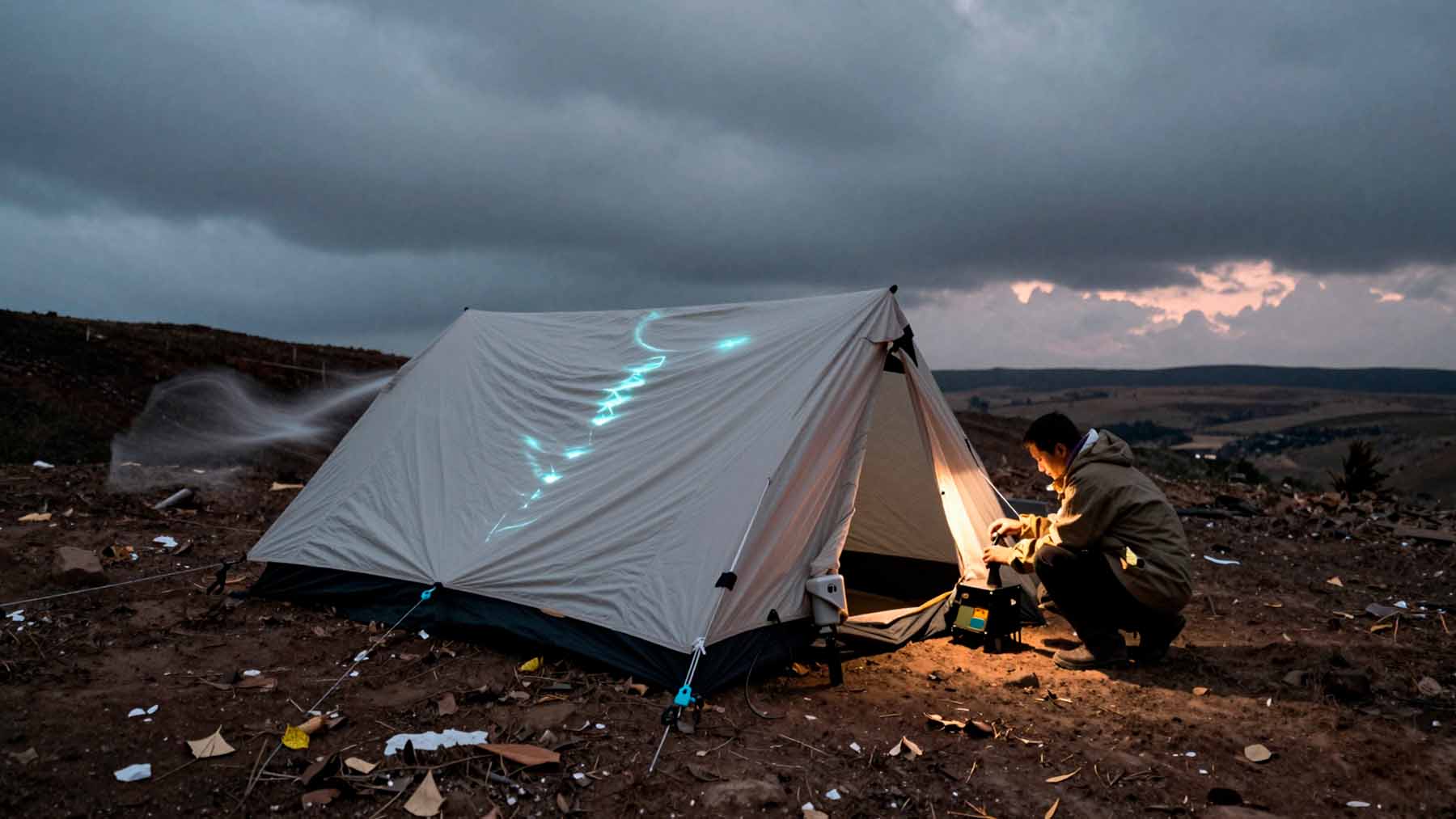 Image generated with artificial intelligence
In a disaster zone or remote camp, power is often the first thing missing and the hardest to replace. Generators need fuel that may not arrive. Solar panels go dark when skies cloud over. Batteries run out.
A team of researchers may have found an unlikely answer inside the shelter itself. They’ve developed a tent whose fabric can quietly harvest electricity from the wind pressing against its walls, the sound of rain, or a person simply shifting position inside — no sunlight, no fuel, no grid connection required.
A shelter that pulls power from its own motion
The tent described in the study, published July 31 in the journal Matter, treats the shelter itself as an active power system rather than a passive structure. Every gust pressing against the walls, every step across the floor, every moment of handling during setup becomes a potential source of electricity.
If those questions get answered, the tent could represent a genuinely new category of emergency infrastructure — one that generates power simply by existing.
Two main components drive the design. The floor incorporates magnetoelastic ribbons that respond to footsteps and body movement, while the roof uses a layered architecture combining conductive fibers and magnetoelastic film that flexes with wind and sound. Together, the entire envelope of the tent participates in energy generation.
The science behind magnetoelasticity
Magnetoelasticity isn’t a new concept — physicist Emilio Villari first described the principle in 1865. When mechanical stress is applied to certain materials inside an external magnetic field, their magnetic flux density changes. That shift is the core of how the tent works.
When the tent fabric bends or stretches, its magnetic state changes, and that change converts into electrical energy through induction. It’s a chain reaction triggered by ordinary motion. Researchers have previously used magnetoelastic devices to harvest energy from body movement and sound at small scales, but this study scales the concept up to full fabric systems — a meaningful leap from a wearable patch to an entire shelter.
What the prototype can actually do
The lab results give a concrete sense of the technology’s current output. When a researcher tapped a small textile sample by hand, it charged a 0.22-microfarad capacitor to 5.8 volts in just 1.5 seconds. That’s roughly the charge you’d see in a tiny timing or filter capacitor on a low-power sensor node. Impressive for a piece of fabric.
That’s not enough to charge a smartphone in any practical sense, and the researchers aren’t targeting smartphones. Their intended use cases are modest: LED lighting, small heaters, basic phone charging in a pinch. The tent is positioned as a supplemental power source — something that quietly offsets demand rather than replacing a generator or battery bank outright.
Why existing portable power solutions fall short
Every current option for off-grid power comes with a catch. Generators require fuel, which is often the first supply to run short in a disaster zone or remote deployment. Batteries add significant weight and need periodic maintenance or replacement. Solar panels are perhaps the most common alternative, but they’re fundamentally dependent on sunlight — cloud cover, shade, or nightfall renders them useless at exactly the moments when shelter matters most.
The magnetoelastic tent sidesteps these constraints entirely. It doesn’t need sun, fuel, or a grid connection. It only needs the fabric to keep flexing, which it does as long as the wind blows or someone moves inside. That makes it functional in darkness, indoors, and in conditions where other portable power options would struggle.
Open questions before this reaches the field
The prototype is genuinely promising, but significant unknowns remain before this technology could appear in a real emergency kit or off-grid camp, as explained in Live Science.
Durability is the most immediate question. Tents get folded, packed, dragged, and exposed to rain, dust, and temperature swings — how the magnetoelastic materials hold up under that kind of repeated stress hasn’t been demonstrated yet. Real-world energy output under field conditions also remains unquantified. Lab tapping is a controlled scenario, not a storm or a crowded shelter floor.
Manufacturing cost presents its own challenge. Scaling a specialized textile system to the volumes needed for disaster relief or military deployment requires affordable production, and that threshold hasn’t been reached.
The researchers frame their work as a proof of concept. What they’ve shown is that the principle works at the fabric level, and that a shelter could, in theory, do more than keep someone dry. The next phase of research will need to prove it can do so reliably, affordably, and under the conditions where it would matter most. If those questions get answered, the tent could represent a genuinely new category of emergency infrastructure — one that generates power simply by existing.
You can check the full study here: Fan, X., Tat, T., Chen, G., Shen, S., Zhou, Y., Zhao, X., … & Chen, J. (2026). Self-powered magnetoelastic tents for sustainable energy access in unhoused communities. Matter.


Carlos is an engineer with strong expertise in technical and industrial topics. He previously worked at international companies such as Siemens and is multilingual.
