
Dug 168 miles into South Florida marl to cool two reactors, the canals at Turkey Point just hatched 606 crocodiles in a single season, and the number hiding in the warm water tells a stranger story than the record
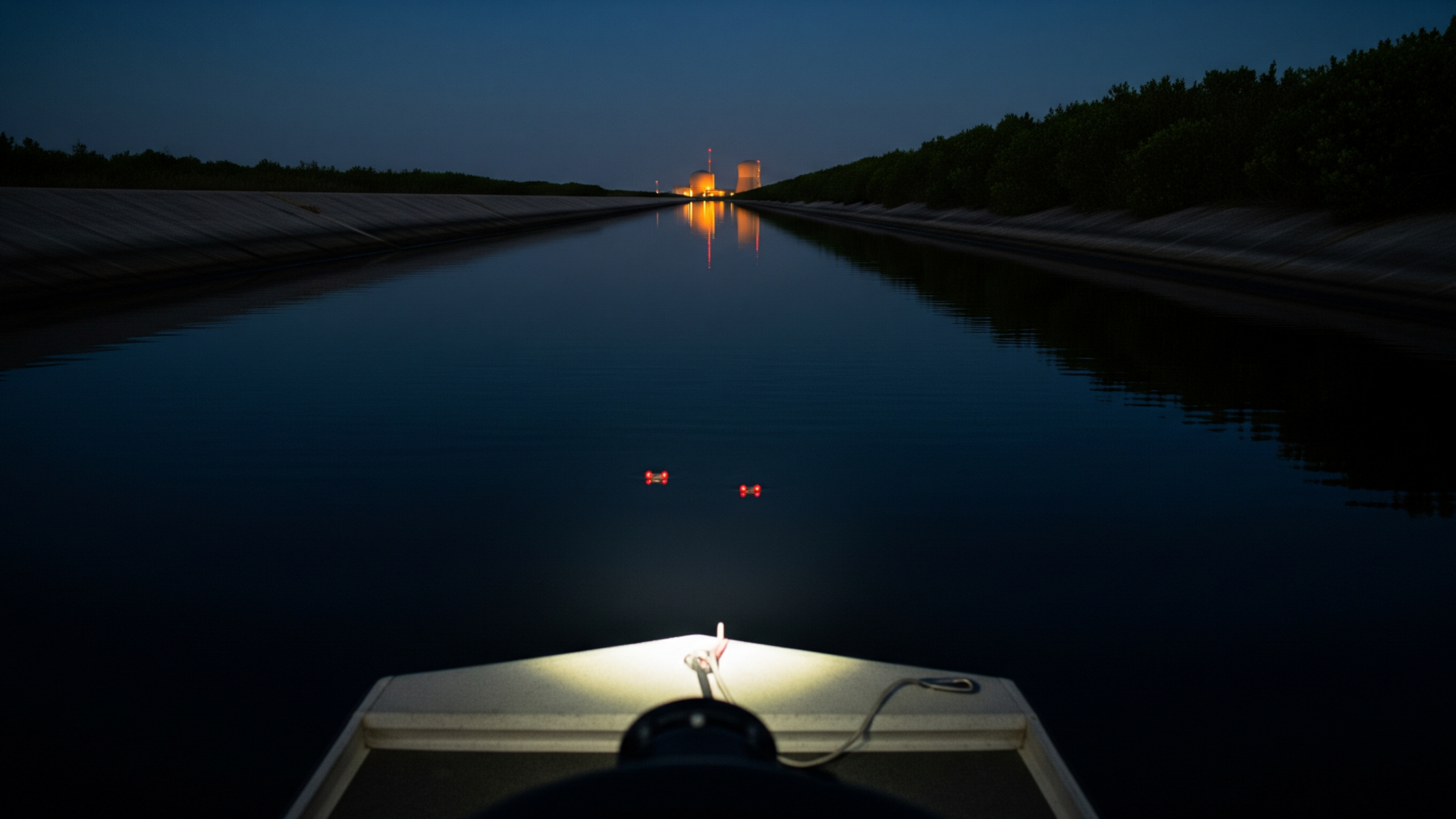
South of Miami, well past the last strip mall and the last stoplight, the land flattens into marl and mangrove and finally gives way to open bay. Turkey Point Nuclear Generating Station sits at that edge, its two reactor domes barely visible from the water. What runs behind them, invisible from any public road, is stranger than the plant itself.
A grid of perfectly straight ditches fans out across 6,800 acres of South Florida wetland, built for one reason alone: to cool two reactors that refuse to stop making heat. Nobody who drew those canals in the 1960s was thinking about reptiles.
Something has been nesting on the spoil banks between those canals for nearly five decades, and the 2025 season produced a number that stopped the crew counting it cold.
The American crocodile was nearly gone from the continental United States by the 1970s, with habitat loss reducing the population to a few hundred animals.
A machine built to lose heat, and what moved in because of it
Florida Power and Light’s two pressurized water reactors at Turkey Point generate roughly 1,600 megawatts of electricity, but the physics of nuclear fission means that for every megawatt leaving on a wire, roughly two more leave as heat. More than 3,600 megawatts of thermal waste has to go somewhere, continuously, and the engineers’ answer was to dig 168 miles of canals into the surrounding marl and let the South Florida sun and breeze carry the heat away.
The canals work. They also did something no cooling system calculation ever included. The spoil from all that digging piled into long elevated berms between the ditches, which stay dry, stay warm, and sit right beside the bay where American crocodiles have always lived. The first nest appeared in 1976, two years after the reactors came online, and Florida Power and Light recognized quickly that this was an opportunity rather than a nuisance. The FPL Crocodile Monitoring Program launched in 1978 and has run every summer since.
The airboat goes out after dark, two nights every week
The count happens at night, from an airboat, with a headlamp. A hatchling American crocodile gives itself away as two red points of reflected light set about an inch apart. Someone leans off the bow, scoops the animal out of the warm water, and passes it back to be measured, microchipped and released into the same canal where it emerged.
Mike Lloret, the FPL wildlife biologist who runs the Turkey Point team, has been doing this for years. The 2025 season kept the crew especially busy: his group collected 606 tiny crocodiles from an estimated 30 nests, the first time in the program’s 47 years that Turkey Point surpassed 600 hatchlings. Lloret described the milestone with characteristic warmth, telling colleagues: “Lovingly, we’re calling it the 600 Club.”
The FPL team’s work is credited with moving the American crocodile’s classification under the Endangered Species Act from endangered to threatened in 2007. Today, Turkey Point shelters roughly 25 percent of the approximately 2,000 American crocodiles living in the United States.
What the berms give, and what the water quietly takes away
The canals are ideal crocodile habitat in several respects. The saltwater suits adult animals, the elevated berms are dry and warm enough to incubate eggs, and adjacent freshwater ponds serve as a nursery where hatchlings find calmer, less saline conditions than the canals themselves provide.
A long running study of the South Florida crocodile population found that animals exposed to hypersaline conditions above 40 practical salinity units grew 13 percent slower after one year, 24 percent slower after five years and 29 percent slower after ten. The canals regularly exceed that threshold. Record nesting ground and difficult water turn out to come from the same excavation, a tension the hatchling counts alone never capture.
606 crocodiles, and the bigger story they are swimming inside
The American crocodile was nearly gone from the continental United States by the 1970s, with habitat loss reducing the population to a few hundred animals. In 1986, biologists found a single crocodile nest near Flamingo in Everglades National Park; in 2025, there were 129. Crocodiles have even started reclaiming parts of their historic range as mangroves spread north.
Turkey Point did not set out to reverse that collapse, but it may have done more for the species than any deliberate conservation program of the same era. bioGraphic’s on-the-water account of the 2025 season documents Lloret’s view that the plant’s location beside Biscayne National Park and Everglades National Park “is very inviting for crocodiles” and that the security perimeter keeping humans well clear matters as much as the warm water itself.
What the 600 Club actually means for a threatened species
A hatchling American crocodile is about ten inches long and weighs less than a hardback book. Only a small fraction survive to adulthood, because they begin life near the bottom of the food chain. At Turkey Point, the security perimeter keeps away the humans who would otherwise disturb or harm them, giving each animal a genuine early advantage.
The same logic that draws wildlife to nuclear plant outflows and exclusion zones worldwide is operating here in its most productive recorded form. The decommissioning decisions being made at other plants around the country will, in time, test whether that logic runs in reverse.
Lloret puts the running total north of 10,000 tagged hatchlings since 1978, nearly five decades of airboat nights and headlamp beams. None of that changes what the 2025 count added up to: the most productive crocodile nursery in the United States runs on nuclear waste heat, and the animal it is saving had no say in the arrangement and no complaint about it either.
Hugo is an engineer with strong technical expertise. Multilingual from an early age, his writing combines technical clarity with a strong interest in science and energy.
